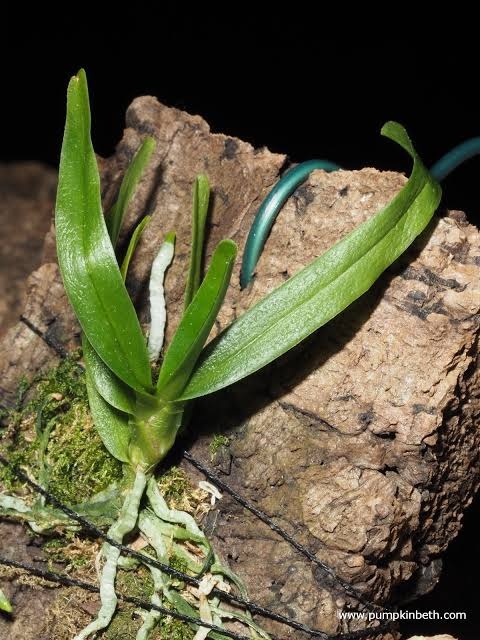
At a glance
RECORDED PROFILE DATA- Scientific name
- Angraecum drouhardii H.Perrier
- Name status
- Accepted in POWO
- Native region
- Northern Madagascar
- Growth habit
- Epiphytic subshrub; mini-miniature epiphyte
- Cultivation temperature group
- Cool growing (IOSPE); exact thresholds Not documented
- Flower size
- 3 cm (1.2 in) per IOSPE
- Habitat elevation
- Around 1200 m (IOSPE)
- Flowering context
- Fall and spring (IOSPE); calendar months Not documented
- Synonym
- Perrierangraecum drouhardii (H.Perrier) Szlach., Mytnik & Grochocka
- Common name
- Drouhard's Angraecum (IOSPE)
Names and Taxonomy
Angraecum drouhardii H.Perrier is the accepted scientific name for this species in Plants of the World Online (POWO), which records it as first published in Notulae Systematicae 7: 117 (1938) [1]. POWO places the species in the family Orchidaceae and records its native range as northern Madagascar [1]. The same source lists one homotypic synonym: Perrierangraecum drouhardii (H.Perrier) Szlach., Mytnik & Grochocka, published in Biodiversity Research and Conservation 29: 20 (2013) [1]. That synonym is not treated here as a separate species; it is a later combination based on the same original name.
IOSPE gives the common name Drouhard’s Angraecum and places the species in Angraecum section Perrierangraecum [2]. The common name is a horticultural label rather than a formal taxonomic category. No varieties, subspecies, or hybrids of A. drouhardii are documented in the supplied sources. Labels using the synonym Perrierangraecum drouhardii should be understood as referring to the same taxon when the identity is otherwise verified.
How to Identify This Species
POWO describes Angraecum drouhardii as an epiphytic subshrub [1]. IOSPE describes it more horticulturally as a mini-miniature-sized, cool-growing epiphyte with a short, thickened stem [2]. The leaves are reported as 5 to 12 in number, two-ranked, rigid, oblong, and unequally bilobed at the apex [2]. The inflorescence is axillary and single-flowered, entirely covered by two or three sheaths and a similar floral bract [2]. IOSPE gives the flower size as 1.2 inches (3 cm) [2].
NativePlants.info lists the growth habit as epiphytic, the flower color as white, and the plant as fragrant [3]. Those attributes are not present in the POWO or IOSPE snippets used here, so they should be treated as secondary-source observations until corroborated. The same secondary source reports a height of 30 cm [3], while IOSPE uses the descriptor “mini-miniature sized” without giving a numeric height in the available excerpt [2]. The two statements are not necessarily incompatible, but the 30 cm figure is not independently supported by the stronger taxonomic or IOSPE evidence in this file.
Documented diagnostic features therefore include the short thickened stem, the 5–12 rigid, two-ranked, apically bilobed leaves, the single-flowered axillary inflorescence with two or three sheaths, and flowers about 3 cm across [2]. Detailed lip and spur measurements, flower longevity, and a full morphological description are not documented in the supplied excerpts. A photograph or label showing only a white, small-flowered Angraecum is not sufficient for certain identification; the leaf arrangement, inflorescence structure, and provenance should be checked against a verified description or specimen.
Native Range and Habitat
Angraecum drouhardii is native to Madagascar, with POWO specifying northern Madagascar [1]. POWO also describes the species as growing primarily in the wet tropical biome [1]. No introduced or naturalized populations are documented in the supplied sources. The native range should not be confused with cultivated occurrences in orchid collections.
IOSPE reports the species from mossy montane forests at elevations around 1200 meters, where it grows as an epiphyte [2]. The available evidence does not define a full elevation range, host-tree preferences, or microhabitat details beyond the montane-forest and epiphytic context. The habitat description is therefore useful background, but it is not a cultivation prescription: an elevation of about 1200 m and a mossy montane forest are not, by themselves, verified greenhouse setpoints. Seasonal flowering is discussed below because the source reports fall and spring flowering without giving calendar months [2].
Species-Specific Care
The supplied evidence contains only one explicit cultivation descriptor for A. drouhardii: IOSPE calls it “cool growing” [2]. Most other care variables are not documented for this species in the available sources. The table below separates what is actually supported from what remains unknown.
| Factor | Documented guidance | Evidence or context |
|---|---|---|
| Temperature | Cool growing is stated. Exact day/night temperatures, seasonal range, and tolerable limits are Not documented. | IOSPE uses “cool growing” [2]; no numeric thresholds are supplied. |
| Light | Not documented. | No species-specific light level or photoperiod is given in the supplied sources. |
| Watering | Not documented. | No watering schedule, drying interval, or seasonal water regime is supplied for this species. |
| Humidity and airflow | Not documented. | Mossy montane forest is habitat context [2], not a measured cultivation humidity or airflow target. |
| Potting or mounting | Not documented. | The species is epiphytic [1][2], but no source in this file recommends a specific pot, mount, or medium. |
| Feeding | Not documented. | No species-specific fertilizer rate or timing is supplied. |
| Repotting | Not documented. | No repotting interval or root-disturbance guidance is supplied. |
| Seasonal changes | Flowering is reported in fall and again in spring; a dry rest or other seasonal care change is Not documented. | IOSPE reports the flowering seasons [2]; no cultivation rest period is stated. |
The “cool growing” label is best treated as a comparative temperature descriptor, not as a complete temperature schedule. Because the source does not give day and night temperatures, a minimum, or a maximum, a grower cannot derive precise setpoints from the available evidence. The same limitation applies to light, watering, humidity, airflow, potting, feeding, and repotting: these are essential care topics for which species-specific data are missing here. General Angraecum care should not be substituted for documented A. drouhardii care without labeling it as a general inference.
The epiphytic habit is documented [1][2], but that fact alone does not establish whether the species performs better mounted or potted, nor does it define a compost. The native elevation of about 1200 m and the mossy montane forest report [2] are habitat data; they do not prove that a particular indoor or greenhouse temperature, humidity, or watering regime will be suitable. A practical cultivation account for this species would need species-specific observations with stated conditions, which are not present in the supplied research.
Flowering and Pollination
IOSPE reports that A. drouhardii blooms in the fall and again in the spring on an axillary, single-flowered inflorescence [2]. The source does not translate those seasons into calendar months, and it does not state whether the observation was made in Madagascar, in a greenhouse, or under another cultivation context. Because Madagascar lies in the Southern Hemisphere, “fall” and “spring” should not be silently converted to Northern Hemisphere months without a documented location. NativePlants.info lists bloom months across January to December [3], which conflicts with the more specific seasonal report from IOSPE [2]. The all-year listing may be an aggregated horticultural summary rather than a precise flowering calendar; it should not be used to override the seasonal statement without better evidence.
IOSPE gives the flower size as 3 cm (1.2 inches) [2]. NativePlants.info reports white flowers and a fragrant plant [3], but the available IOSPE excerpt does not confirm color or fragrance. Flower longevity, fragrance timing, nectar-spur length, and pollination biology are Not documented in the supplied sources. No pollinator is recorded here, and flower shape alone is not enough to assign one. The single-flowered inflorescence with two or three sheaths and a similar floral bract is documented [2], but detailed lip and spur morphology would require a fuller description or specimen-based study.
Conservation and Responsible Cultivation
No formal conservation assessment for Angraecum drouhardii is present in the supplied evidence. POWO records the species as accepted and native to northern Madagascar [1], but the available snippet does not provide an IUCN category or a legal trade status. A documented native range and an accepted name are not the same as a conservation assessment. Cultivation and trade statements should therefore be limited to what can be verified: the species is native to Madagascar, and no assessment or legal determination is documented here.
Evidence and Limitations
This profile is based on search snippets and short excerpts, not on a full reading of the original 1938 description, a complete flora treatment, a monograph, or a pollination study. POWO is used for accepted-name status, authorship, publication details, synonymy, and native distribution [1]. IOSPE is used for the sectional placement, growth habit, leaf and inflorescence description, flower size, habitat elevation, and seasonal flowering report [2]. NativePlants.info is a secondary horticultural source used only for the color, fragrance, height, and broad bloom-month claims that it explicitly lists [3]; those claims are flagged where they are uncorroborated or conflict with IOSPE.
Material gaps include exact temperature thresholds, light levels, watering regime, humidity and airflow targets, potting or mounting method, feeding, repotting, flower longevity, fragrance timing, lip and spur dimensions, pollinator identity, and formal conservation status. These are marked Not documented rather than filled with generic Angraecum values. The identity of cultivated plants should be checked against a verified description or specimen; a horticultural label alone is not proof of species identity. This draft has not been botanically reviewed and should not be treated as a publication-ready taxonomic treatment.
Frequently asked questions
Is Angraecum drouhardii an accepted species?
Yes. POWO lists Angraecum drouhardii H.Perrier as an accepted species and records Perrierangraecum drouhardii as a homotypic synonym.
Where is Angraecum drouhardii native?
POWO records its native range as northern Madagascar. IOSPE reports it from mossy montane forests at elevations around 1200 meters.
How large are the flowers of Angraecum drouhardii?
IOSPE gives the flower size as 1.2 inches (3 cm). Other flower dimensions, such as lip and spur length, are not documented in the supplied sources.
What temperature should Angraecum drouhardii be grown at?
IOSPE describes the species as cool growing, but exact day and night temperatures, seasonal ranges, and tolerable limits are Not documented in the available evidence.
When does Angraecum drouhardii bloom?
IOSPE reports flowering in fall and again in spring, without giving calendar months or a stated cultivation location. A secondary source lists all-year bloom months, but that conflicts with the more specific IOSPE report and should be treated cautiously.
Related terminology
- Perrierangraecum drouhardii
- A homotypic synonym of Angraecum drouhardii published by Szlach., Mytnik and Grochocka in 2013, as listed by POWO.
- Epiphyte
- A plant that grows on another plant for support. Angraecum drouhardii is documented as epiphytic.
- Mini-miniature
- A size descriptor used by IOSPE for this species; the available excerpt does not define a numeric size convention.
FOLLOW THE EVIDENCE
Sources & references
- Plants of the World Online (POWO), Kew Science. “Angraecum drouhardii H.Perrier.” https://powo.science.kew.org/taxon/urn:lsid:ipni.org:names:616091-1
- IOSPE PHOTOS. “Angraecum drouhardii H.Perrier 1938.” https://www.orchidspecies.com/angdrouhardii.htm
- NativePlants.info. “Angraecum drouhardii (Angraecum drouhardii).” https://www.nativeplants.info/plant/magnoliophyta-flowering-plants/orchidaceae/angraecum/angraecum_drouhardii.html

