At a glance
RECORDED PROFILE DATA- Scientific name
- Angraecum multiflorum Thouars
- Name status
- Accepted
- Native region
- Madagascar, Mauritius, Réunion, Seychelles
- Growth habit
- Epiphytic subshrub
- Cultivation temperature group
- Not documented
Names and Taxonomy
The accepted scientific name is Angraecum multiflorum Thouars. The name was first published in Nouv. Bull. Sci. Soc. Philom. Paris 1: Tabl. Angorkis (1809) and is listed as accepted by Kew’s Plants of the World Online.1 Numerous synonyms exist, including Aerobion multiflorum (Thouars) Spreng., Monixus multiflorus (Thouars) Finet, and Mystacidium multiflorum (Thouars) Cordem.1 In French it is known as “Angrec de Cilaos.”7
How to Identify This Species
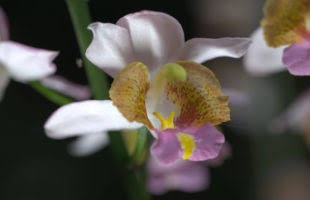
Plants are small epiphytic subshrubs, typically reaching about 30 cm in height.9 Leaves are arranged along the stem in a monopodial fashion, as is typical for the genus, but specific leaf dimensions are not documented in the available sources. The inflorescence bears several white to cream flowers; detailed measurements of the flower, lip, or spur are not provided. Flowers are reported to be fragrant and may appear throughout the year.9 Because precise morphological data are lacking, identification should be confirmed with a herbarium specimen or a reliable photograph showing the flower’s lip and spur.
Native Range and Habitat
Angraecum multiflorum occurs naturally on Madagascar, Mauritius, Réunion and the Seychelles.1 It is an epiphyte of humid, sub‑humid forest, most often found at elevations between 1 000 m and 1 500 m.8 The species prefers the canopy or branches of mature trees where moisture is abundant.
Species‑Specific Care
| Factor | Documented guidance | Source |
|---|---|---|
| Growth medium | Not documented – treat as a typical epiphytic orchid (mount or coarse bark mix) pending further observation. | — |
| Light | Not documented – native habitat suggests bright, filtered light. | — |
| Temperature | Not documented – mid‑elevation tropical forest implies moderate warm temperatures. | — |
| Humidity | Not documented – high humidity in native forest. | — |
| Watering | Not documented – water regularly to keep medium moist but not soggy. | — |
| Fertilisation | Not documented – a balanced orchid fertilizer at reduced strength during active growth is a common practice, but specific data for this species are lacking. | — |
Because specific horticultural studies are absent, growers should start with the general requirements for humid‑forest Angraecum species and adjust based on plant response. Monitoring for typical epiphytic signs—root health, leaf turgor, and flowering—will help refine care.
Flowering and Pollination
Flowers are reported to be white or cream and fragrant, with a possible year‑round blooming period in cultivation.9 Detailed information on flower longevity, spur length, or pollinator identity is not documented in the sources consulted.
Evidence and Limitations
The profile relies on taxonomic data from Kew (POWO) and distribution/elevation notes from the African Plant Database. Morphological and horticultural details are sparse; many aspects of plant size, flower morphology, and cultural requirements are marked as “Not documented.” Further field observations or cultivated specimens are needed to complete a comprehensive care guide.
FOLLOW THE EVIDENCE
Sources & references
- Plants of the World Online – Angraecum multiflorum Thouars, Royal Botanic Gardens, Kew, https://powo.science.kew.org/taxon/urn:lsid:ipni.org:names:616285-1
- TaxRef – Angraecum multiflorum, Muséum national d'Histoire naturelle, https://taxref.mnhn.fr/taxref-web/taxa/705843
- African Plant Database – Angraecum multiflorum Thouars, https://africanplantdatabase.ch/en/nomen/specie/209792/angraecum-multiflorum-thouars
- NativePlants.info – Angraecum multiflorum, https://www.nativeplants.info/plant/magnoliophyta-flowering-plants/orchidaceae/angraecum/angraecum_multiflorum.html

