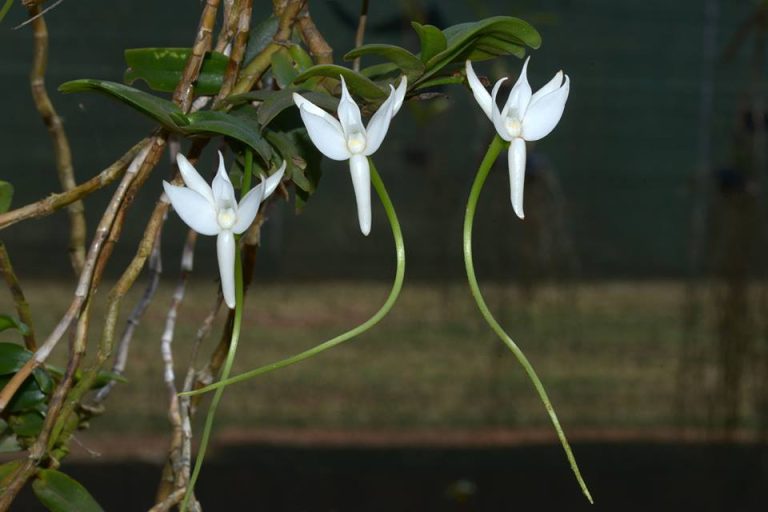
At a glance
RECORDED PROFILE DATA- Scientific name
- Angraecum dasycarpum Schltr.
- Name status
- Accepted
- Native region
- Madagascar (north‑eastern lowlands)
- Growth habit
- Epiphytic, occasionally lithophytic
- Cultivation temperature group
- Not documented
Names and Taxonomy
The accepted scientific name for this species is Angraecum dasycarpum Schltr. The name was first published in Repert. Spec. Nov. Regni Veg. 15: 337 (1918) and is listed as an accepted name by Kew’s Plants of the World Online.[1] A homotypic synonym is Pectinariella dasycarpa (Schltr.) Szlach., Mytnik & Grochocka, created when the species was transferred to the genus Pectinariella in 2013.[1] No common name is recorded in the consulted sources.
How to Identify This Species
Angraecum dasycarpum is a small‑sized orchid that grows as an epiphyte or, less commonly, a lithophyte on moss‑covered rocks or tree trunks in coastal eastern Madagascar.[2] Key features include:
- Stem: short, cylindrical, pendant to erect, bearing a dense rosette of leaves.
- Leaves: fleshy, broad, brown‑speckled, oblong to shortly apiculate, arranged densely along the stem.
- Roots: hairy, typical of epiphytic orchids.
- Size: plants reach about 30 cm in height (including leaves) in the wild.[4]
- Flower: solitary, white, fragrant (fragrance not specifically described in the sources), about 1.3 cm (½ in) across.[2]
- Spur: relatively short; the exact length is not given in the available excerpts.
Because many Angraecum species share a white, long‑spurred flower, identification should rely on the combination of a very short, dense leaf rosette, low growth habit, and the specific flower size noted above. Comparison with closely related species such as Angraecum rotundifolium (which has broader leaves and a different lip shape) is discussed in the 2020 taxonomic revision, but the diagnostic characters listed here are the ones directly documented for A. dasycarpum.[3]
Native Range and Habitat
The species is endemic to Madagascar, recorded from the north‑eastern part of the island, particularly coastal lowland forests.[1][4] It inhabits wet tropical forest biomes, growing on moss‑covered rocks or on the trunks of trees at elevations from sea level up to about 800 m.[2] The habitat is characterised by high humidity and warm temperatures typical of Madagascar’s eastern rainforests.

Species‑Specific Care
| Factor | Documented guidance | Evidence |
|---|---|---|
| Growth habit | Epiphytic or lithophytic; can be mounted on bark or grown in a very well‑draining medium. | Observed in the wild as epiphyte/lithophyte.[2] |
| Light | Not documented; growers typically provide bright, filtered light to mimic forest canopy. | Not documented in the sources. |
| Temperature | Warm to hot conditions typical of lowland eastern Madagascar; exact temperature range not specified. | Described as “hot to warm growing” in field notes.[2] |
| Watering / Humidity | Not documented; natural habitat is wet tropical forest, suggesting a preference for regular moisture and high humidity. | Habitat description only. |
| Feeding | Not documented. | — |
| Seasonal rest | Not documented. | — |
Because detailed horticultural studies for this species are lacking, growers are advised to imitate its natural environment: mount the plant on bark or place it in a coarse, airy medium, keep it warm, provide abundant indirect light, and maintain high humidity. Monitoring the plant’s response and adjusting care accordingly is essential.
Flowering and Pollination
In its native range the plant flowers in the summer and autumn months (approximately November to March in the Southern Hemisphere). The flower is solitary, white, and about 1.3 cm across.[2] No specific pollinator has been recorded for Angraecum dasycarpum in the cited literature; pollination biology remains undocumented.
Conservation and Responsible Cultivation
The species appears in the CITES Orchid Checklist, confirming it is recognised in international trade monitoring, but a formal IUCN Red List assessment is not provided in the available sources.[4] Conservation status therefore cannot be stated with certainty. Collectors should ensure that any material is sourced from legally documented propagation rather than wild collection.
Evidence and Limitations
Key aspects such as precise temperature thresholds, watering regime, humidity requirements, and pollinator identity are not documented in the consulted references. The care recommendations above are therefore extrapolated from the species’ natural habitat rather than from controlled cultivation studies. Further field observations and horticultural trials would be needed to refine these guidelines.
Frequently asked questions
What is the typical flower size of Angraecum dasycarpum?
The flower is about 1.3 cm (½ in) across, based on field observations recorded on IOSPE.[2]
Does Angraecum dasycarpum have a known pollinator?
No specific pollinator has been documented for this species in the available literature.
Is Angraecum dasycarpum threatened?
The species is listed in the CITES Orchid Checklist, but an IUCN Red List assessment is not provided in the sources; its conservation status is therefore not documented.
FOLLOW THE EVIDENCE
Sources & references
- Angraecum dasycarpum Schltr. – Plants of the World Online, Royal Botanic Gardens, Kew, 2026, https://powo.science.kew.org/taxon/urn:lsid:ipni.org:names:616070-1
- IOSPE Photos – Angraecum dasycarpum, 2026, http://orchidspecies.com/angdasycarpum.htm
- New species and nomenclatural changes in Angraecum (Orchidaceae) from Madagascar, Kew Bulletin, 2020, https://link.springer.com/article/10.1007/s12225-020-09902-7
- CITES Orchid Checklist – Angraecum dasycarpum distribution, 2026, https://www.kew.org/sites/default/files/PART_II_Names_in_current_use.pdf