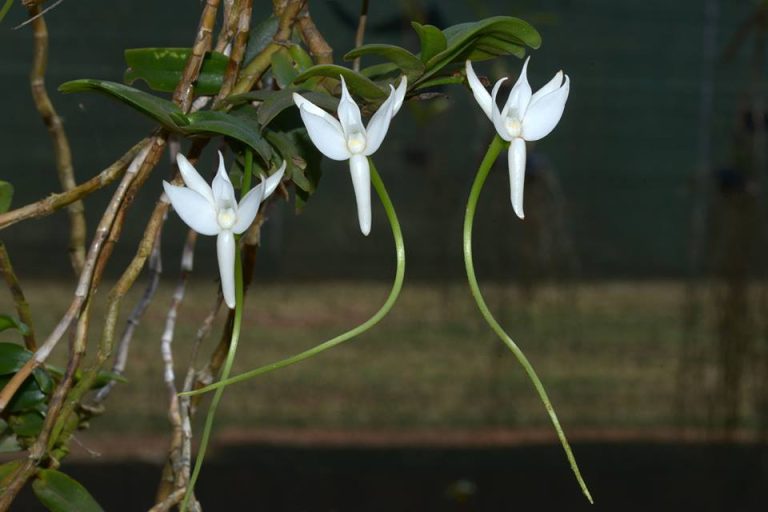
At a glance
RECORDED PROFILE DATA- Scientific name
- Angraecum arachnites Schltr.
- Name status
- Accepted by POWO; homotypic synonym Angraecum ramosum var. arachnites
- Common name
- Spider-Like Angraecum (IOSPE horticultural name)
- Native region
- N. and E. Central Madagascar
- Growth habit
- Epiphyte
- Cultivation temperature group
- Cool-growing (IOSPE horticultural label; no numeric thresholds supplied)
- Flower size
- About 9 cm (3.6 in), per IOSPE
- Habitat elevation
- About 1380–1500 m, per IOSPE
- Pollinator
- Panogena lingens, longest and most slender proboscis morph, per Nilsson et al. 1985
- Conservation status
- Not documented in supplied sources
Angraecum arachnites Schltr. is a small epiphytic orchid from northern and east-central Madagascar. It is accepted by Plants of the World Online and is grown for its single-flowered, nocturnally fragrant inflorescences. Published pollination studies associate it closely with the hawkmoth Panogena lingens. Horticultural literature calls it cool-growing, but species-specific numeric temperature, light, and watering data are not documented in the supplied evidence, so cultivation advice should be conservative and observation-led.
Names and Taxonomy
Angraecum arachnites Schltr. was first published in Repertorium Specierum Novarum Regni Vegetabilis, Beiheft 33: 321 (1925). Plants of the World Online accepts the species and gives its native range as N. and E. Central Madagascar (1). The requested locality phrase C Madagascar is narrower than the accepted native range and should not be treated as the full distribution.
The main homotypic synonym is Angraecum ramosum var. arachnites (Schltr.) H.Perrier, published in Flore de Madagascar 49(2): 301 (1941) and treated as a synonym of A. arachnites by POWO (2). POWO also notes that an alternative taxonomy cited this name under Angraecum germinyanum (Govaerts, 1995 and 2003), but its current treatment accepts A. arachnites (1). That historical disagreement is a taxonomic placement issue, not evidence that the two names should be grown as separate species.
The horticultural common name Spider-Like Angraecum appears in the Internet Orchid Species Photo Encyclopedia, which also places the species in section Arachnangraecum (4). The sectional placement is taken from that horticultural account and was not independently verified here. No hybrid or subspecies is documented in the supplied sources.
How to Identify This Species
The IOSPE horticultural account describes A. arachnites as a miniature to just small-sized epiphyte with an erect to ascending, simple to sparsely branched stem that is completely enveloped by leafless and leaf-bearing sheaths (4). The leaves are spreading, oblong-ligulate to ligulate, thin and leathery, unequally and obtusely bilobed at the apex, recurved, and minutely serrate (4). These vegetative characters are useful but are not, by themselves, a guarantee of identity.
The inflorescence is axillary, longer than the leaf, and single-flowered, with an ovate, spiculate floral bract (4). IOSPE gives a flower size of 3.6 inches, or about 9 cm, and describes the flowers as nocturnally fragrant (4). The supplied excerpts do not specify flower colour. A study table excerpt reports spur length values of about 10–15.5 cm for A. arachnites, but the excerpt’s formatting does not make clear whether these are separate measurements or a range (5). Wasserthal (2015) notes an upright labellum in this species (6).
Identification from labels or photographs should be treated cautiously. The flowers are reported to be often confused with A. germinyanum; IOSPE distinguishes A. arachnites by smaller leaves and a small, narrower lip (4). That is a horticultural comparison, not a complete diagnostic key. Confirmation should rely on consistent vegetative and floral characters, provenance, and, where possible, comparison with verified herbarium or taxonomic resources.
Native Range and Habitat
POWO gives the native range as N. and E. Central Madagascar and describes the species as an epiphyte growing primarily in the wet tropical biome (1). IOSPE reports it from central Madagascar in evergreen, humid forests at elevations around 1380 to 1500 m (4). The 1985 pollination study was conducted in a primary forest on the Central Plateau of Madagascar (3). These records agree on a Malagasy forest habitat but differ in how broadly the range is phrased.
Growth substrate is documented as epiphytic (1). The supplied sources do not document particular host tree species, canopy position, or microhabitat preferences beyond evergreen, humid forest. No introduced or naturalised occurrence is documented in the supplied evidence. The requested C Madagascar wording should be read alongside the broader POWO range rather than as a complete distribution statement.
Seasonality is only partly documented. The Biotropica study table, as excerpted, lists flowering in October–December in the Madagascar study context (5). IOSPE gives a horticultural flowering period of later spring through early fall but does not state the hemisphere or growing location (4). These should not be combined into a single universal flowering calendar.
Species-Specific Care
Species-specific cultivation data are limited. The table below separates what is documented from what is not; it does not import care assumptions from other Angraecum species.
| Factor | Documented guidance | Evidence or context |
|---|---|---|
| Temperature | Described as cool-growing in a horticultural account; no numeric day or night thresholds are supplied. | IOSPE (4). The native elevation of about 1380–1500 m is habitat context, not a greenhouse setpoint (4). |
| Light | Not documented species-specific. | Not documented in the supplied sources. |
| Watering | Not documented species-specific. | Not documented in the supplied sources. |
| Humidity and airflow | Habitat described as evergreen, humid forest; no cultivation humidity target or airflow protocol is documented. | IOSPE habitat description (4). Do not convert habitat humidity into a measured cultivation target. |
| Potting or mounting | Documented as an epiphyte in habitat; no controlled comparison of pot culture versus mounting is supplied. | POWO (1); IOSPE (4). The epiphytic habit is documented; no pot-versus-mount trial is supplied. |
| Feeding | Not documented species-specific. | Not documented in the supplied sources. |
| Repotting | Not documented species-specific. | Not documented in the supplied sources. |
| Seasonal changes | Flowering is reported in later spring through early fall by IOSPE, and October–December in a Madagascar study table; no dry rest is documented. | IOSPE (4); Biotropica (5). Do not infer a rest period from flowering time alone. |
The most defensible care statement is that A. arachnites is a small epiphyte from humid evergreen forest and has been labelled cool-growing in horticulture (1, 4). The label cool-growing is not a numeric temperature prescription. A grower should record actual temperatures, light, and drying rates in the growing space and adjust slowly, rather than assuming that another Angraecum regime will fit this species.
Because the supplied sources do not document species-specific watering, feeding, repotting, or light values, those points are marked Not documented rather than filled with generic orchid advice. The epiphytic habit and humid-forest origin are habitat facts; they do not establish a particular potting medium, humidity percentage, or fertilizer rate. Any cultivation notes beyond the table should be treated as local grower experience unless supported by a species-specific trial.
Flowering and Pollination
IOSPE describes the inflorescence as single-flowered and the flowers as nocturnally fragrant, with a horticultural flowering period of later spring through early fall (4). The Biotropica study table excerpt lists October–December flowering in the Madagascar study context (5). Flower longevity and nectar volume are not documented in the supplied excerpts.
Pollination is unusually well documented for this species relative to its cultivation data. The abstract of Nilsson et al. (1985) reports that in a primary forest on the Central Plateau of Madagascar, A. arachnites was pollinated by and adapted to a single hawkmoth species, Panogena lingens, despite the presence of many concurrent long-tongued Sphingidae (3). The same abstract states that P. lingens was dimorphic in proboscis length and breadth and that only the morph with the longest and most slender proboscis was recorded pollinating the orchid. The authors interpreted the relationship as monophily, with exclusive and precise adaptation in floral morphology and probably in flowering phenology and chemical signalling (3).
The 1987 Biotropica abstract reports that pollinaria of A. arachnites, A. compactum, Neobathiea grandidierana, and Jumellea teretifolia were deposited on the basal portion of the proboscis, and that several concurrently flowering orchids shared P. lingens as a pollinator resource (5). Wasserthal (2015) notes that P. lingens never swing-hovers and visits A. arachnites with an upright labellum, carrying pollinaria on the underside of the proboscis base (6). These are published observations or abstract reports; the full experimental details were not read here.
A recorded pollinator is not the same as a complete breeding system. The supplied sources do not document self-pollination, fruit set rates, seed viability, or pollinator behaviour outside the study sites. The strong pollinator association should not be used to promise flowering or pollination in cultivation.
Similar Species
Angraecum germinyanum is the main documented look-alike. IOSPE states that A. arachnites is often confused with it but has smaller leaves and a small, narrower lip (4). POWO also records a historical alternative taxonomy in which A. arachnites was cited under A. germinyanum (1). That history helps explain confusion but does not make the two names interchangeable. A photograph showing only a flower, without scale, lip shape, leaf size, and provenance, is weak evidence for identification.
Evidence and Limitations
This profile is based on the supplied search snippets and abstracts, not on full-text reading of the pollination papers, herbarium specimens, or a complete taxonomic revision. POWO is used for accepted-name status and native range (1), and its synonym page supports the treatment of A. ramosum var. arachnites (2). IOSPE is a horticultural compilation used for morphological and cultivation descriptions (4). The pollination reports come from the 1985 abstract (3), the 1987 Biotropica abstract (5), and a 2015 article excerpt (6).
Material gaps remain. Flower colour is not documented in the supplied excerpts. Numeric temperature, light, watering, humidity, feeding, and repotting guidance is not documented for this species. No formal conservation assessment or legal status is supplied, so none is assigned here. The spur-length values in the Biotropica table excerpt are difficult to interpret from the snippet and should be checked against the full table before being treated as a definitive range. The requested C Madagascar phrase is narrower than the POWO native range and should not be used as a complete distribution statement.
Frequently asked questions
Is Angraecum arachnites an accepted species?
Yes. Plants of the World Online accepts Angraecum arachnites Schltr. and treats Angraecum ramosum var. arachnites as a homotypic synonym. POWO also records a historical alternative taxonomy under Angraecum germinyanum, but its current treatment accepts A. arachnites.
What pollinates Angraecum arachnites?
Published studies report pollination by the hawkmoth Panogena lingens. The 1985 abstract states that only the morph with the longest and most slender proboscis was recorded pollinating the orchid.
What temperature should Angraecum arachnites be grown at?
The supplied evidence only labels it cool-growing in a horticultural account and gives no numeric day or night thresholds. Native elevation is habitat context, not a cultivation setpoint, so a grower should not assume a temperature regime from another Angraecum species.
How is Angraecum arachnites distinguished from Angraecum germinyanum?
IOSPE notes that A. arachnites is often confused with A. germinyanum but has smaller leaves and a small, narrower lip. This is a horticultural comparison, not a complete diagnostic key.
When does Angraecum arachnites flower?
IOSPE gives a horticultural flowering period of later spring through early fall without stating the hemisphere or growing location. A Biotropica study table excerpt lists October–December in the Madagascar study context. Flowering timing should be tied to the local growing context.
What is the conservation status of Angraecum arachnites?
No formal conservation assessment or legal status is documented in the supplied sources, so no IUCN category or legal status is assigned here.
Related terminology
- Monophily
- A pollination strategy in which a plant is adapted to and pollinated primarily by a single pollinator species, as reported for Angraecum arachnites and Panogena lingens.
- Panogena lingens
- A hawkmoth reported as the pollinator of Angraecum arachnites; only the longest and most slender proboscis morph was recorded pollinating the orchid.
- Angraecum ramosum var. arachnites
- A homotypic synonym of Angraecum arachnites, published by H. Perrier in 1941 and treated as a synonym by POWO.
- Nocturnally fragrant
- Fragrance produced at night; IOSPE describes Angraecum arachnites flowers as nocturnally fragrant.
FOLLOW THE EVIDENCE
Sources & references
- Angraecum arachnites Schltr. | Plants of the World Online | Kew Science. Royal Botanic Gardens, Kew. https://powo.science.kew.org/taxon/urn:lsid:ipni.org:names:615949-1
- Angraecum ramosum var. arachnites (Schltr.) H.Perrier | Plants of the World Online | Kew Science. Royal Botanic Gardens, Kew. https://powo.science.kew.org/taxon/urn:lsid:ipni.org:names:77263688-1
- Nilsson, L. A., Jonsson, L., Rason, L., and Randrianjohany, E. (1985). Monophily and pollination mechanisms in Angraecum arachnites Schltr. (Orchidaceae) in a guild of long-tongued hawk-moths (Sphingidae) in Madagascar. Biological Journal of the Linnean Society 26(1): 1–19. https://doi.org/10.1111/j.1095-8312.1985.tb01549.x
- Internet Orchid Species Photo Encyclopedia (IOSPE). Angraecum arachnites Schltr. 1925. https://www.orchidspecies.com/angarachnites.htm
- Biotropica (1987). Angraecoid Orchids and Hawkmoths in Central Madagascar: Specialized Pollination Systems and Generalist Foragers. https://doi.org/10.2307/2388628
- Wasserthal, L. T. (2015). Angraecum-Orchideen und langrüsslige Schwärmer, Bestäubung und Evolution. Die Orchidee 66(3): 175–181. http://www.ltwasserthal.de/page42/files/4.pdf