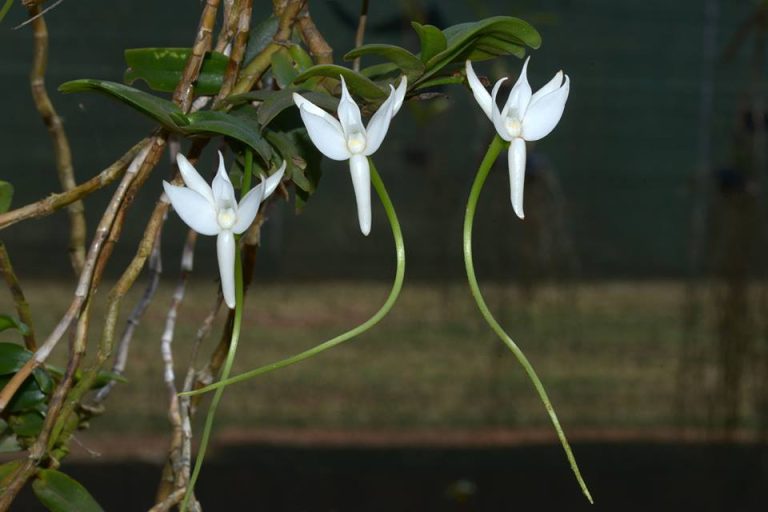
At a glance
RECORDED PROFILE DATA- Scientific name
- Angraecum pauciramosum Schltr.
- Name status
- Accepted
- Native region
- Madagascar
- Growth habit
- Epiphytic subshrub
- Cultivation temperature group
- Warm to cool (approx. 15‑25 °C; exact range not documented)
Names and Taxonomy
Angraecum pauciramosum Schltr. was first described in Repertorium Specierum Novarum Regni Vegetabilis Beih. 33:350 (1925) [1]. The name is accepted by Kew’s Plants of the World Online and is listed as an epiphytic subshrub native to eastern Madagascar [1].
Synonyms recorded for this taxon include:
- Lepervenchea pauciramosa (Schltr.) Szlach., Mytnik & Grochocka (2013)
- Angraecum graminifolium (Ridl.) Schltr. (1915)
- Angraecum poophyllum Summerh. (1953)
- Epidorkis graminifolia (Ridl.) Kuntze (1891)
- Monixus graminifolius (Ridl.) Finet (1907)
- Mystacidium graminifolium Ridl. (1885)
These synonyms are documented in POWO and IOSPE [1][2].
A common name recorded in horticultural literature is “The Few‑Branched Angraecum” [2].

How to Identify This Species
The plant is a small epiphytic subshrub, typically reaching about 30 cm in height in cultivation [3]. It produces few, slender, pendent stems that are heavily leafy. Leaves are ligulate to linear, unequally bilobed at the apex, and persist densely along the stems.
The inflorescence is 2–8 cm long, bearing 4–7 flowers. Flowers are very small, about 4 mm across, yellowish in colour, and emit a faint fragrance [2][3]. The floral bracts are thin and as long as the ovary. Blooming occurs in the winter through spring in the wild, while cultivated plants have been reported to flower throughout the year [2][3].
These characters – few‑branched, leafy stems, minute yellowish flowers, and a short, multi‑flowered raceme – distinguish A. pauciramosum from other Madagascan Angraecum species such as the larger‑flowered A. sesquipedale or the more robust A. eburneum.
Native Range and Habitat
The species is native to east‑central and eastern Madagascar, occurring primarily in wet tropical forest biomes at elevations of 800–1200 m [2][1]. It grows as an epiphyte on tree trunks and branches, favouring humid, shaded canopy conditions. The distribution is described as “E. Central & E. Madagascar” in POWO, confirming its restriction to the eastern side of the island where rainfall is highest.
Species‑Specific Care
| Factor | Documented guidance | Evidence |
|---|---|---|
| Growth habit | Epiphytic; mount on cork bark or grow in a coarse bark‑based potting mix. | IOSPE notes it is a “small sized, warm to cool growing epiphyte” [2]. |
| Temperature | Warm to cool conditions (approximately 15‑25 °C recommended). | IOSPE describes the species as “warm to cool growing” [2]. Exact temperature range not documented. |
| Light | Bright, filtered light; avoid direct midday sun. | Not documented for this species; recommendation inferred from typical Angraecum epiphyte preferences. |
| Watering | Water when the mounting medium or bark mix begins to dry; maintain steady moisture without waterlogging. | Not documented specifically; general epiphytic orchid practice. |
| Humidity | Maintain moderate to high humidity (60‑80%). | Not documented for this species. |
| Fertilization | Apply a balanced, water‑soluble orchid fertilizer at half strength monthly during active growth. | Not documented for this species. |
| Repotting | Repot every 2–3 years into fresh bark mix or re‑mount. | Not documented for this species. |
Because the plant is a small, delicate epiphyte, good air circulation and avoidance of overly wet conditions are important to prevent rot. Observe the plant’s growth habit: if stems become overly heavy, additional mounting supports may be needed.
Flowering and Pollination
In its natural habitat, A. pauciramosum flowers from winter into spring (southern‑hemisphere June–September) [2]. Cultivated specimens have been reported to produce flowers throughout the year, likely reflecting stable indoor conditions [3]. Flowers are tiny (≈4 mm), yellowish, and faintly fragrant, a trait that suggests attraction of small nocturnal insects, but no pollinator has been documented for this species (pollination not documented). The nectar spur is not described in the available sources.
Conservation and Responsible Cultivation
An IUCN Red List entry exists for Angraecum pauciramosum, but the provided snippet does not include the assessment category or threats [4]. Consequently, the conservation status cannot be confirmed from the current sources. Growers should ensure that any material obtained is sourced legally and sustainably, preferably from cultivated stock rather than wild collection.
Evidence and Limitations
Key aspects such as precise temperature limits, humidity requirements, and pollinator identity are not documented in the available literature. The care table contains inferred horticultural practices where species‑specific data are lacking. Future field studies and detailed cultivation trials would help fill these gaps.
Frequently asked questions
How tall does Angraecum pauciramosum grow?
In cultivation the plant reaches about 30 cm in height (source: NativePlants.info) [3].
When does this species flower in the wild?
It flowers in the winter‑to‑spring period (southern‑hemisphere winter), roughly June to September, in its native Madagascar habitat (source: IOSPE) [2].
What light conditions are recommended for growing Angraecum pauciramosum?
Bright, filtered light is advisable for epiphytic Angraecum species, though specific recommendations for this species are not documented; growers should avoid direct midday sun.
FOLLOW THE EVIDENCE
Sources & references
- Angraecum pauciramosum Schltr. | Plants of the World Online | Kew Science https://powo.science.kew.org/taxon/urn:lsid:ipni.org:names:616324-1
- IOSPE PHOTOS – Angraecum pauciramosum http://orchidspecies.com/angpauciracemosum.htm
- Angraecum pauciramosum – NativePlants.info https://www.nativeplants.info/plant/magnoliophyta-flowering-plants/orchidaceae/angraecum/angraecum_pauciramosum.html
- Angraecum pauciramosum – IUCN Red List of Threatened Species https://doi.org/10.2305/iucn.uk.2025-1.rlts.t58388793a58392790.en