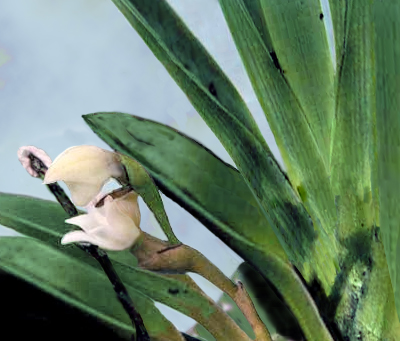
At a glance
RECORDED PROFILE DATA- Scientific name
- Angraecum cadetii Bosser
- Name status
- Accepted in POWO
- Native region
- Mauritius and Réunion (Mascarenes)
- Growth habit
- Epiphytic subshrub; monopodial epiphytic orchid
- Cultivation temperature group
- Not documented
- Habitat elevation
- 0–1000 m a.s.l. in Réunion primary lowland wet forest
- Flower color
- White-cream
- Inflorescence
- One to four erect racemes, each with one to five flowers
- Pollinator
- Raspy cricket (Glomeremus sp.) reported
- Conservation prediction
- Threatened (AERP 2024 prediction; not formal IUCN)
Names and Taxonomy
Angraecum cadetii Bosser is the accepted scientific name for this Mascarene orchid in Plants of the World Online (POWO), where it is placed in Orchidaceae, genus Angraecum [1]. The name was first published in Adansonia, n.s., 9: 252 (1987 publ. 1988) [1]. POWO records one homotypic synonym, Hadrangis cadetii (Bosser) Szlach., Mytnik & Grochocka, published in Biodiversity Research and Conservation 29: 15 (2013) [1]. The species belongs to Angraecum section Hadrangis, a Mascarene-endemic group that the cited pollination study also lists with A. bracteosum and A. striatum [3]. A French common name, “Angrec de Cadet,” is recorded by the Réunion SINP atlas [5]. No English common name, variety, subspecies, or hybrid status is documented in the supplied sources; labels using another name should be checked against POWO.
How to Identify This Species
Documented habit is a monopodial epiphytic orchid [3]; POWO describes it as an epiphytic subshrub [1]. In Réunion, plants usually produce one to four erect racemes, each with one to five fleshy white-cream flowers [3]. No leaf dimensions, stem length, root description, flower measurements, spur length, fragrance, or lip details are provided in the supplied excerpts, so those characters are Not documented in the available sources. Identification from a photograph or label should therefore be treated cautiously; the combination of epiphytic monopodial habit, erect few-flowered white-cream racemes, and Mascarene origin is useful context, not a single diagnostic key. Close relatives in section Hadrangis include A. bracteosum and A. striatum [3], but the supplied sources do not provide a character-by-character comparison.
Native Range and Habitat
Angraecum cadetii is native to Mauritius and Réunion in the Mascarene Islands [1][5]. POWO gives the native range as Mascarenes and lists Mauritius and Réunion [1]. In Réunion, the species is reported as relatively common in primary lowland wet forests, mainly from 0 to 1000 m a.s.l.; in Mauritius it is rare [3]. It is epiphytic [1][3]. Host-tree specificity, canopy position, and microhabitat are Not documented in the supplied sources. Flowering season is Not documented in the available excerpts. The elevation range is habitat data, not a cultivation setpoint. No introduced records are documented in the supplied sources.
Species-Specific Care
No species-specific cultivation record was supplied. The table therefore separates documented habitat facts from cultivation guidance; missing entries are not guesses.
| Factor | Documented guidance | Evidence or context |
|---|---|---|
| Temperature | Not documented | Native habitat from 0 to 1000 m in Réunion is habitat context, not a greenhouse setpoint [3]. |
| Light | Not documented | No species-specific light record supplied. |
| Watering | Not documented | No species-specific watering or rest-period record supplied. |
| Humidity and airflow | Not documented | No species-specific humidity or airflow record supplied. |
| Potting or mounting | Not documented | It is epiphytic in habitat [1][3], but the sources do not prescribe pot culture or mounting. |
| Feeding | Not documented | No species-specific fertilizer record supplied. |
| Repotting | Not documented | No species-specific repotting record supplied. |
| Seasonal changes | Not documented | No documented dry rest or seasonal treatment supplied. |
| Cultivation temperature group | Not documented | No supported temperature-group assignment in supplied sources. |
Because the supplied evidence contains no cultivation trial, the practical conclusion is limited: growers should not treat the native elevation range as a temperature prescription, and should not assume a dry rest or a particular potting mix for A. cadetii. The only firm horticultural starting point supported here is its epiphytic habit in wet tropical habitat [1][3]. Any care advice beyond that would need species-specific grower records or a cultivation reference, neither of which is present in the supplied evidence.
Flowering and Pollination
In Réunion, plants usually produce one to four erect racemes of one to five fleshy white-cream flowers [3]. The supplied excerpt does not give flowering months, flower longevity, fragrance timing, spur dimensions, or nectar volume; these are Not documented in the available sources. The species is notable for its pollination: Micheneau et al. (2010) reported pollination by a raspy cricket (Glomeremus sp., Gryllacrididae, Orthoptera) and described it as the first clear case of orthopteran-mediated pollination in the angiosperms [3].
The gecko record should be kept separate from the cricket pollination report. Bègue et al. (2014) documented Phelsuma borbonica visiting flowers of A. cadetii and feeding on orchid nectar in Réunion; this is a visitation and nectar-feeding record, not proof of effective pollination [4]. The supplied excerpt does not establish gecko pollination, and the paper title poses that question rather than confirming it [4].
Conservation and Responsible Cultivation
POWO’s General Information page reproduces an Angiosperm Extinction Risk Prediction (AERP) of “threatened” with “confident” confidence (2024) [2]. This is a modelled extinction-risk prediction, not a formal IUCN Red List assessment. The cited field study describes the species as relatively common in Réunion’s primary lowland wet forests but rare in Mauritius [3]. No legal protection status, CITES listing, or trade guidance specific to this species is documented in the supplied sources. A nursery purchase should not be assumed legal or sustainably sourced without separate evidence.
Evidence and Limitations
This profile is based on search snippets and selected page excerpts, not full-page or full-paper review. The accepted-name and distribution statements are supported by POWO [1]; the pollination and habitat statements by the Micheneau et al. excerpt [3]; the gecko visitation by Bègue et al. [4]; and the French common name by the Réunion SINP atlas [5]. Material gaps include plant and flower measurements, leaf and spur morphology, fragrance, flowering months, host-tree relationships, and any species-specific cultivation conditions. No cultivation temperature group is assigned. The AERP prediction should not be presented as a formal conservation assessment. Identification from photographs should be checked against a taxonomic description or herbarium specimen.
Frequently asked questions
Is Angraecum cadetii an accepted species?
Yes. POWO accepts Angraecum cadetii Bosser, with Hadrangis cadetii as a homotypic synonym.
Where is Angraecum cadetii native?
It is native to Mauritius and Réunion in the Mascarene Islands.
What pollinates Angraecum cadetii?
A raspy cricket (Glomeremus sp.) was reported as a pollinator, and the study described this as the first clear case of orthopteran-mediated pollination in angiosperms. Day geckos have been recorded feeding on nectar, but the supplied evidence does not confirm effective gecko pollination.
What cultivation temperature group does Angraecum cadetii need?
Not documented in the supplied sources. The native 0–1000 m elevation range in Réunion is habitat context, not a supported greenhouse setpoint.
Is Angraecum cadetii threatened?
POWO’s General Information page reproduces an AERP prediction of “threatened” with “confident” confidence (2024). This is a modelled prediction, not a formal IUCN Red List assessment.
Related terminology
- Angraecum section Hadrangis
- A Mascarene-endemic section of Angraecum; the cited study places A. cadetii with A. bracteosum and A. striatum in this section.
- Raspy cricket
- A cricket of the family Gryllacrididae; a Glomeremus species is reported as a pollinator of A. cadetii.
- Angiosperm Extinction Risk Prediction (AERP)
- A modelled extinction-risk prediction reproduced by POWO; it is not necessarily a formal IUCN Red List assessment.
- Monopodial
- A growth pattern with a single continuing stem; A. cadetii is described as a monopodial epiphytic orchid.
FOLLOW THE EVIDENCE
Sources & references
- Angraecum cadetii Bosser | Plants of the World Online | Kew Science. Royal Botanic Gardens, Kew. https://powo.science.kew.org/taxon/934379-1
- Angraecum cadetii Bosser | Plants of the World Online | Kew Science — General Information. Royal Botanic Gardens, Kew. https://powo.science.kew.org/taxon/urn:lsid:ipni.org:names:934379-1/general-information
- Orthoptera, a new order of pollinator. Micheneau, C., Fournel, J., Warren, B. H., Hugel, S., Gauvin-Bielecki, A., Pailler, T., Strasberg, D., & Chase, M. W. (2010). Annals of Botany 105(3):355–364. https://pmc.ncbi.nlm.nih.gov/articles/PMC2826249/
- New record of day geckos feeding on orchid nectar in Reunion Island: can lizards pollinate orchid species? Bègue, J.-F., Sanchez, M., Micheneau, C., & Fournel, J. (2014). https://natureoceanindien.org/wp-content/uploads/2025/02/14-2014_Begue-et-al.-PHEBOR-orchid.pdf
- Angrec de Cadet - Angraecum cadetii | atlas - SINP de La Réunion. https://geonature.borbonica.re/atlas/espece/705822

