At a glance
RECORDED PROFILE DATA- Scientific name
- Angraecum eburneum subsp. superbum (Thouars) H.Perrier
- Name status
- Accepted subspecies (POWO); RHS lists the name as correct
- Native region
- Seychelles, Comoros, Madagascar
- Growth habit
- Lithophytic subshrub; also reported as an occasional epiphyte
- Cultivation temperature group
- Not documented; IOSPE describes it as hot-growing without a defined group
- Habitat elevation
- 0–400 m
- Flower size
- 8.75 cm (IOSPE, under the synonym A. superbum)
- Fragrance
- Sweet; reported as nocturnal by Orchid Dynasty and IOSPE
- Flower longevity
- About 4 weeks (Smithsonian Gardens)
- Common name
- The Ivory-Colored Angraecum subspecies (Smithsonian Gardens)
Angraecum eburneum subsp. superbum is an accepted orchid subspecies from the western Indian Ocean. It is treated by Plants of the World Online as Angraecum eburneum subsp. superbum (Thouars) H.Perrier, first published in Flore de Madagascar et des Comores in 1941 [1]. The subspecies is lithophytic in the wild and is recorded from Seychelles, Comoros, and Madagascar [1]. Horticultural sources describe larger, whiter, waxy flowers and nocturnal fragrance, but species-specific care data are limited and partly conflicting [5][7][8].
Names and Taxonomy
POWO accepts Angraecum eburneum subsp. superbum (Thouars) H.Perrier as the accepted name [1]. The species A. eburneum Bory is also accepted and includes four accepted infraspecific taxa: subsp. eburneum, subsp. giryamae, subsp. superbum, and subsp. xerophilum [2]. RHS lists the name as correct, with synonyms A. brongniartianum, A. comorense, and A. superbum [4].
POWO lists homotypic synonyms Aerobion superbum (Thouars) Spreng., Angorkis superba (Thouars) Kuntze, and Angraecum superbum Thouars; heterotypic synonyms include Angorkis superbangis Thouars, Angraecum comorense Kraenzl., and Angraecum voeltzkowianum Kraenzl. [1]. A conflict exists: RHS places A. brongniartianum among synonyms of subsp. superbum [4], whereas POWO’s treatment places A. brongniartianum under subsp. eburneum [3]. The synonym list should therefore be checked before applying a name to a cultivated plant. IOSPE uses A. superbum Thouars 1822 [7], while POWO dates the basionym publication to 1809 [1]; the date discrepancy is unresolved in the supplied evidence.
Documented common names are limited. Smithsonian Gardens lists The Ivory-Colored Angraecum subspecies [5], and IOSPE lists The Magnificent Angraecum for the synonym A. superbum [7]. These names are not evidence of a separate species; A. superbum is treated here as a synonym of the accepted subspecies [1].
How to Identify This Species
POWO describes the subspecies as a lithophytic subshrub [1], and Smithsonian Gardens records it as lithophytic [5]. IOSPE describes it as a large-sized epiphyte or occasional lithophyte [7]. AOS describes the genus Angraecum as monopodial, with thick, fleshy, grey-green leaves [9]; the supplied species-specific sources do not give leaf dimensions, root details, or a complete vegetative description. Plant size is therefore only broadly documented: IOSPE calls it large-sized [7], while Orchid Dynasty states that robust plants become the largest in the genus without giving a measurement [8].
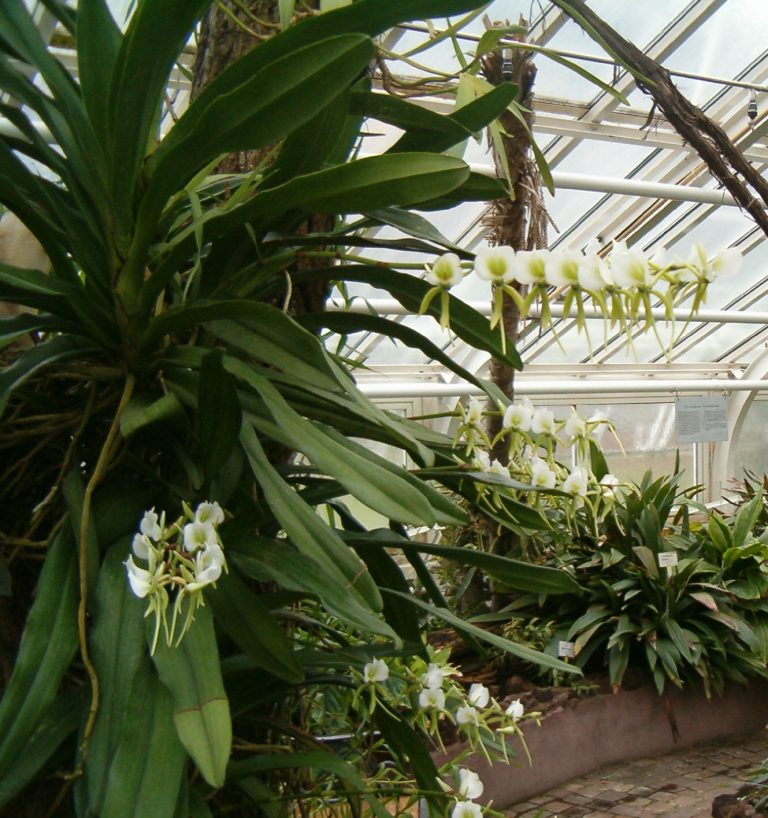
Flower and inflorescence characters are better documented but still need verification. IOSPE reports a flower size of 8.75 cm and densely many-flowered, axillary racemes up to 120 cm long that can be as long as or longer than the leaves [7]. Smithsonian Gardens describes the flowers as larger than those of the species, with a whiter lip, waxy texture, about four weeks of longevity, an arching inflorescence, and a sweet fragrance [5]. Orchid Dynasty describes the form it offers as pure concolor white, contrasting with green tepals and a white lip in typical A. eburneum, and reports nocturnal fragrance [8]. The Smithsonian and Orchid Dynasty color descriptions are not fully equivalent; they may reflect different clones or horticultural selections, so flower color alone should not be used as a definitive identification.
No single visual feature guarantees identification. Labels and photographs can be misleading because the subspecies has circulated under several synonyms and because horticultural forms vary [1][4][8]. A useful comparison is with typical A. eburneum: Orchid Dynasty reports green tepals and a white lip in the typical form [8], while Smithsonian Gardens reports larger flowers and a whiter lip in subsp. superbum [5]. Confirmation should rely on a combination of provenance, flower structure, and comparison with verified specimens.
Native Range and Habitat
POWO records the native range of subsp. superbum as Seychelles, Comoros, and Madagascar, in the wet tropical biome [1]. Smithsonian Gardens gives the same three areas and describes the habitat as damp tropical forests at 0–400 m, with a lithophytic life form [5][6]. It also notes an observation that the subspecies prefers growing in full sun on clove trees more than on other trees [5]. IOSPE similarly reports elevations below 400 m in hot, damp tropical woods, but its wording includes eastern Madagascar, eastern Africa, and Indian Ocean islands [7]; that broader statement conflicts with POWO’s subspecies-level range and may reflect species-level or synonym-level treatment. RHS gives the plant range as Mascarenes [4], which is less precise than POWO’s three-area distribution. These sources should not be averaged into a single expanded range; POWO is the most specific taxonomic source supplied for the subspecies [1].
Seasonal rainfall, host specificity, and microhabitat details beyond the clove-tree observation are not documented in the supplied sources. Native elevation and damp-forest habitat are context, not cultivation setpoints.
Species-Specific Care
Species-specific cultivation evidence is sparse. The table separates documented observations from missing guidance; it does not convert habitat data into greenhouse setpoints.
| Factor | Documented guidance | Evidence or context |
|---|---|---|
| Light | Habitat observation: full sun on clove trees. IOSPE reports flowering after higher light in cultivation. No measured light level or shade percentage is documented. | Smithsonian Gardens [5]; IOSPE [7]. |
| Temperature | IOSPE describes it as hot-growing. No numerical day/night range or formal temperature group is documented. | IOSPE [7]. Do not infer setpoints from the 0–400 m habitat record [5]. |
| Watering | Not documented species-specific. The damp tropical forest habitat is not a watering schedule. | POWO [1]; Smithsonian Gardens [5]. |
| Humidity and airflow | Not documented species-specific. No humidity percentage or airflow specification is supplied. | No species-specific source in the supplied evidence. |
| Potting or mounting | Lithophytic in habitat; IOSPE also calls it an occasional epiphyte. No species-specific medium, pot size, or mount trial is documented. | POWO [1]; Smithsonian Gardens [5]; IOSPE [7]. |
| Feeding | IOSPE mentions heavy summer fertilizing with higher light in connection with flowering. This is a horticultural observation, not a tested recommendation. | IOSPE [7]. |
| Repotting | Not documented. | No species-specific source in the supplied evidence. |
| Seasonal changes | IOSPE says it blooms at most any time of year. No dry rest is documented. | IOSPE [7]. Do not impose a rest from habitat elevation alone. |
The most useful supported starting points are the lithophytic habit, the hot-growing description, and the reports of full sun in habitat and higher light in cultivation [5][7]. These are not a complete culture recipe. AOS cautions that Angraecum is ecologically diverse and that generalized warm, wet advice has failed for some species [9]; that warning applies here because no controlled cultivation trial or numerical setpoints were supplied for subsp. superbum. Watering, humidity, airflow, potting medium, and repotting intervals should therefore be treated as Not documented rather than filled with values from other Angraecum species.
Flowering and Pollination
Smithsonian Gardens reports waxy flowers that last about four weeks on an arching inflorescence and have a sweet fragrance [5]. IOSPE reports many-flowered racemes up to 120 cm, nocturnal, long-lasting, waxy, fragrant flowers, and flowering at most any time of year [7]. Orchid Dynasty also describes nocturnal fragrance [8]. No month-by-month flowering calendar tied to a location or hemisphere is documented in the supplied sources. The 120 cm raceme length and 8.75 cm flower size come from IOSPE’s treatment under the synonym A. superbum [7] and should be checked against verified material.
No species-specific pollinator is documented in the supplied evidence. AOS and RHS describe the genus as having night-blooming, moth-attracting flowers [4][9], but that is a genus-level statement and should not be treated as confirmed for this subspecies. Nectar-spur dimensions and pollination observations for subsp. superbum are Not documented in the available sources.
Evidence and Limitations
This profile is based on search snippets and selected excerpts, not on a full taxonomic revision or a controlled cultivation study. Material gaps include the absence of a complete morphological description, leaf and root measurements, species-specific watering and humidity thresholds, a defined temperature group, repotting guidance, a species-specific pollinator record, and a formal conservation assessment in the supplied sources. The synonymy is unsettled in the sources: RHS includes A. brongniartianum under subsp. superbum, while POWO places it under subsp. eburneum [3][4]. Distribution statements also differ, with POWO limiting the subspecies to Seychelles, Comoros, and Madagascar [1], RHS giving Mascarenes [4], and IOSPE using a broader eastern Africa and Indian Ocean wording [7]. Flower color descriptions differ between Smithsonian Gardens and Orchid Dynasty [5][8]. These conflicts are noted rather than resolved. The draft should not be treated as botanically reviewed or publication-ready.
Frequently asked questions
Is Angraecum eburneum subsp. superbum an accepted name?
Yes. POWO accepts Angraecum eburneum subsp. superbum (Thouars) H.Perrier, first published in 1941. RHS also lists the name as correct, but synonym lists differ, especially for Angraecum brongniartianum.
Where is Angraecum eburneum subsp. superbum native?
POWO records Seychelles, Comoros, and Madagascar. RHS gives Mascarenes, and IOSPE uses a broader eastern Africa and Indian Ocean wording; those conflict with POWO's subspecies-level range and should be checked.
What temperature does it need in cultivation?
No numerical temperature range or formal temperature group is documented in the supplied sources. IOSPE describes it as hot-growing, but that is not a setpoint; do not infer a greenhouse temperature from its 0–400 m habitat record alone.
How long do the flowers last?
Smithsonian Gardens reports waxy flowers lasting about four weeks on an arching inflorescence, with a sweet fragrance. IOSPE describes the flowers as nocturnal, long-lasting, waxy, and fragrant.
Does it need a dry rest?
No dry rest is documented in the supplied species-specific sources. IOSPE says it blooms at most any time of year. A rest period should not be imposed without evidence for this subspecies.
Related terminology
- Angraecum eburneum
- The accepted species to which this subspecies belongs; POWO lists four accepted infraspecific taxa.
- Lithophyte
- A plant that grows on rock or rock-like substrates; POWO and Smithsonian Gardens describe this subspecies as lithophytic.
- Homotypic synonym
- A synonym based on the same nomenclatural type as the accepted name; POWO lists Angraecum superbum as a homotypic synonym.
- Heterotypic synonym
- A synonym based on a different nomenclatural type; POWO lists Angraecum comorense and Angraecum voeltzkowianum as heterotypic synonyms.
- Nocturnal fragrance
- Scent released or strongest at night; reported for this subspecies by Orchid Dynasty and IOSPE.
FOLLOW THE EVIDENCE
Sources & references
- Plants of the World Online (POWO), Royal Botanic Gardens, Kew. Angraecum eburneum subsp. superbum (Thouars) H.Perrier. https://powo.science.kew.org/taxon/urn:lsid:ipni.org:names:77188785-1
- Plants of the World Online (POWO), Royal Botanic Gardens, Kew. Angraecum eburneum Bory. https://powo.science.kew.org/taxon/616096-1
- Plants of the World Online (POWO), Royal Botanic Gardens, Kew. Angraecum eburneum subsp. eburneum. https://powo.science.kew.org/taxon/urn:lsid:ipni.org:names:77167551-1
- Royal Horticultural Society (RHS). Angraecum eburneum subsp. superbum. https://www.rhs.org.uk/plants/1286/angraecum-eburneum-subsp-superbum/details
- Smithsonian Gardens. Angraecum eburneum subsp. superbum. https://gardens.si.edu/collections/explore/object/ofeo-sg_2009-1392A
- Smithsonian Institution. Angraecum eburneum subsp. superbum. https://www.si.edu/object/angraecum-eburneum-subsp-superbumofeo-sg_2017-0534A
- IOSPE PHOTOS: Angraecum superbum Thouars 1822. Internet Orchid Species Photo Encyclopedia. https://www.orchidspecies.com/angsuperbum.htm
- Orchid Dynasty. Angraecum eburneum subsp. superbum. https://orchiddynasty.com/angraecum-eburneum-subsp-superbum/
- American Orchid Society (AOS). Angraecum. https://www.aos.org/explore/angraecum