At a glance
RECORDED PROFILE DATA- Scientific name
- Angraecum huntleyoides Schltr.
- Name status
- Accepted
- Native region
- Madagascar (eastern and central)
- Growth habit
- Epiphytic subshrub
- Cultivation temperature group
- Warm to cool (intermediate) – not formally defined
- Flower size
- ≈2.5 cm (1 inch)
- Elevation
- 500–1 200 m
- Synonym
- Angraecum chloranthum Schltr. (1913)
Names and Taxonomy
Angraecum huntleyoides Schltr. is the accepted name for this species. It was first described in Botanische Jahrbücher für Systematik 38:160 (1906) by Rudolf Schlechter [2]. Kew’s Plants of the World Online lists the name as accepted and records its native range as eastern Madagascar [1]. A heterotypic synonym is Angraecum chloranthum Schltr., published in 1913 [6]. No other common names are documented, although the IOSPE site refers to it as “The Huntleya‑Like Angraecum”.
How to Identify This Species
The plant is a small to medium‑sized epiphytic subshrub that often lacks a distinct stem. It bears 5–6 leaves that are unequally bilobed at the apex. Leaves are arranged along the short axis of the plant and are typical of many Angraecum species.
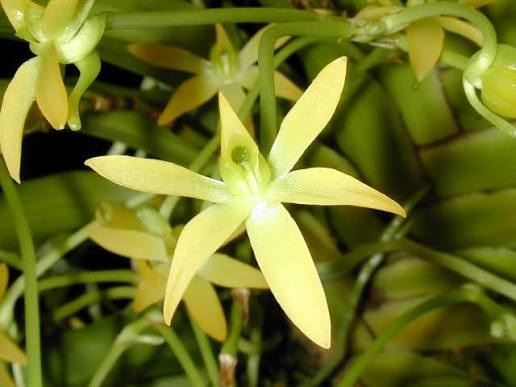
Flowering occurs on an axillary inflorescence 4–5 cm long, bearing two to three flowers. Each flower is about 2.5 cm (1 inch) across, initially pale yellow and turning more orange‑brown with age. The lip is modestly bilobed, and the spur is present but not specifically measured in the sources. The flowering period in the wild is reported as summer (December–February in the Southern Hemisphere) [6]. The combination of a short, almost stemless habit, few bilobed leaves, and small yellowish flowers helps separate it from close relatives such as Angraecum chloranthum, which is now considered a synonym.
Native Range and Habitat
This orchid is endemic to Madagascar, occurring in the eastern and central parts of the island, particularly in moist, moss‑covered forest patches. It is recorded at elevations between 500 and 1 200 m, growing as an epiphyte on tree branches in a wet tropical biome [1] and [6]. The habitat is characterized by high humidity, frequent mist, and diffused light under the forest canopy.
Species‑Specific Care
| Factor | Documented guidance | Source |
|---|---|---|
| Temperature | Warm to cool (intermediate) conditions | 6 |
| Light | Not documented | |
| Watering | Not documented | |
| Humidity | High humidity, reflecting its moss‑forest origin | 6 |
| Substrate / Growing medium | Epiphytic; suitable on bark, moss or mounted on a slab | 1, 6 |
| Fertilization | Not documented | |
| Repotting / Re‑mounting | Not documented |
Because the species inhabits humid, moss‑laden trees, growers should aim to provide a well‑aerated bark‑based medium or a moss mount that retains moisture without becoming water‑logged. Maintaining a warm‑to‑cool temperature range (approximately 18–24 °C day, 12–18 °C night) aligns with its natural environment, though precise thresholds are not published for this taxon. High ambient humidity (≥70 %) is advisable, and good air circulation helps prevent fungal problems.
Flowering and Pollination
In the wild, Angraecum huntleyoides flowers in the summer months of the Southern Hemisphere (roughly December to February). Individual flowers last long enough for observation, but specific longevity data are not provided. The flowers are fragrant (though the source does not describe scent) and possess a nectar spur typical of Angraecum, suggesting moth pollination, which is common in the genus. However, no direct pollinator observations have been documented for this species.
Evidence and Limitations
The profile is based on a limited set of sources: Kew’s Plants of the World Online for taxonomic status and distribution, IPNI for the original publication, and the IOSPE species page for morphological and ecological details. Precise measurements of the spur, detailed light and watering regimes, and confirmed pollinator identities are not documented in the available literature. Further field studies or cultivation trials would be needed to fill these gaps.
FOLLOW THE EVIDENCE
Sources & references
- Angraecum huntleyoides Schltr. | Plants of the World Online | Kew Science, https://powo.science.kew.org/taxon/urn:lsid:ipni.org:names:616184-1
- Angraecum huntleyoides | International Plant Names Index, https://www.ipni.org/n/616184-1
- IOSPE PHOTOS – Angraecum huntleyoides, http://orchidspecies.com/angchloranthum.htm
- CITES Orchid Checklist – Part II (Accepted names), https://cites.org/sites/default/files/common/com/nc/tax_ref/PART_II_Names_incurrentuse.pdf
- Angraecum huntleyoides – orchidroots.com summary, https://orchidroots.com/display/summary/orchidaceae/9462/

