At a glance
RECORDED PROFILE DATA- Scientific name
- Angraecum bancoense Burg
- Name status
- Accepted
- Native region
- West Tropical Africa; West-Central Tropical Africa
- Growth habit
- Miniature epiphytic subshrub
- Cultivation temperature group
- Not documented
Names and Taxonomy
The accepted scientific name is Angraecum bancoense Burg.[1][2] The name was first published in Misc. Pap. Landbouwhoogeschool 19: 26 (1980). Kew’s Plants of the World Online (POWO) lists the name as accepted and places it in the Orchidaceae, subfamily Epidendroideae, tribe Vandeae, subtribe Angraecinae.[1]
One homotypic synonym is Dolabrifolia bancoensis (Burg) Szlach. & Romowicz, published in Richardiana 7: 54 (2007).[3] The synonym is treated as a later‑published name that refers to the same taxon.[3]
Commonly the species is called the “Banco Angraecum”, a reference to the Banco Forest Reserve in Ivory Coast.[4]
Name status: Accepted.
Authorship: Burg.

How to Identify This Species
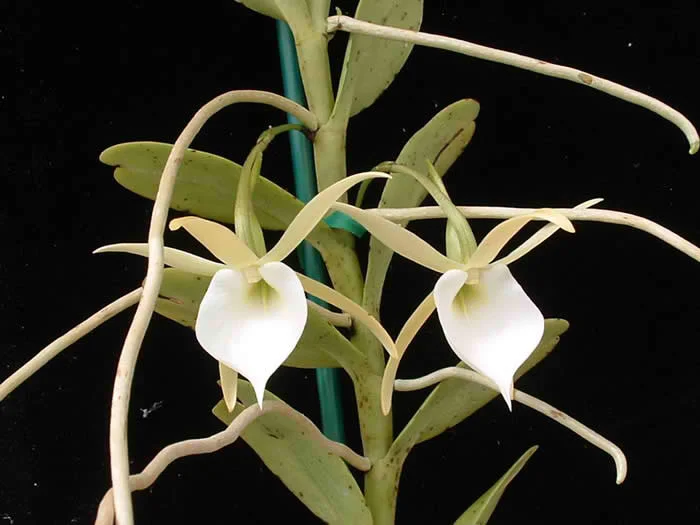
Angraecum bancoense is a miniature epiphytic subshrub that rarely exceeds 30 cm in height.[5] The stem is short, often hidden by imbricate leaf sheaths. Leaves are arranged in two ranks, glossy dark‑green, bilaterally compressed, curved‑elliptic to orbicular, and deciduous. The plant bears a single‑flowered inflorescence that emerges opposite the leaves and can be up to 9 mm (≈ 3.6 in) long.[4]
The flower is non‑resupinate, white to greenish‑white, and measures about 6 mm (≈ 0.2 in) across.[4] The lip is modestly trilobed, and the nectar spur is short but distinct; precise spur length is not documented in the available sources. The flower is fragrant, emitting a sweet scent, especially at night.[5][12]
Because the species closely resembles Angraecum distichum, identification should consider the smaller overall size, the shape of the lateral sepals, and the different spur morphology noted in specialist photographs.[4] A definitive identification requires observation of these floral details or comparison with a verified herbarium specimen.
Native Range and Habitat
POWO records the native range as West and West‑Central Tropical Africa, including Benin, Cameroon, Central African Republic, Congo, Democratic Republic of the Congo, Equatorial Guinea, Gabon, Ghana, Guinea, Ivory Coast, Liberia, Nigeria, Rwanda, Sierra Leone, and the Gulf of Guinea Islands.[1] The species inhabits wet tropical rainforests, growing as an epiphyte on tree trunks and large branches. It is frequently found on hosts such as Calamus, Lophira alata, Macrolebium, and Blighia welwitschii.[9]
Elevation records range from 200 m to 1 600 m above sea level, indicating tolerance of both lowland and submontane forest conditions.[4] The climate of its native habitat is humid, with high and relatively constant temperatures typical of tropical rainforests.
Species‑Specific Care
| Factor | Documented guidance | Source |
|---|---|---|
| Light | Very bright, filtered light; avoid direct midday sun. | [4][12] |
| Temperature | Warm to cool conditions; tolerates a range typical of lowland to mid‑elevation tropical forests. | [4][12] |
| Watering | Regular watering to keep the medium moist but not water‑logged. | [4][7] |
| Humidity | Not documented for this species; high humidity is typical of its native rainforest. | Not documented |
| Mounting / Potting | Can be grown mounted on bark or in a well‑draining orchid mix; miniature size suits small pots or hanging mounts. | [4][12] |
| Fertilisation | Apply a balanced, water‑soluble orchid fertilizer at half strength every 2‑4 weeks during active growth. | Not documented (standard orchid practice) |
| Repotting | Repot every 2‑3 years in spring, when new growth begins. | [12] |
| Seasonal changes | In cultivation the plant often blooms in winter; maintain slightly cooler night temperatures to encourage flowering. | [12] |
Because the species is described as “difficult” by growers, attention to airflow and avoidance of water stagnation are important to prevent rot. The plant’s low drought tolerance means it should not be allowed to dry out completely between waterings.[7]
Flowering and Pollination
In the wild the species can flower throughout the year, with some reports of winter peaks in cultivation.[4][12] Individual flowers are short‑lived, lasting a few days, and emit a sweet fragrance, especially in the evening.[5][12]
The nectar spur suggests pollination by long‑tongued moths, a pattern common in the genus, but no specific pollinator for A. bancoense has been documented.Not documented
Conservation and Responsible Cultivation
The IUCN Red List assesses Angraecum bancoense as Least Concern (LC) as of the 2014 assessment.[1][9] While the species is not currently threatened, habitat loss from deforestation in West and Central Africa could impact local populations. Cultivators should source plants from reputable growers who use tissue‑culture propagation rather than wild collection.
Evidence and Limitations
Key gaps include precise temperature and humidity requirements, detailed pollinator observations, and quantitative growth rates. Most cultivation advice derives from a limited number of growers and may reflect conditions in temperate greenhouses rather than the species’ native environment. Further field studies would help refine care recommendations and confirm pollination biology.
Frequently asked questions
What is the common name of Angraecum bancoense?
It is commonly known as the Banco Angraecum, named after the Banco Forest Reserve in Ivory Coast.[4]
How tall does Angraecum bancoense grow?
Mature plants reach about 30 cm (12 in) in height.[5]
Are the flowers fragrant?
Yes, the flowers emit a sweet fragrance, especially in the evening.[5][12]
What light conditions does it need in cultivation?
It prefers very bright, filtered light but should be protected from direct midday sun.[4][12]
What is its IUCN conservation status?
The species is assessed as Least Concern (LC) on the IUCN Red List.[1][9]
Related terminology
- epiphyte
- A plant that grows upon another plant (such as a tree) non‑parasitically, using its host for physical support only.
- spur
- A tubular extension of the petal or lip that often contains nectar and is adapted to specific pollinators.
FOLLOW THE EVIDENCE
Sources & references
- Angraecum bancoense Burg | Plants of the World Online | Kew Science, https://powo.science.kew.org/taxon/urn:lsid:ipni.org:names:615965-1
- Angraecum bancoense | International Plant Names Index, https://www.ipni.org/n/615965-1
- Dolabrifolia bancoensis (Burg) Szlach. & Romowicz | Plants of the World Online | Kew Science, https://powo.science.kew.org/taxon/urn:lsid:ipni.org:names:77081754-1
- IOSPE PHOTOS – Angraecum bancoense, https://www.orchidspecies.com/angbancoense.htm
- Angraecum bancoense – NativePlants.info, https://www.nativeplants.info/plant/magnoliophyta-flowering-plants/orchidaceae/angraecum/angraecum_bancoense.html
- Angraecum bancoense – Wikipedia, https://en.wikipedia.org/wiki/Angraecum_bancoense
- Angraecum bancoense – Jardin‑secrets, https://jardin-secrets.com/angraecum-bancoense.html