At a glance
RECORDED PROFILE DATA- Scientific name
- Angraecum longicalcar (Bosser) Senghas
- Name status
- Accepted
- Native region
- Madagascar
- Growth habit
- Lithophytic subshrub
- Cultivation temperature group
- Not documented
How to Identify This Species
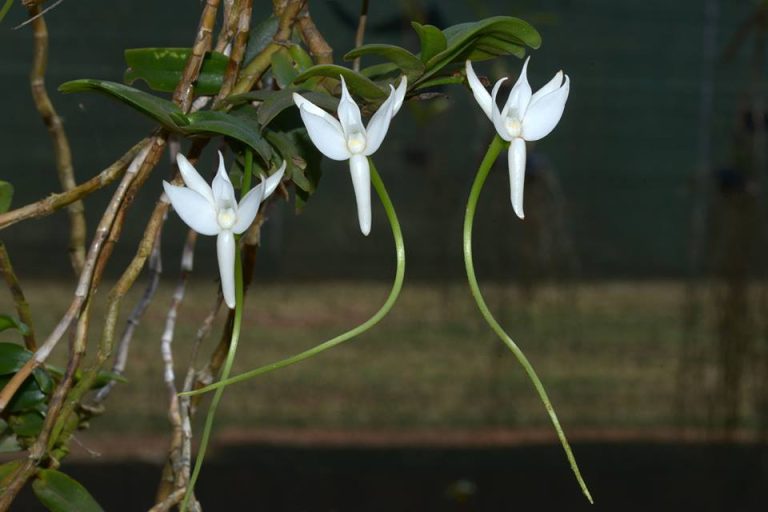
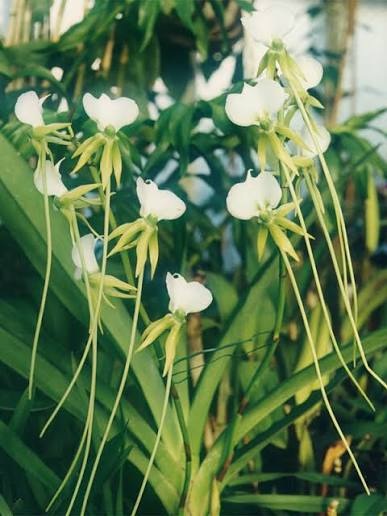
Angraecum longicalcar is a lithophytic orchid that grows as a compact, woody subshrub. Individual plants develop multiple stems bearing two rows of stiff, evergreen leaves.2 The most diagnostic floral feature is an exceptionally long nectar spur, reported to reach about 40 cm, far exceeding the 8 cm spur of its close relative A. eburneum【4】. Flowers are produced on a tall inflorescence (up to ~85 cm in cultivated specimens) bearing roughly 11 white‑green flowers. Each flower emits a strong nocturnal fragrance, a trait common in many Angraecum species that are moth‑pollinated【4】. The lip is relatively broad with a modestly recurved tip, but precise measurements are not documented in the cited sources.
Because the variety name longicalcar historically referred to the same taxon, herbarium labels or horticultural catalogs may still use the synonym. Verification should therefore consider the long spur and fragrance as key identifiers.
Native Range and Habitat
The species is endemic to Madagascar, specifically the central and south‑central regions of the island【2】. In the wild it is lithophytic, growing on exposed rocks and boulders in seasonally dry tropical forest or open woodland. The habitat is described as a “seasonally dry tropical biome,” indicating a pronounced wet‑dry seasonal cycle. Elevation data are not provided in the available sources, but the central highlands of Madagascar typically range from 800 to 1500 m above sea level.
Occurrences are limited to Madagascar; no reliable records of natural populations outside the island are documented.
Species‑Specific Care
| Factor | Documented guidance | Source |
|---|---|---|
| Growth medium | Not documented | — |
| Light | Not documented | — |
| Temperature | Not documented | — |
| Watering schedule | Not documented | — |
| Humidity | Not documented | — |
| Fertilisation | Not documented | — |
| Repotting / mounting | Not documented | — |
| Seasonal rest | Not documented | — |
Published horticultural literature does not provide species‑specific cultivation protocols for A. longicalcar. Growers therefore often apply general Angraecum guidelines (e.g., mounting on bark, moderate light, and high humidity) but these practices are not verified for this taxon. Prospective cultivators should treat the species as a research plant and monitor growth closely, adjusting conditions based on plant response.
Flowering and Pollination
In cultivation the plant produces an inflorescence bearing about 11 flowers, each with the characteristic long spur. Flowers open sequentially and emit a strong fragrance at night, suggesting adaptation to nocturnal pollinators. The long spur (≈40 cm) implies pollination by a large hawk moth with an equally long proboscis, a hypothesis consistent with other Angraecum species but not directly confirmed for A. longicalcar in the cited literature【4】.
Evidence and Limitations
The taxonomic status of Angraecum eburneum var. longicalcar remains a point of historical disagreement; current Kew databases list it as a synonym of the accepted species A. longicalcar【2】. Habitat description is limited to broad biome and island location; elevation, precise substrate, and population size are not documented. Cultivation information is essentially absent from peer‑reviewed or horticultural sources, so the care table reflects that gap. Floral measurements (spur length, flower count) are taken from a Wikipedia summary, which itself cites secondary sources; therefore these values should be treated as provisional until confirmed by primary botanical descriptions.
FOLLOW THE EVIDENCE
Sources & references
- Angraecum eburneum var. longicalcar Bosser | Plants of the World Online | Kew Science, https://powo.science.kew.org/taxon/urn:lsid:ipni.org:names:9373-4
- Angraecum longicalcar (Bosser) Senghas | Plants of the World Online | Kew Science, https://powo.science.kew.org/taxon/urn:lsid:ipni.org:names:942935-1
- Taxonomy browser (Angraecum longicalcar) | NCBI, https://ncbi.nlm.nih.gov/Taxonomy/Browser/wwwtax.cgi?id=339148&mode=Info
- Angraecum longicalcar | Wikipedia, https://en.wikipedia.org/wiki/Angraecum_longicalcar