At a glance
RECORDED PROFILE DATA- Scientific name
- Angraecum calceolus Thouars
- Name status
- Accepted
- Native region
- Mozambique, Comoros, Madagascar, Mauritius, Rodrigues, Réunion, Seychelles
- Growth habit
- Epiphytic herb/subshrub
- Cultivation temperature group
- Not documented
Names and Taxonomy
The accepted scientific name is Angraecum calceolus Thouars. Kew’s Plants of the World Online lists the name as accepted and records the original publication in Hist. Orchid. t. 77 (1822)【1】. The species has an extensive synonymy, including Aeranthes calceola (Thouars) S.Moore, Aerobion calceolus (Thouars) Spreng., Epidorkis calceolus (Thouars) Kuntze, and several others【1】. No common names were found in the consulted sources.
How to Identify This Species
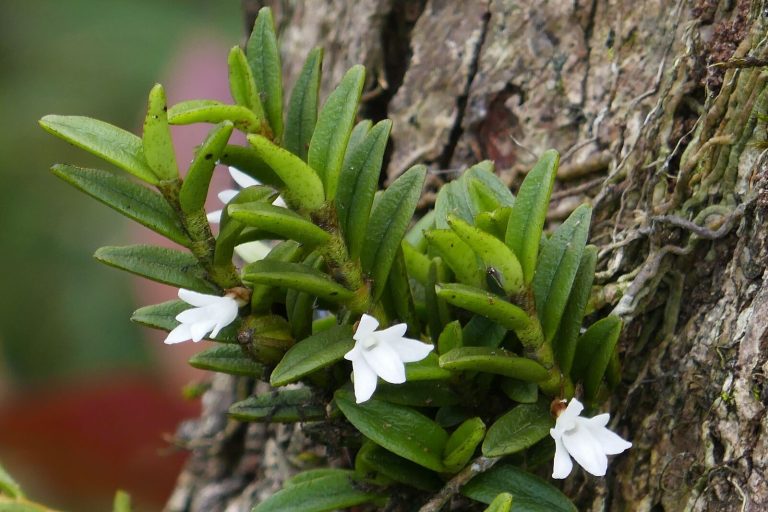
Growth habit: A small epiphytic (occasionally lithophytic) herb forming a woody stem up to about 9 cm long, often erect and sometimes clumped【2】.
Leaves: Numerous, ligulate, pseudo‑petiolate, 17–22 mm long and 1.5–2.5 mm wide, with a markedly unequal bilobed apex (one lobe reduced, the other ~6 mm)【2】.
Roots: Fine, numerous, about 1.5 mm in diameter【2】.
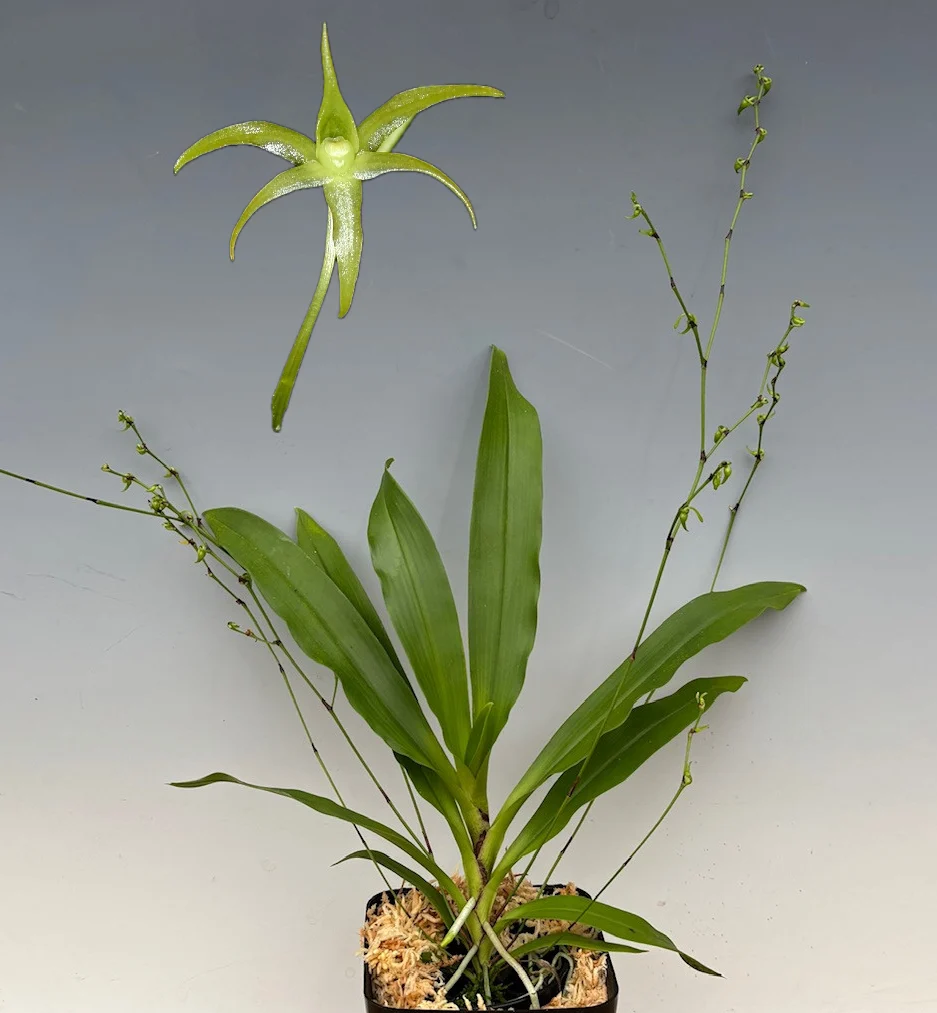
Inflorescence: Paniculated, 15–30 cm long, up to five‑branched, each branch bearing several flowers. Bracts are ~2 mm long【2】.
Flowers: Pale yellow‑green, thin‑textured. Sepals: dorsal 7–8 × 2–4 mm, lateral ~8 × 1.5 mm. Petals 6 × 1.5–3 mm. Labellum (lip) ~7 × 3 mm with a 2 mm acumen; spur slender, ~12 mm long【2】. Flower size is roughly 2 cm across, with a spur 10–12 mm long as noted by a grower source【3】.
These characters, especially the unequal bilobed leaf apex and the long slender spur, help separate A. calceolus from other Angraecum species, though overlap exists with some Mascarene taxa.
Native Range and Habitat
The species is native to Mozambique and a suite of western Indian Ocean islands: Comoros, Madagascar, Mauritius, Rodrigues, Réunion, and Seychelles【1】. It occurs in coastal, humid to subhumid forests, typically on the trunks and branches of shrubs and trees at elevations from near sea level up to about 2000 m【3】【10】. The habitat is described as “shady, humid forests” within a seasonally dry tropical biome【1】【2】.
Species‑Specific Care
| Factor | Documented guidance | Source |
|---|---|---|
| Light | Bright indirect or dappled shade, mimicking forest understory | 【3】 |
| Temperature | Hot to cool conditions; exact range not documented | Not documented |
| Humidity | High humidity; the species is native to humid coastal forests | 【3】 |
| Substrate | Epiphytic mounting on bark or tree fern fibre; can be grown in a well‑draining orchid mix with coarse bark | Not documented |
| Watering | Keep medium moist but allow brief drying between waterings; avoid prolonged dryness | Not documented |
| Fertilisation | Balanced orchid fertilizer at half strength during active growth | Not documented |
| Seasonal changes | None specifically recorded; follow natural cycle of humid, warm conditions | Not documented |
Because detailed horticultural studies are lacking, growers should observe the plant closely and adjust watering and temperature to avoid stress. Maintaining good airflow and preventing rot are general orchid best practices.
Flowering and Pollination
Flowers are produced on a long, sometimes branched inflorescence and are pale yellow‑green with a prominent nectar spur about 12 mm long【2】【3】. Specific flowering months are not recorded in the available sources, nor is a pollinator identified. The spur length suggests moth pollination, a common trait in many Angraecum species, but this remains a hypothesis for A. calceolus.
Evidence and Limitations
Key morphological data come from Kew’s Plants of the World Online and a cultivated‑orchid description. Habitat and distribution are well documented, but precise horticultural parameters (temperature ranges, watering schedules, fertilisation regimes) are largely absent. Pollination biology and conservation status have not been found in the supplied sources; further field studies and IUCN assessments would be needed.
FOLLOW THE EVIDENCE
Sources & references
- Angraecum calceolus Thouars | Plants of the World Online | Kew Science, https://powo.science.kew.org/taxon/urn:lsid:ipni.org:names:616001-1
- Angraecum calceolus Thouars – General information | Plants of the World Online, https://powo.science.kew.org/taxon/urn:lsid:ipni.org:names:616001-1/general-information
- Orchid Species: Angraecum calceolus, https://www.orchids.org/grexes/angraecum-calceolus
- Taxon: Angraecum calceolus Thouars – GRIN-Global, https://npgsweb.ars-grin.gov/gringlobal/taxon/taxonomydetail?id=3443
- African Plant Database – Angraecum calceolus Thouars, https://africanplantdatabase.ch/en/nomen/specie/43499/angraecum-calceolus-thouars