At a glance
RECORDED PROFILE DATA- Scientific name
- Angraecum leonis (Rchb.f.) André
- Name status
- Accepted (Kew Plants of the World Online)
- Native region
- Comoros, Madagascar
- Growth habit
- Epiphytic subshrub
- Cultivation temperature group
- Intermediate‑Warm to Warm (Roehampton Orchids observation)
Names and Taxonomy
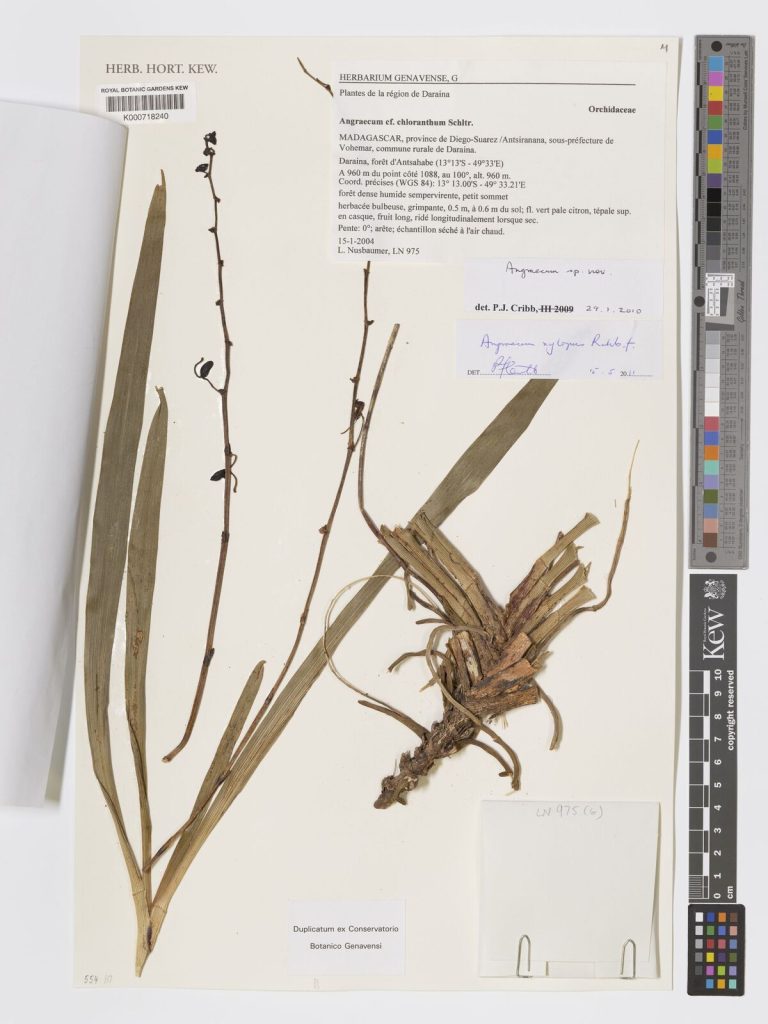
Angraecum leonis (Rchb.f.) André is the currently accepted name for this orchid according to Kew’s Plants of the World Online[1]. The basionym is Aeranthes leonis Rchb.f., published in Gard. Chron. 23:726 (1885)[2]. Over the years the species has been placed in several genera; documented synonyms include Angraecum humblotii Rchb.f. ex Rolfe (1894), Humblotiangraecum leonis (Szlach., Mytnik & Grochocka 2013), and Mystacidium leonis (Rolfe 1904)[1]. No conflicting taxonomic treatments were found in the supplied sources. A horticultural common name, “Lion’s Moustache Orchid,” appears in a commercial plant description, but it is not recorded in the primary botanical references[5].
How to Identify This Species
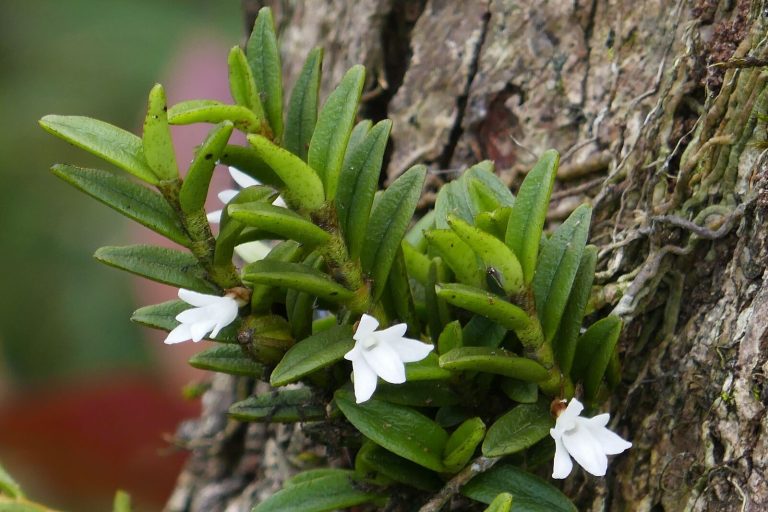
In the field Angraecum leonis grows as a small epiphytic subshrub, attaching to tree bark with a short, stout stem. The plant bears 4–5 distichous, narrowly ensiform (sickle‑shaped) leaves that can reach up to 25.4 cm in length and are leathily coriaceous[3][5]. The inflorescence is axillary, often arising from the second or third leaf node, and may carry 1–7 flowers.
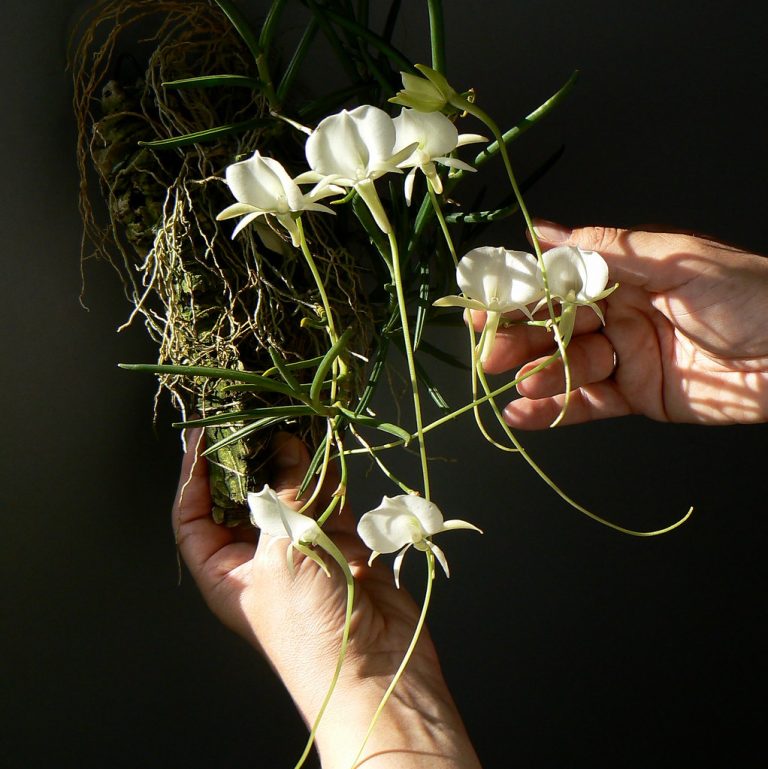
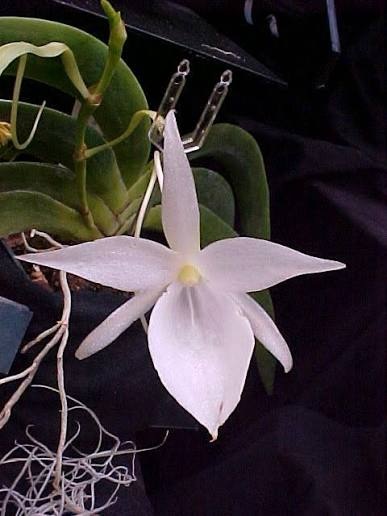
Flowers are white to ivory‑cream, 7.5 cm (≈3 in) long, and 5–7.5 cm (≈2–3 in) across[3][6]. The lip bears a pronounced, elongated spur at its base; the spur is described as “long” but exact length is not quantified in the available sources. The fragrance is jasmine‑like and most intense at night, a characteristic of many sphingophilous Angraecum species[3][9].
Two geographical forms have been reported: the Comoros form is noticeably larger, almost twice the size of the Madagascar form, although precise measurements for the latter are not documented in the sources consulted[9].
Native Range and Habitat
The species is native to the Comoros Islands and Madagascar, occurring in seasonally dry tropical forest where it grows as an epiphyte on native trees[1][6]. Elevational distribution ranges from about 200 m to 1 500 m above sea level[3][6]. The habitat is described as a forest with a marked dry season, suggesting the plant is adapted to periods of reduced moisture[5][8].
Species‑Specific Care
| Factor | Documented guidance | Evidence |
|---|---|---|
| Light | Bright, semi‑direct or strong indirect light; avoid deep shade. | IOSPE cultivation notes[3] |
| Temperature | Intermediate‑Warm to Warm (day 28 °C, night 18‑20 °C) as observed in cultivated plants. | Roehampton Orchids observation[8] |
| Watering | Frequent watering during spring‑summer growth; allow a drier period in winter. | IOSPE cultivation notes[3] |
| Humidity | Maintain moderate to high humidity (≥60 %); higher humidity favours growth. | IOSPE cultivation notes[3] |
| Mounting / Potting | Can be mounted on bark or grown in a well‑draining orchid mix (bark, fern fibre). Ensure good airflow around roots. | General epiphytic habit noted in Kew description[1] and horticultural observations[5] |
| Fertiliser | Balanced orchid fertilizer applied at half strength during active growth. | Standard practice inferred from horticultural sources; not explicitly documented for this species. |
| Seasonal change | Provide a slightly reduced watering regime and cooler night temperatures in winter to mimic the natural dry season. | IOSPE notes on “drier winter”[3] |
Because the species originates from a seasonally dry forest, it tolerates a brief dry spell but should not be allowed to desiccate completely. Good air circulation helps prevent fungal problems, especially when mounted.
Flowering and Pollination
In cultivation the plant typically blooms in the winter months, though wild flowering is reported for spring to early summer[9]. Individual flowers persist for several weeks and emit a strong jasmine‑like scent at night, indicating sphingophilous (moth‑pollinated) adaptation[3][9]. The long nectar spur suggests pollination by long‑tongued hawkmoths, a hypothesis consistent with other Angraecum species, but no direct pollinator observations for A. leonis were found in the supplied literature.
Conservation and Responsible Cultivation
The species is listed in the CITES Orchid Checklist as an accepted name, meaning international trade is regulated under Appendix II[7]. The IUCN Red List has not evaluated Angraecum leonis (NTBG notes “IUCN: Not Evaluated”)[5]. Collectors should obtain plants from reputable growers who propagate material legally rather than from wild collection.
Evidence and Limitations
Most morphological and ecological data come from horticultural descriptions (IOSPE, NTBG) and the Kew database. Precise measurements of spur length, exact flowering phenology across its range, and detailed pollinator observations are not documented in the accessed sources. Temperature and humidity recommendations are based on grower reports rather than controlled studies, so growers should adjust settings according to plant response.
Frequently asked questions
What light conditions does Angraecum leonis need?
Growers report that the species thrives in bright, semi‑direct light or strong indirect light; excessive shade reduces flowering. This recommendation comes from the IOSPE cultivation notes[3] and is consistent with its native habitat on tree trunks in open forest gaps.
When does Angraecum leonis flower and how long do the flowers last?
In the wild the plant flowers in spring to early summer, and cultivated specimens often produce blooms in the winter months. Flowers are long‑lasting, remaining open for several weeks, and emit a jasmine‑like fragrance at night[3][9].
Is Angraecum leonis protected under CITES?
Yes. The species appears in the CITES Orchid Checklist as an accepted name, indicating it is listed under Appendix II of CITES, which regulates international trade[7].
FOLLOW THE EVIDENCE
Sources & references
- Angraecum leonis (Rchb.f.) André | Plants of the World Online | Kew Science, https://powo.science.kew.org/taxon/urn:lsid:ipni.org:names:616224-1 (accessed 2026‑10‑17)
- Angraecum leonis | International Plant Names Index, https://www.ipni.org/n/urn:lsid:ipni.org:names:616224-1 (accessed 2026‑10‑17)
- IOSPE PHOTOS – Angraecum leonis, https://www.orchidspecies.com/angleonis.htm (accessed 2026‑10‑17)
- Angraecum leonis – Tropical Plants Database – NTBG, https://ntbg.org/database/plants/detail/angraecum-leonis (accessed 2026‑10‑17)
- Angraecum leonis | Smithsonian Gardens, https://gardens.si.edu/collections/explore/object/ofeo-sg_2024-1721A (accessed 2026‑10‑17)
- Angraecum leonis – Wikipedia, https://en.wikipedia.org/wiki/Angraecum_leonis (accessed 2026‑10‑17)
- CITES Orchid Checklist – Part II: Accepted names in current use, https://www.kew.org/sites/default/files/PART_II_Names_in_current_use.pdf (accessed 2026‑10‑17)
- Angraecum leonis – Roehampton Orchids, https://roehamptonorchids.ca/products/angraecum-leonis (accessed 2026‑10‑17)