At a glance
RECORDED PROFILE DATA- Scientific name
- Angraecum filicornu Thouars
- Name status
- Unplaced name (not currently accepted)
- Native region
- Madagascar (primary); also reported from Mauritius and Réunion
- Growth habit
- Miniature to small epiphytic orchid
- Cultivation temperature group
- Not documented
Names and Taxonomy
The accepted scientific name is Angraecum filicornu Thouars. The name was first published in Hist. Orchid. t. 52 (1822) as an isonym of a name originally issued in 1809 (IPNI)[1]. Kew’s Plants of the World Online lists the name as unplaced, meaning it is not currently accepted in the Kew checklist and cannot be definitively synonymised (POWO)[2].
Several homotypic synonyms have been recorded:
- Aeranthes thouarsii S.Moore (1877)
- Aerobion filicornu (Thouars) Spreng. (1826)
- Pseudojumellea filicornu (Thouars) Szlach., Mytnik & Grochocka (2013)
These synonyms appear in the POWO synonymy list (POWO synonymy)[2] and in the Index de la flore (Index de la flore)[3]. No widely used common name is documented.
How to Identify This Species
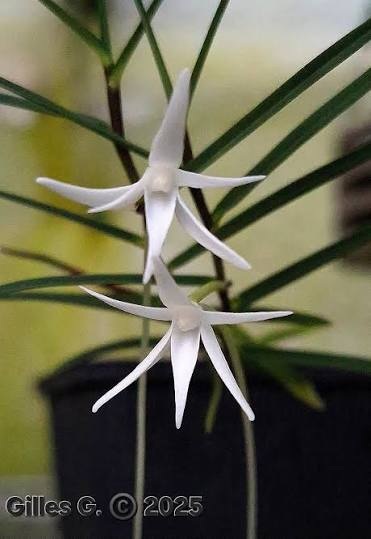
Angraecum filicornu is a miniature to small epiphytic orchid. Plants have thin, grass‑like linear leaves arranged in two ranks along a short, slender stem. The leaves are described as “thin and grass‑like, linear” (IOSPE)[5]. The inflorescence is axillary, usually bearing a single flower on a short peduncle.
The flower is about 2 cm (≈ 2/3 in) across, white‑creamy, and bears a long, thread‑like nectar spur that gives the species its epithet “filicornu” (Latin for “thread‑horn”). The spur is prominent in photographs and is a key diagnostic feature (IOSPE)[5]. Flowering can occur at any time of the year, and the plant may produce flowers intermittently.
Because the plant is diminutive and the flower is small, it can be confused with other miniature Angraecum or Aeranthes species. The combination of linear leaves, single short‑pedicellate flower, and a conspicuously elongated spur helps separate it from look‑alikes such as Angraecum nasutum (which has broader leaves and a shorter spur).
Native Range and Habitat
The species is documented as native to Madagascar, specifically eastern lowland rainforests from sea level to about 900 m elevation (IOSPE)[5]. The GRIN‑Global entry also records native occurrences in Toamasina and Toliara, Madagascar (GRIN‑Global)[6]. The CITES Orchid Checklist lists the species under Madagascar, Mauritius and Réunion, indicating possible presence in the Mascarene Islands (CITES)[4]. However, Kew’s primary distribution record only cites Madagascar, so Madagascar is the core native region.
In the wild the orchid grows as an epiphyte on tree trunks and large branches in humid, shaded forest interiors. The habitat is characterised by warm temperatures, high humidity, and abundant airflow typical of tropical rainforests.
Species‑Specific Care
| Factor | Documented guidance | Source |
|---|---|---|
| Temperature | Warm to hot conditions; typical of lowland tropical rainforest (≈ 22–30 °C day, 18–24 °C night) | [5] |
| Light | Bright, filtered light; avoid direct midday sun | [5] |
| Watering | Keep medium consistently moist but well‑drained; water when the surface begins to dry | [5] |
| Humidity | High humidity (≥ 70 %) mimicking rainforest conditions | [5] |
| Mounting / Medium | Suitable for bark mounts or a very coarse, airy orchid mix (e.g., bark, perlite, charcoal) | [5] |
| Fertilisation | Balanced, water‑soluble orchid fertilizer at half strength during active growth | Not documented |
| Seasonal changes | No specific rest period recorded; maintain warm, humid conditions year‑round | Not documented |
Because the species is small and prefers high humidity, growers often mount it on cork bark or attach it to a basket with a coarse medium to improve airflow. Excessive drying of the roots can quickly stress the plant, so regular misting or a humidity tray is beneficial. No reliable reports of a distinct dry‑rest period have been found, so continuous warm and moist conditions are recommended.
Flowering and Pollination
Flowers are small (≈ 2 cm) and may appear at any time of year in both wild and cultivated plants (IOSPE)[5]. The long, thread‑like spur suggests adaptation to moth pollination, a common trait in many Angraecum species, but no specific pollinator has been documented for A. filicornu. Flower longevity and fragrance are not recorded in the available sources.
Evidence and Limitations
Key information such as exact plant dimensions, detailed phenology, pollinator identity and formal conservation status are not documented in the sources consulted. The name is currently treated as “unplaced” by Kew, indicating taxonomic uncertainty. Cultivation recommendations are derived from a single horticultural description (IOSPE) and may not reflect the full range of successful practices.
Frequently asked questions
How large does Angraecum filicornu grow?
It is described as a miniature to small orchid; exact plant dimensions are not documented in the available sources.
When does Angraecum filicornu flower?
Flowers may appear at any time of the year; no specific flowering season is recorded.
Is Angraecum filicornu protected under CITES?
The species appears in the CITES Orchid Checklist, but the exact appendix listing is not specified in the sources.
FOLLOW THE EVIDENCE
Sources & references
- Angraecum filicornu | International Plant Names Index, https://www.ipni.org/n/616121-1
- Angraecum filicornu | Plants of the World Online, https://powo.science.kew.org/taxon/616121-1
- Index de la flore – Angraecum filicornu, https://mascarine.cbnm.org/index.php/flore/index-de-la-flore/nom?code_taxref=705834
- CITES Orchid Checklist – PART II (Names in current use), https://www.kew.org/sites/default/files/PART_II_Names_in_current_use.pdf
- IOSPE PHOTOS – Angraecum filicornu, https://www.orchidspecies.com/angfilicorne.htm
- GRIN-Global – Angraecum filicornu, https://npgsweb.ars-grin.gov/gringlobal/taxon/taxonomydetail?id=3446

