At a glance
RECORDED PROFILE DATA- Scientific name
- Angraecum pectinatum Thouars
- Name status
- Accepted
- Native region
- Comoros, Madagascar, Mauritius, Réunion (Mascarene Islands)
- Growth habit
- Epiphytic or lithophytic chamaephyte
- Cultivation temperature group
- Not documented
Names and Taxonomy
Angraecum pectinatum Thouars is the accepted name for this species according to Kew’s Plants of the World Online [1]. The epithet *pectinatum* (Latin “comb‑like”) refers to the linear, regularly arranged leaves. The name was first published in Nouveau Bulletin des Sciences, Société Philomathique de Paris 1: Tabl. Angorkis (1809) [1]. A number of later synonyms exist, most of which are homotypic transfers to other genera (e.g., Aeranthes pectinata, Aerobion pectinatum, Macroplectrum pectinatum) and are listed by Kew [1]. No vernacular name is documented in the supplied sources, although the IOSPE entry refers to it as “The Combed Angraecum” [3].
How to Identify This Species
Angraecum pectinatum is a miniature epiphytic or lithophytic chamaephyte. In cultivation it reaches about 30 cm in height [4]. The stems are short and may be simple or sparsely branched, bearing numerous distichous (two‑row) linear leaves that are sub‑acute, thick and fleshy [3]. Leaves are typically 5–10 cm long, though exact measurements are not provided in the cited excerpts.
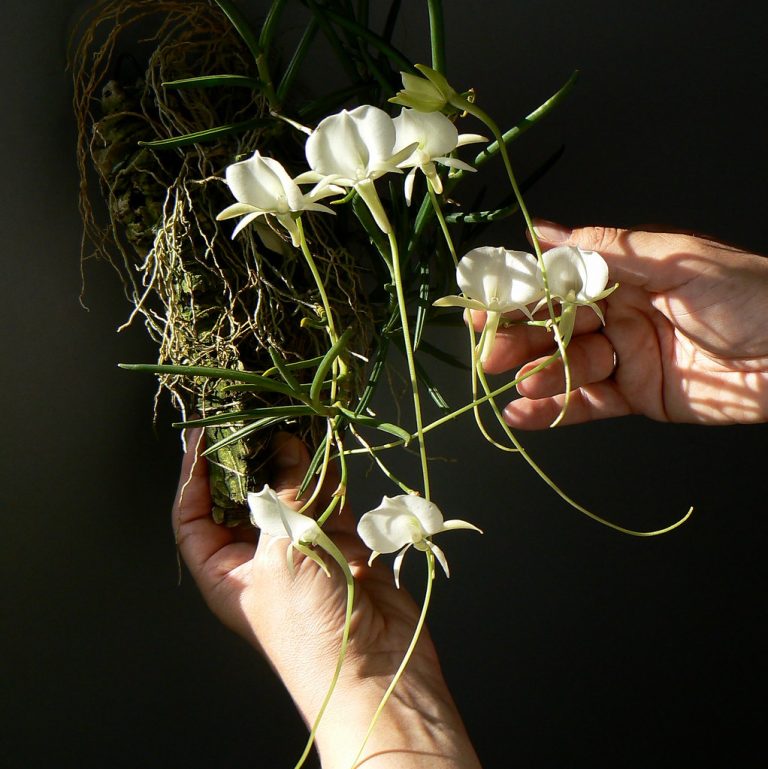
The inflorescence is axillary, sessile and usually bears a single flower. Flowers are white (occasionally greenish) and about 2 cm across [3]. The lip is modest, and the nectar spur is relatively short compared with many larger Angraecum species; its exact length is not detailed in the sources. The fragrance is reported as nocturnal and noticeable in the evening, a trait common in many night‑pollinated Angraecums [6]. Because the plant often grows directly on bark, the roots are compact, velamen‑covered, and cling tightly to the substrate [5]. These characters together distinguish it from larger, more robust Angraecums such as A. sesquipedale.
Native Range and Habitat
The species is native to the western Indian Ocean islands: the Comoros, Madagascar, Mauritius and Réunion (the Mascarene islands) [1]. It occurs in humid, shaded forest interiors, frequently on bare trunks and large branches where it can attach directly to bark [5]. The habitat is described as wet tropical forest, ranging from sea level up to at least 1 700 m elevation on Réunion, while other reports give a narrower range of 0–700 m [5][8]. The plant prefers the high‑humidity microclimate of these forests and is typically found in areas with constant air movement.
Species‑Specific Care
| Factor | Documented guidance | Source |
|---|---|---|
| Light | Low to medium light; 1 500–3 000 lux; bright indirect or filtered light. | [5][6] |
| Temperature | Temperate to hot conditions; cooler night temperatures are beneficial (exact values not documented). | [5][6] |
| Humidity | High humidity; avoid letting roots dry for extended periods. | [5][12] |
| Airflow | Good ventilation; a fan or natural breeze is recommended. | [5][6] |
| Substrate / Mounting | Fine bark mixed with chopped sphagnum, or mounted on bark/moss; medium should stay moist but well‑drained. | [5][8] |
| Watering | Keep medium consistently damp; do not allow prolonged drying of roots. | [5][12] |
| Fertilisation | Not documented in the available sources. | Not documented |
| Repotting / Re‑mounting | Not documented; typical orchid practice is to repot when roots fill the container. | Not documented |
| Seasonal changes | Not documented; growers report year‑round flowering under stable indoor conditions. | [4] |
In practice, growers find success by mounting the orchid on a slab of cork bark or tree fern fiber, securing it with fishing line, and misting daily to maintain humidity. Because the plant tolerates low drought, it should not be allowed to sit in waterlogged media, which can cause root rot.
Flowering and Pollination
Flowering has been observed throughout the year in cultivated plants [4], while field reports note a spring‑to‑autumn flowering period [3]. Individual flowers are short‑lived (a few days) and emit a sweet fragrance that intensifies at night [6]. The nectar spur suggests adaptation to moth pollination, but no specific pollinator has been documented for this species in the supplied literature.
Common Growing Problems
Specific problem reports for A. pectinatum are not present in the provided sources. General orchid issues such as fungal rot from excess moisture, insufficient airflow, or pest infestations (scale, mealybugs) are likely relevant, but growers should refer to broader Angraecum care guides for troubleshooting.
Conservation and Responsible Cultivation
Formal conservation assessments (e.g., IUCN Red List) are not cited in the available sources, and the species does not appear in the excerpted CITES Orchid Checklist [10]. Nevertheless, because the plant is native to islands with ongoing habitat pressure, responsible sourcing from reputable growers and avoidance of wild collection are advised.
Evidence and Limitations
Most morphological and ecological information derives from horticultural observations (blogs, cultivation sites) rather than peer‑reviewed field studies. Exact measurements of leaf length, spur length, and temperature ranges are lacking. Pollinator identity remains undocumented. Future field surveys and taxonomic revisions could refine the species’ status and ecological profile.
FOLLOW THE EVIDENCE
Sources & references
- Angraecum pectinatum Thouars | Plants of the World Online | Kew Science, https://powo.science.kew.org/taxon/urn:lsid:ipni.org:names:616325-1
- Angraecum pectinatum | International Plant Names Index, https://www.ipni.org/ipni/idPlantNameSearch.do?id=616325-1
- IOSPE PHOTOS – Angraecum pectinatum, https://www.orchidspecies.com/angpectinatum.htm
- Angraecum pectinatum – NativePlants.info, https://www.nativeplants.info/plant/magnoliophyta-flowering-plants/orchidaceae/angraecum/angraecum_pectinatum.html
- Angraecoid orchids: Angraecum pectinatum Thouars (1822) – Blog, http://angraecoid-orchids.blogspot.com/2016/02/angraecum-pectinatum-thouars-1822.html
- How to Care for Angraecum pectinatum – botanapp.com, https://botanapp.com/plant/angraecum-pectinatum
- Angraecum pectinatum – Pumpkin Beth, https://www.pumpkinbeth.com/plants/angraecum-pectinatum/