At a glance
RECORDED PROFILE DATA- Scientific name
- Angraecum appendiculoides Schltr.
- Name status
- Accepted (Kew POWO)
- Native region
- Madagascar
- Growth habit
- Epiphytic subshrub, pendant
- Cultivation temperature group
- Cool (mountain) – precise range not documented
Names and Taxonomy
Angraecum appendiculoides Schltr. was first described in Repert. Spec. Nov. Regni Veg. 18: 325 (1922) and is accepted as the correct name by Kew’s Plants of the World Online [1]. A homotypic synonym is Lepervenchea appendiculoides (Schltr.) Szlach., Mytnik & Grochocka (2013) [1]. No other common names are documented in the available sources.
How to Identify This Species
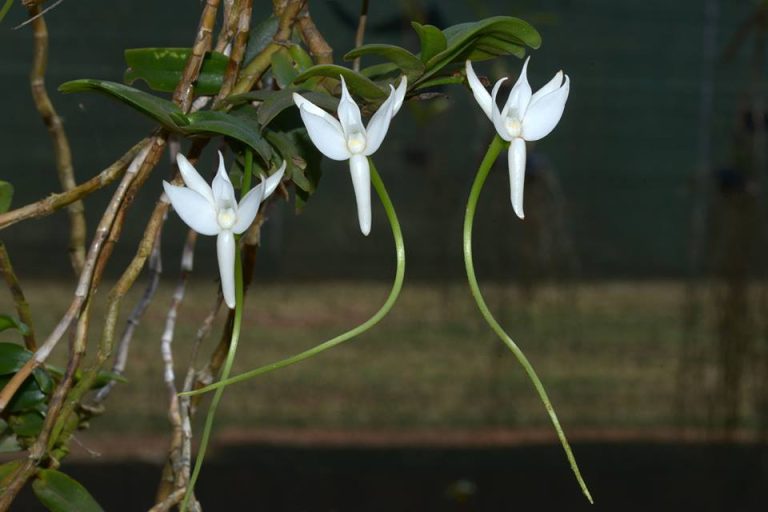
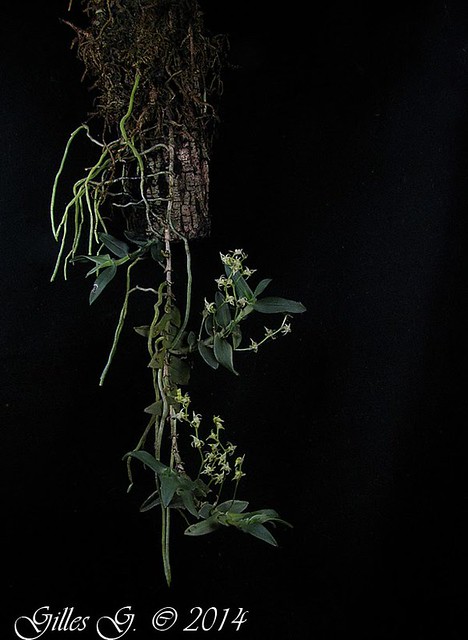
The plant is a small to medium‑sized epiphytic subshrub with an elongate stem that bears many spreading, oval‑lanceolate, cordate leaves that clasp the stem at the base [2]. Leaves are typically arranged along the stem and give the plant a pendant habit. The inflorescence is axillary, lax, and carries four to seven flowers. Flowers are about 0.2 in (5 mm) across, white to greenish‑white, with a broadly oval‑acuminate floral bract that exceeds the ovary length [2]. The species is reported as fragrant [3]. Flowering occurs in the later spring in its native habitat.
Native Range and Habitat
Angraecum appendiculoides is endemic to central Madagascar, occurring in mossy, wet tropical forests at elevations of roughly 1700–2000 m [1][2]. It grows as an epiphyte on tree trunks and large branches, favouring humid, shaded micro‑habitats within the forest canopy.
Species‑Specific Care
| Factor | Documented guidance | Evidence |
|---|---|---|
| Growth habit | Epiphytic; mount on bark or a well‑draining moss mix | [2] |
| Temperature | Cool‑growing (mountain) – precise range not documented | [2] |
| Humidity | High humidity typical of mossy forest; exact % not documented | [2] |
| Watering | Keep substrate moist but avoid waterlogging – specific schedule not documented | Not documented |
| Light | Shade to bright indirect light – specific intensity not documented | Not documented |
| Fertilisation | Not documented | Not documented |
| Repotting / Re‑mounting | Not documented | Not documented |
| Propagation | Seed sowing requires symbiotic mycorrhizal fungi or sterile agar medium; conventional cold stratification is not applicable | [3] |
In practice, growers treat the species as a cool‑mountain epiphyte, mounting it on bark slabs in a humid environment and providing moderate, indirect light. Because precise temperature and humidity targets are not published, growers should aim to mimic the cool, moist conditions of its native high‑elevation forest.
Flowering and Pollination
Flowering is reported for the later spring in the wild, with each inflorescence bearing four to seven blooms that last a few days each [2]. Flowers are fragrant, suggesting attraction of nocturnal or crepuscular pollinators, but specific pollinator observations for this species have not been documented.
Evidence and Limitations
Most morphological and ecological details are derived from the IOSPE species page and Kew’s taxonomic database. Cultivation information is limited to general statements about its cool, humid mountain habitat; precise horticultural parameters (temperature ranges, humidity percentages, watering schedules) remain undocumented. Further field or cultivation studies would be needed to refine care recommendations and to identify pollinators.
Frequently asked questions
What temperature range is suitable for Angraecum appendiculoides?
The species is described as cool‑growing in mountain habitats, but precise temperature ranges have not been published. Growers should aim for cooler conditions than lowland tropical orchids, mimicking the cool, moist environment of 1700–2000 m elevation in central Madagascar.
How large does Angraecum appendiculoides grow?
In the wild the plant reaches about 30 cm in height, with a pendant habit. Cultivated size may vary, and detailed measurements for cultivated specimens are not documented.
FOLLOW THE EVIDENCE
Sources & references
- Angraecum appendiculoides Schltr. – Plants of the World Online, Royal Botanic Gardens, Kew, 2026, https://powo.science.kew.org/taxon/urn:lsid:ipni.org:names:615947-1
- IOSPE PHOTOS – Angraecum appendiculoides, https://www.orchidspecies.com/angappendiculoides.htm
- NativePlants.info – Angraecum appendiculoides, https://www.nativeplants.info/plant/magnoliophyta-flowering-plants/orchidaceae/angraecum/angraecum_appendiculoides.html