At a glance
RECORDED PROFILE DATA- Scientific name
- Angraecum sesquipedale Thouars
- Name status
- Accepted
- Native region
- Eastern and southeastern Madagascar
- Growth habit
- Epiphytic (occasionally lithophytic)
- Cultivation temperature group
- Warm (USDA zones 9‑11)
Names and Taxonomy
The accepted scientific name is Angraecum sesquipedale Thouars. The name was first published in Nouveau Bulletin des Sciences de la Société Philomatique de Paris in 1809[7]. Kew’s Plants of the World Online lists the species as accepted and records several homotypic synonyms, including Aeranthes sesquipedalis (Lindl.) and Macroplectrum sesquipedale (Pfitzer)[1]. Two infraspecific varieties are recognised: var. angustifolium Bosser & Morat and var. sesquipedale (the nominal form)[1].
Common names documented in horticultural sources are “Darwin’s orchid”, “Christmas orchid”, “Comet orchid”, and “One‑and‑a‑Half‑Foot Long Angraecum”[5][9].
How to Identify This Species
Growth habit. In the wild the plant is an epiphyte (occasionally lithophytic) growing on tree branches in low‑land coastal forests[1][8].
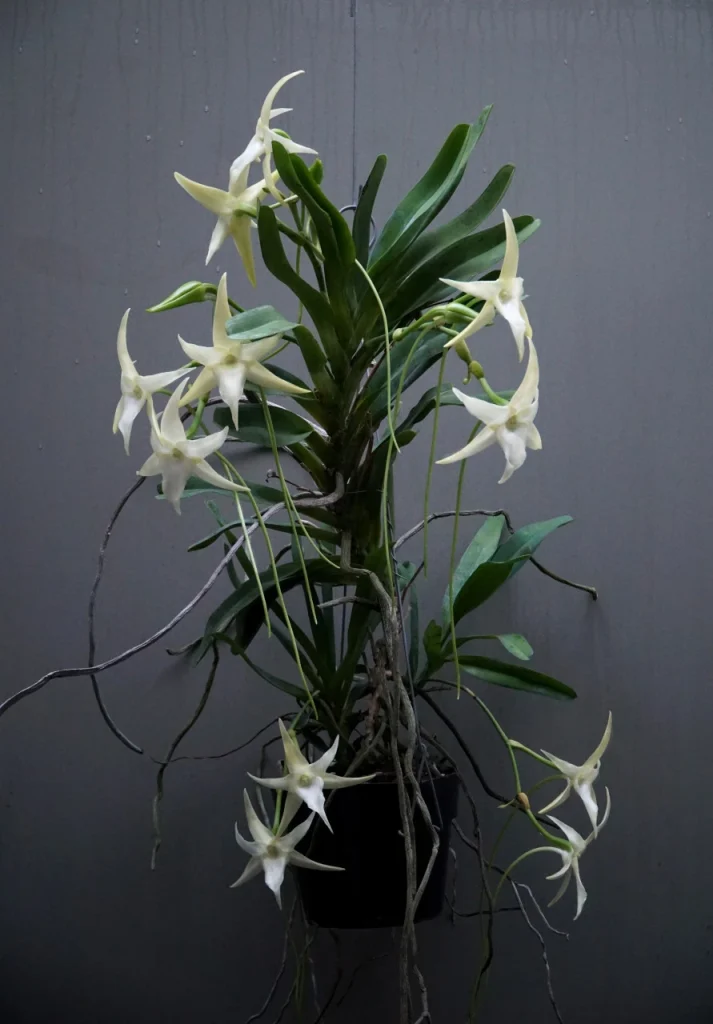
Vegetative characters. Mature plants develop a branching stem up to 30 cm tall, bearing two rows of narrow, strap‑like leaves about 27 cm long and 3 cm wide; the leaf tips often split into two lobes[5]. Leaves are arranged alternately along the stem and are leathery, an adaptation to the humid environment.
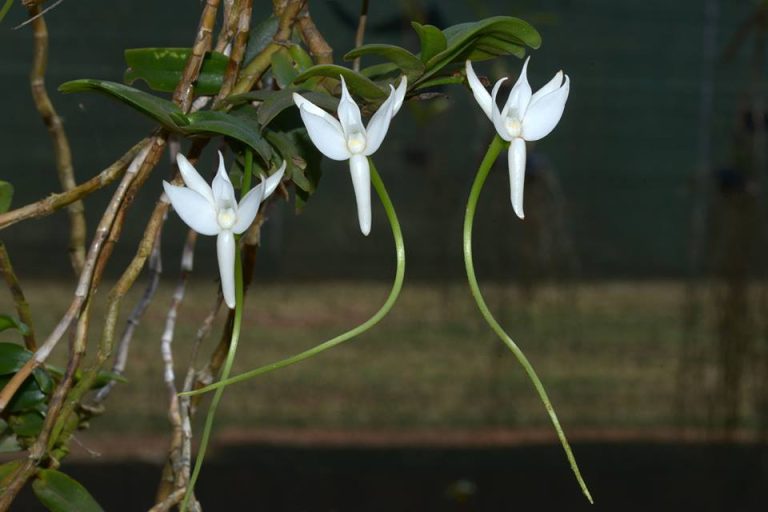
Inflorescence. Flower stalks arise from the upper leaf axils, are erect to arching, and can reach about 1 m in length, bearing 2–6 (occasionally up to 8) flowers[5][8].
Flower morphology. Each flower is creamy‑white, star‑shaped, and measures roughly 15–20 cm across (including the lip)[8]. The lower lip is three‑lobed, with the central lobe forming a short spur‑bearing tube; the most diagnostic feature is the long, hollow nectar spur extending up to 45 cm behind the flower[5][8]. The fragrance is jasmine‑like and intensifies at night[8][5].
Because several Angraecum species share a similar white, star‑shaped flower, the combination of a very long spur (>40 cm), leaf size (≈27 cm), and the split leaf tips is most reliable for confirming A. sesquipedale. Photographs or herbarium specimens lacking a visible spur should be treated with caution.
Native Range and Habitat
The species is endemic to eastern and southeastern Madagascar, occurring from sea level up to about 100 m elevation[2][8]. It is most frequently recorded along the humid littoral strip where trade winds bring heavy rainfall year‑round, creating a warm, consistently moist microclimate with little seasonal temperature fluctuation[7][8]. The orchid grows on the trunks and branches of native trees, preferring sites with good air circulation and bright, filtered light.
Species‑Specific Care
| Factor | Documented guidance | Source |
|---|---|---|
| Growth habit | Epiphytic; can be mounted on bark or grown in a coarse, well‑draining orchid mix | [4][6] |
| Light | Bright indirect light; avoid direct midday sun which can scorch leaves | [4][5] |
| Temperature | Warm conditions; USDA zones 9‑11 are suitable. Night temperatures should not drop below 15 °C. | [4] |
| Humidity | High humidity (70‑90 %); misting or a humidity tray is beneficial. | [5][8] |
| Watering | Keep the medium evenly moist but not water‑logged; reduce watering in winter only if the plant is kept in a cooler, drier environment. | [6][4] |
| Fertilisation | Apply a balanced orchid fertilizer (20‑20‑20) at half strength bi‑weekly during active growth. | Not documented; general orchid practice |
| Airflow | Good circulation is essential to prevent fungal problems; a fan on low setting works well. | [4][5] |
| Repotting | Repot every 2–3 years or when the mount becomes over‑grown; use bark chips, perlite, and a small amount of sphagnum. | Not documented; inferred from epiphytic habit |
| Seasonal cues | In its native range the plant flowers in the warm, wet season (June‑September in Madagascar). Replicating a slightly warmer, more humid period in late winter can encourage bloom in cultivation. | [5][8] |
Overall, the most critical cultural needs are warm, stable temperatures, high humidity, and bright filtered light. Because the orchid is adapted to a consistently moist environment, allowing the medium to dry out completely can stress the plant and suppress flowering.
Flowering and Pollination
In the wild, flowers appear from June to September, which corresponds to the austral winter‑spring period in eastern Madagascar[5]. In cultivation in the northern hemisphere, flowering is often observed from November to May, reflecting the plant’s response to temperature and light cues rather than strict calendar dates[8]. Individual flowers are long‑lasting (several weeks) and emit a strong jasmine fragrance at night, which attracts its natural pollinator.
The pollinator is the hawkmoth Xanthopan morganii var. praedicta, a species possessing a proboscis up to 45 cm long—matching the orchid’s spur length. This classic example of co‑evolution was first hypothesised by Charles Darwin in 1862 and later confirmed when the moth was described in 1903[5][8]. The moth inserts its proboscis into the spur, contacts the pollinia, and transfers them to the next flower.
Evidence and Limitations
The profile relies on authoritative taxonomic data from Kew’s Plants of the World Online and IPNI, as well as horticultural observations from Kew’s “Darwin’s orchid” page, Smithsonian Gardens, Chicago Botanic Garden, and the Orchid Society field notes. Detailed quantitative cultivation data (e.g., exact watering volumes, precise humidity thresholds) are not documented for this species in the available sources; the care table therefore incorporates general epiphytic orchid practices where species‑specific guidance is lacking. Conservation status has not been evaluated by the IUCN according to Kew[5]. Further field studies would improve knowledge of its exact elevation range, population trends, and any regional threats.
Frequently asked questions
What is the most distinctive feature of Angraecum sesquipedale?
The orchid’s exceptionally long nectar spur—up to 45 cm—combined with its large white, jasmine‑scented flowers distinguishes it from most other Angraecum species.
Can Angraecum sesquipedale be grown on a pot rather than a mount?
Yes. While it is naturally epiphytic, growers successfully cultivate it in well‑draining orchid mixes or on bark mounts, provided the medium remains moist and airy.
FOLLOW THE EVIDENCE
Sources & references
- Angraecum sesquipedale Thouars | Plants of the World Online | Kew Science, https://powo.science.kew.org/taxon/urn:lsid:ipni.org:names:616416-1
- Darwin’s orchid | Kew, https://www.kew.org/plants/darwins-orchid
- Angraecum sesquipedale – Smithsonian Gardens, https://si.gardenexplorer.org/taxon-19788.aspx
- Angraecum sesquipedale | Chicago Botanic Garden, https://www.chicagobotanic.org/plant-information/plant-finder/angraecum-sesquipedale-darwins-orchid
- The Wild Records for Angraecum Sesquipedale Point to a Hot, Wet Lowland Plant | Orchid Society, https://orchidsociety.com/the-wild-records-for-angraecum-sesquipedale-point-to-a-hot-wet-lowland-plant/
- NParks | Angraecum sesquipedale, https://www.nparks.gov.sg/florafaunaweb/flora/5/9/5986
- Angraecum sesquipedale | International Plant Names Index, https://www.ipni.org/n/77332345-1