At a glance
RECORDED PROFILE DATA- Scientific name
- Angraecum ankeranense H.Perrier
- Name status
- Accepted
- Native region
- Madagascar
- Growth habit
- Epiphytic
- Cultivation temperature group
- Not documented
Names and Taxonomy
Angraecum ankeranense H.Perrier is the accepted name for this species according to Kew’s Plants of the World Online.[1] The name was first published in Notul. Syst. (Paris) 7:115 (1938). A later homotypic synonym is Perrierangraecum ankeranense (H.Perrier) Szlach., Mytnik & Grochocka, proposed in 2013.[1] No other scientific synonyms or infraspecific taxa are documented. A vernacular name “The Ankeramadinika Angraecum” appears in an IOSPE description, but it is not established in the botanical literature; therefore it is treated as an informal label.[2]
How to Identify This Species
In the wild the plant is a compact epiphytic subshrub, typically reaching about 30 cm in height.[3] A short, monopodial stem bears 5–6 thick, leathery leaves that are bilobed at the tip. The leaves are arranged alternately along the stem and persist year‑round.
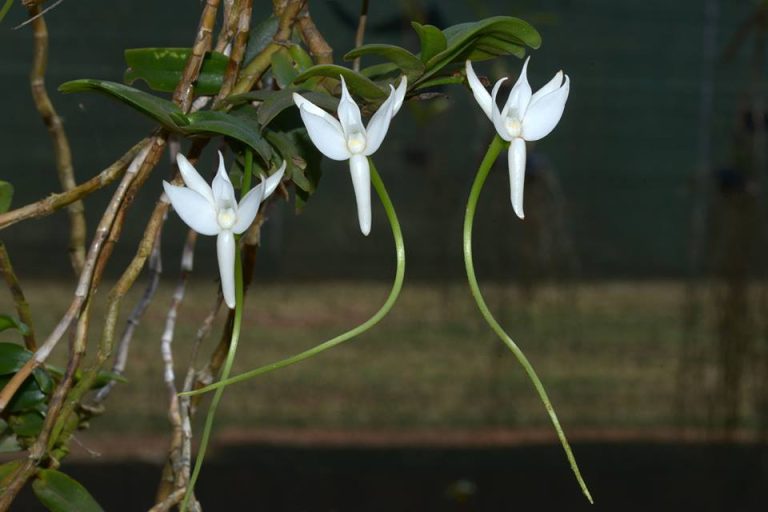
The inflorescence is axillary, short, and usually bears a single flower; a second flower is frequently aborted.[2] The flower is white, fragrant (especially at night), and measures roughly 7.5 cm across (about 3 in). The lip is modestly sized, and the nectar spur is long and slightly curved, a typical feature of many Angraecum species.[2] The fragrance is described as sweet and noticeable in the evening, a trait valued by collectors.
Key diagnostic points:

- Compact epiphytic habit, 30 cm tall.
- 5–6 thick, bilobed leaves.
- Single white, night‑fragrant flower ~7.5 cm wide.
- Long, slightly curved spur.
- Growth in moss‑rich forest at 700–2000 m elevation.
Because the flower is similar to that of Angraecum bicallosum, growers sometimes confuse the two. However, A. bicallosum is known from only a single herbarium specimen and is considered extremely rare; most cultivated plants labelled as that species are in fact A. ankeranense (see grower notes).[9]
Native Range and Habitat
The species is endemic to central Madagascar, occurring primarily in moist, moss‑covered forest canopies.[1][6] It is recorded from elevations between 700 and 2000 m, where the climate is cool‑to‑warm and the forest is persistently humid. The plant grows epiphytically on tree branches, often among mosses that retain moisture, indicating a preference for high‑air‑circulation sites within the wet tropical biome.[1][2]
Species‑Specific Care
| Factor | Documented guidance | Source |
|---|---|---|
| Mounting | Best grown mounted on cork or tree fern slab to mimic natural epiphytic habit. | [2][8] |
| Light | Bright but filtered light; avoid direct midday sun. | [2][8] |
| Temperature | Warm to cool range, 18 °C – 30 °C (64 °F – 86 °F) works well. | [8] |
| Humidity | High humidity, ideally 70 %–85 %. | [8] |
| Watering | Frequent misting and regular watering during active growth; allow roots to dry slightly between waterings, reduce frequency in cooler months. | [2][8] |
| Air movement | Good airflow to prevent fungal buildup. | [2] |
| Medium | Very airy substrate – a mix of fine pine bark, sphagnum moss, and a touch of charcoal when mounted. | [8] |
| Fertilisation | Balanced orchid fertilizer at half strength every 2–3 weeks during growth. | Not documented (general orchid practice) |
| Repotting / Re‑mounting | Every 2–3 years or when the moss medium breaks down. | Not documented |
Growers stress that the plant tolerates a range of temperatures but performs best when night temperatures do not fall below 15 °C. Because it originates from a cool‑to‑warm montane environment, sudden temperature spikes should be avoided. Regular misting replicates the constant moisture of its native moss forest, and a well‑ventilated mount reduces the risk of rot.
Flowering and Pollination
In its native habitat the plant blooms in the late spring to early summer months of the Southern Hemisphere (approximately October‑December). The single flower opens in the late afternoon and remains fragrant through the night, a pattern typical of moth‑pollinated Angraecum species. Specific pollinator observations for A. ankeranense have not been published; the long spur suggests adaptation to long‑tongued nocturnal pollinators such as hawkmoths, but this remains a hypothesis.[2]
Evidence and Limitations
The profile relies on authoritative taxonomic data from Kew (accepted name, distribution) and on cultivation notes from IOSPE, NativePlants.info, and a commercial grower (The Green Corner). Detailed phenological data (exact flowering months, pollinator identity) and formal conservation assessments (e.g., IUCN status) are not available in the cited sources. Consequently, some horticultural recommendations are based on grower experience rather than peer‑reviewed studies, and should be adapted to local conditions.
FOLLOW THE EVIDENCE
Sources & references
- Angraecum ankeranense H.Perrier | Plants of the World Online | Kew Science, https://powo.science.kew.org/taxon/urn:lsid:ipni.org:names:615939-1
- IOSPE PHOTOS – Angraecum ankeranense, https://www.orchidspecies.com/angankeranense.htm
- Angraecum ankeranense | NativePlants.info, https://www.nativeplants.info/plant/magnoliophyta-flowering-plants/orchidaceae/angraecum/angraecum_ankeranense.html
- CITES Orchid Checklist – Part II (Accepted names), https://www.kew.org/sites/default/files/PART_II_Names_in_current_use.pdf
- Angraecum ankeranense – The Green Corner, https://thegreencorner.es/angraecum-ankeranense