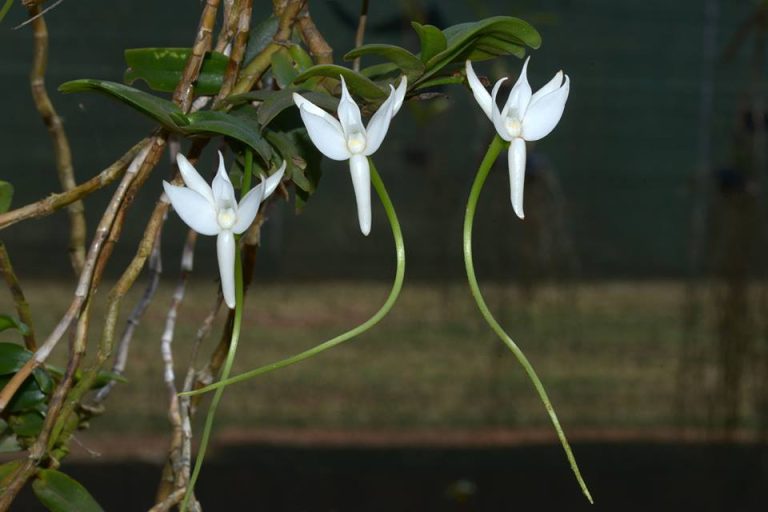
At a glance
RECORDED PROFILE DATA- Scientific name
- Angraecum vesiculiferum Schltr.
- Name status
- Accepted
- Native region
- Madagascar
- Growth habit
- Epiphytic subshrub
- Cultivation temperature group
- Warm (18‑25 °C)
Names and Taxonomy
Angraecum vesiculiferum Schltr. is the accepted name for this species according to Kew’s Plants of the World Online.[1] It was first published in Repert. Spec. Nov. Regni Veg. Beih. 33: 341 (1925). A homotypic synonym is Boryangraecum vesiculiferum (Schltr.) Szlach., Mytnik & Grochocka, published in 2013.[1] No common names are documented in the available sources.
How to Identify This Species
The species is described as an epiphytic subshrub growing in wet tropical forests.[1] Detailed morphological characters of the leaves, stems, and flowers are not provided in the sources consulted, so a precise field identification based on flower morphology is not possible from the current data. Observers should verify identity with herbarium specimens or expert consultation.
Native Range and Habitat
Angraecum vesiculiferum is native to central Madagascar, occurring in the island’s wet tropical biome.[1][2] It grows as an epiphyte on trees in humid forest environments. Elevational limits are not documented in the sources reviewed.
Species‑Specific Care
| Factor | Documented guidance | Source |
|---|---|---|
| Light | Bright, indirect sunlight; avoid direct harsh sun. | [3] |
| Temperature | Maintain day/night temperatures between +18 °C and +25 °C. | [3] |
| Humidity | Keep relative humidity around 60 %–80 %. | [3] |
| Substrate / Mounting | Well‑aerated medium such as a mix of pine bark, charcoal and sphagnum moss; can be mounted or grown in a hanging basket. | [3] |
| Watering | Water with soft, filtered water; keep medium moist but not soggy; occasional misting helps maintain humidity. | [3] |
| Airflow | Provide good air circulation to prevent root rot. | [3] |
| Feeding | Apply a balanced, diluted orchid fertilizer regularly during active growth. | [3] |
| Repotting / Re‑mounting | Refresh substrate when it breaks down; avoid disturbing roots excessively. | [3] |
These recommendations are drawn from a cultivation guide that specifically mentions Angraecum vesiculiferum as a rare epiphytic orchid from Madagascar.[3] Growers should monitor the plant for signs of over‑watering or low airflow, which are common problems for epiphytic orchids.
Flowering and Pollination
Information on the timing of flowering, flower longevity, fragrance, or pollinator interactions for this species is not documented in the sources consulted.
Conservation and Responsible Cultivation
No formal conservation assessment (e.g., IUCN Red List category) or CITES listing specific to Angraecum vesiculiferum was found in the available references.
Evidence and Limitations
The profile relies on three online sources. Detailed morphological descriptions, precise elevation range, flowering phenology, and formal conservation status are not available in these references. Further field studies and herbarium research are needed to fill these gaps.
FOLLOW THE EVIDENCE
Sources & references
- Angraecum vesiculiferum Schltr. | Plants of the World Online, Kew Science, 2026, https://powo.science.kew.org/taxon/urn:lsid:ipni.org:names:616477-1
- Angraecum vesiculiferum – OrchidRoots summary, https://orchidroots.com/display/summary/orchidaceae/9746/
- Angraecum vesiculiferum – Orchid Care and Cultivation Guide, Agronom.info, 2026, https://agronom.info/en/crop/angraecum-vesiculiferum