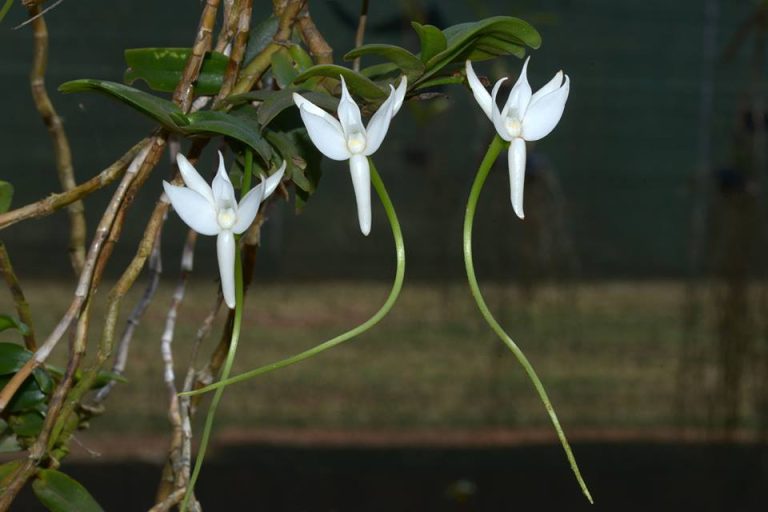
At a glance
RECORDED PROFILE DATA- Scientific name
- Angraecum mirabile Schltr.
- Name status
- Accepted by IOSPE but considered potentially synonymous with A. conchoglossum; status uncertain
- Native region
- Northeastern Madagascar
- Growth habit
- Miniature epiphytic orchid
- Cultivation temperature group
- Not documented
Names and Taxonomy
Angraecum mirabile Schltr. 1918 is the name under which the species was first described (Schlechter, 1918). A later recombination placed it in the segregate genus Arachnangraecum as Arachnangraecum mirabile (Schltr.) Szlach., Mytnik & Grochocka 2013.1 Some authors have treated the taxon as a synonym of Angraecum conchoglossum, noting that the original type specimen has been destroyed and the identity is ambiguous.1 Consequently, the name is accepted by the IOSPE database but its status is regarded as uncertain in the broader orchid literature.2
How to Identify This Species
Key morphological features reported for Angraecum mirabile include:
- Growth habit: miniature to small epiphytic orchid, often forming a short, rigid, rounded stem surrounded by striate, warty leaf sheaths.
- Leaves: numerous, spreading, narrowly linear, terete‑like, sub‑acute, incurved margins; arranged in a fan‑like (distichous) pattern.
- Inflorescence: axillary, slender, stiff, 1.8–2.2 in (4.5–5.5 cm) long, usually bearing a single flower.
- Flower size: approximately 2 in (5 cm) across; colour and fragrance are not documented in the available sources.
Because the type specimen is lost and the species is sometimes lumped with A. conchoglossum, identification based solely on cultivated material can be uncertain. Comparison with the closely related A. conchoglossum (similar size, single flower) is advised, focusing on the warty leaf sheaths and the very short spike as distinguishing traits.1
Native Range and Habitat
The species is reported from the northeastern part of Madagascar, occurring at elevations between 100 m and 500 m.1 In its natural setting it grows as an epiphyte on tree trunks and branches in lowland forest, favouring warm, humid conditions typical of the island’s eastern coastal belt.2
Species‑Specific Care
| Factor | Documented guidance | Evidence |
|---|---|---|
| Growth habit | Epiphytic; can be mounted or grown in a bark‑based potting mix. | IOSPE description of natural habit.1 |
| Temperature | Not documented for cultivation. | — |
| Light | Not documented for cultivation. | — |
| Watering | Not documented for cultivation. | — |
| Humidity | Not documented for cultivation. | — |
| Feeding | Not documented for cultivation. | — |
| Repotting / mounting | Not documented for cultivation. | — |
Because specific horticultural recommendations for Angraecum mirabile are lacking in the consulted literature, growers should start from general Angraecum epiphyte guidelines (bright indirect light, high humidity, well‑draining bark media) and adjust based on the plant’s response.
Flowering and Pollination
Flowering time, fragrance, nectar spur length, and pollinator information are not recorded in the sources consulted. The species is noted to bear a single flower, but further reproductive ecology remains undocumented.1
Evidence and Limitations
The profile relies chiefly on the IOSPE species page, a Wikipedia species list, and a regional orchid checklist page. Critical gaps include: detailed flower colour, scent, precise pollinator observations, comprehensive cultivation protocols, and a definitive taxonomic resolution. Additional field studies and herbarium work are needed to clarify the synonymy with A. conchoglossum and to document horticultural requirements.
Frequently asked questions
Is Angraecum mirabile easy to grow in cultivation?
Specific cultivation guidelines for this species are not documented. Growers can start with general Angraecum epiphyte care (bright indirect light, high humidity, well‑draining bark media) and adjust as needed.
Does Angraecum mirabile have a fragrance?
Fragrance has not been recorded in the available sources.
What is the conservation status of Angraecum mirabile?
A formal conservation assessment was not found in the consulted references.
FOLLOW THE EVIDENCE
Sources & references
- IOSPE PHOTOS – Angraecum mirabile, http://orchidspecies.com/angmirabile.htm
- List of Angraecum species – Wikipedia, https://en.wikipedia.org/wiki/List_of_Angraecum_species
- Madaorchidee – Angraecum mirabile listing, http://madaorchidee.free.fr/lesorchideesdemadagascar/pagesalphabetiques/pageA6.htm
- Angraecum Bory – Plants of the World Online, https://powo.science.kew.org/taxon/urn:lsid:ipni.org:names:325979-2