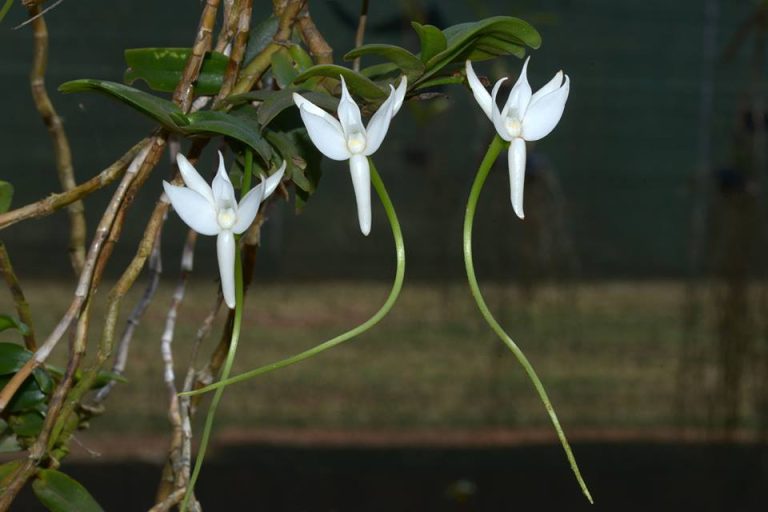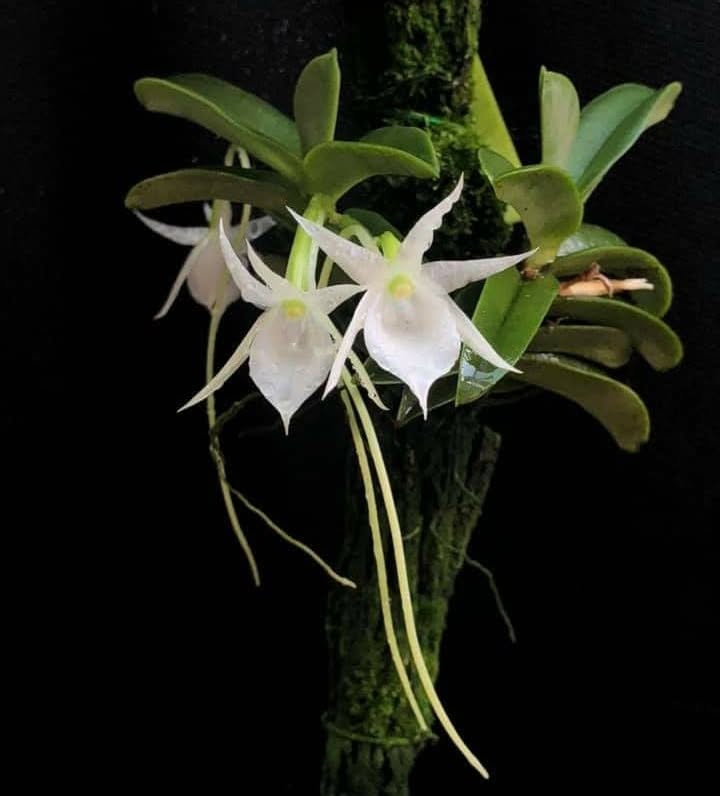
At a glance
RECORDED PROFILE DATA- Scientific name
- Angraecum clareae Hermans, la Croix & P.J.Cribb
- Name status
- Accepted (POWO)
- Native region
- Madagascar (Central per POWO; eastern and central per IOSPE)
- Growth habit
- Epiphytic subshrub; IOSPE describes it as a miniature epiphyte
- Cultivation temperature group
- Cool-growing (IOSPE); numeric thresholds not documented
- Flower size
- About 6.5 cm across (IOSPE)
- Flowering
- Spring in the Northern Hemisphere (IOSPE)
- Habitat elevation
- About 1,350 m (IOSPE)
- Common name
- Clare's Angraecum (IOSPE)
- Synonym
- Humblotiangraecum clareae (POWO)
Names and Taxonomy
Angraecum clareae Hermans, la Croix & P.J.Cribb is the accepted scientific name for this species in Plants of the World Online (POWO), which records its first publication in Orchid Review 109: 43 (2001) [1]. POWO treats the species as accepted and places it in Orchidaceae. The same record lists Humblotiangraecum clareae (Hermans, la Croix & P.J.Cribb) Szlach., Mytnik & Grochocka as a homotypic synonym [1]. The IOSPE species account also uses Angraecum clareae and places it in section Humblotiangraecum; it gives the common name Clare’s Angraecum [2].
No alternate spelling or infraspecific taxon is documented in the consulted sources. The name status should be read as the current POWO treatment, not as a claim that every historical placement has been resolved. Horticultural cultivar names, if encountered, are labels for selected clones and not separate species.
How to Identify This Species
The IOSPE account describes Angraecum clareae as a miniature-sized epiphyte with a short stem and 10 to 20 spreading leaves [2]. The leaves are described as ensiform, conduplicate, fleshy-succulent, triangular in cross-section, glaucous, and greyish green [2]. These vegetative characters are useful for orientation, but the account does not give leaf length or width, so identification should not rely on a single leaf measurement or on the grey-green color alone.
Flowers are reported at about 6.5 cm across [2]. The inflorescence is described as 5 to 10 mm long, bearing one or two flowers, with an undeveloped terminal bud [2]. The same source describes the plant as miniature-sized but gives no numeric plant height; one non-specialist aggregator lists 30 cm height, but that value is not corroborated by the taxonomic or specialist sources consulted here and should be treated as unverified [2][5].
Flower color is reported as white by one aggregator [5], while the IOSPE account does not give a full color description in the available excerpt [2]. Fragrance is also listed as present by that aggregator, but timing and intensity are not documented in the specialist sources consulted [5]. Because these details come from different source types, a confident identification should combine habit, leaf arrangement, flower size, inflorescence length, and provenance rather than a label or photograph alone.
Native Range and Habitat
POWO gives the native range as Central Madagascar and describes the species as an epiphytic subshrub growing primarily in the wet tropical biome [1]. The IOSPE account reports eastern and central Madagascar in evergreen forests at elevations around 1,350 m [2]. The difference between central Madagascar in POWO and eastern and central Madagascar in IOSPE is a source disagreement in range description; both support Madagascar as the native country, but the available excerpts do not resolve the finer distribution.
Within that range, the documented habitat context is evergreen forest at about 1,350 m, with the plant growing as an epiphyte [2]. No host-tree specificity, canopy position, or measured microclimate is documented in the available sources. The elevation and forest description are habitat data, not cultivation setpoints. The species is not documented here as naturalized outside Madagascar.
Species-Specific Care
Species-specific cultivation data for Angraecum clareae are sparse in the supplied evidence. The care table therefore separates direct species-level statements from genus-level guidance. Genus-level Angraecum advice is useful context, but it should not be treated as a tested recipe for this species.
| Factor | Documented guidance | Evidence or context |
|---|---|---|
| Temperature | Described as a cool-growing epiphyte from about 1,350 m; no numeric day/night temperature thresholds are given in the consulted species-specific sources. | IOSPE [2]. The cool-growing label is a cultivation descriptor in that account, not a measured greenhouse regime. |
| Light | Not documented species-specific in the consulted sources. | No species-level light measurement or shade percentage was found. |
| Watering | Not documented species-specific. General Angraecum guides discuss soaking and drying, but those recommendations are not verified for this species. | Cape Orchid Society genus guide [4]. Do not convert genus advice into a fixed schedule for A. clareae. |
| Humidity and airflow | Not documented species-specific. A genus-level guide recommends high humidity, but no species-specific target or airflow measurement is supplied. | Cape Orchid Society [4]. The 70% figure in that guide is genus-level, not a verified A. clareae setpoint. |
| Potting or mounting | Not documented species-specific. Genus-level guidance notes that Angraecums dislike root disturbance and may be mounted or basket-grown. | Cape Orchid Society [4]. This is general Angraecum practice, not a species trial. |
| Feeding | Not documented species-specific. A genus-level guide suggests balanced fertilizer at half strength during active growth. | Cape Orchid Society [4]. No A. clareae-specific rate or season is documented. |
| Repotting | Not documented species-specific. Genus-level caution about root disturbance applies only as general context. | Cape Orchid Society [4]. |
| Seasonal changes | Flowering is reported in spring in the Northern Hemisphere; no documented dry rest or seasonal watering regime is given for this species. | IOSPE [2]. The flowering season is a report, not a guarantee in every cultivation context. |
The most defensible species-level cultivation statement is that Angraecum clareae is a miniature epiphyte reported from cool, evergreen-forest habitat at about 1,350 m [2]. That does not by itself establish a precise greenhouse temperature, light level, or watering interval. Growers working with this species should record provenance, root behavior, and seasonal growth under their own conditions rather than assuming that all Angraecum species require the same treatment. The AOS genus overview likewise notes that Angraecum includes ecologically diverse species and that failure to appreciate that diversity has caused cultivation difficulties [3].
Where genus-level Angraecum guidance is used, it should be applied conservatively: observe whether roots dry between waterings, avoid unnecessary root disturbance, and adjust humidity and airflow gradually. These are practical cautions drawn from general Angraecum culture, not species-specific prescriptions for A. clareae [3][4].
Flowering and Pollination
The IOSPE account reports flowering in spring in the Northern Hemisphere [2]. The inflorescence is 5 to 10 mm long and one- to two-flowered, and the flower is about 6.5 cm across [2]. Flower longevity, nectar volume, and the timing of scent release are not documented in the consulted species-specific sources. One aggregator lists the species as fragrant and white, but without a stated observation context [5]; that should be treated as an unverified horticultural note rather than a confirmed diagnostic character.
No pollinator record for Angraecum clareae was found in the supplied evidence. A species-specific spur measurement or pollination observation is not documented here. A flower-shape hypothesis should not be presented as an observed pollinator record.
Evidence and Limitations
This profile is based on search snippets and selected excerpts, not on a full reading of the original 2001 description or a complete taxonomic revision. The accepted-name and synonym data come from POWO [1]; the main species-level morphological and habitat details come from the IOSPE account [2]. The available sources do not provide a formal conservation assessment, a peer-reviewed ecological study, a pollinator record, or species-specific numerical care values for temperature, light, watering, humidity, feeding, or repotting. Those gaps are marked as Not documented rather than filled with general Angraecum assumptions.
Two source-level uncertainties should be kept visible. First, POWO describes the native range as Central Madagascar, while IOSPE reports eastern and central Madagascar [1][2]. Second, a non-specialist aggregator lists a 30 cm height, year-round bloom months, white flowers, and fragrance, but these details are not corroborated in the specialist sources consulted and one of them conflicts with the IOSPE spring-flowering report [2][5]. The profile is not botanically reviewed and should be updated if the original description, a Madagascar flora treatment, or documented cultivation trials become available.
Frequently asked questions
Is Angraecum clareae an accepted species?
Yes. POWO treats Angraecum clareae Hermans, la Croix & P.J.Cribb as accepted and lists Humblotiangraecum clareae as a homotypic synonym.
Where is Angraecum clareae native?
It is native to Madagascar. POWO gives Central Madagascar; IOSPE reports eastern and central Madagascar in evergreen forest around 1,350 m.
What temperature does Angraecum clareae need?
IOSPE describes it as cool-growing, but the consulted species-specific sources do not give numeric day/night temperature thresholds. Genus-level Angraecum advice should not be treated as a verified setpoint.
How large are the flowers of Angraecum clareae?
IOSPE reports flowers about 6.5 cm across, on one- to two-flowered inflorescences 5 to 10 mm long.
When does Angraecum clareae flower?
IOSPE reports spring flowering in the Northern Hemisphere. Flowering in other hemispheres or cultivation contexts is not documented in the available sources.
Does Angraecum clareae have a fragrance?
One aggregator lists it as fragrant, but the specialist sources consulted do not document scent timing or intensity. Treat the fragrance note as unverified.
Related terminology
- Angraecum
- A genus of about 200 species from Tropical Africa, Madagascar, and adjacent islands, with one species in Sri Lanka, according to the AOS genus overview.
- Humblotiangraecum
- A name associated with this species: POWO lists Humblotiangraecum clareae as a homotypic synonym, and IOSPE places the species in section Humblotiangraecum.
- Epiphyte
- A plant that grows on another plant for support; POWO describes Angraecum clareae as an epiphytic subshrub.
- Miniature orchid
- A horticultural size description; IOSPE calls Angraecum clareae miniature-sized but gives no numeric plant height.
- Cool-growing
- A cultivation descriptor used by IOSPE for this species; the consulted sources do not provide numeric temperature thresholds.
FOLLOW THE EVIDENCE
Sources & references
- Plants of the World Online, Royal Botanic Gardens, Kew. Angraecum clareae Hermans, la Croix & P.J.Cribb. https://powo.science.kew.org/taxon/urn:lsid:ipni.org:names:1018655-1
- Internet Orchid Species Photo Encyclopedia (IOSPE). Angraecum clareae Hermans & la Croix & P.J.Cribb 2001. https://www.orchidspecies.com/angclarae.htm
- American Orchid Society. Angraecum. https://www.aos.org/explore/angraecum
- Cape Orchid Society. Growers guides | Angraecum. http://www.capeorchidsociety.co.za/wp-content/uploads/2019/06/Angraecum.pdf
- NativePlants.info. Angraecum clareae. https://www.nativeplants.info/plant/magnoliophyta-flowering-plants/orchidaceae/angraecum/angraecum_clareae.html