At a glance
RECORDED PROFILE DATA- Scientific name
- Angraecum moratii Bosser
- Name status
- Accepted (Kew Plants of the World Online)
- Native region
- Madagascar – northern and east‑northeastern
- Growth habit
- Epiphytic subshrub (epiphyte)
- Cultivation temperature group
- Warm
Names and Taxonomy
Angraecum moratii Bosser is the accepted name for this species according to Kew’s Plants of the World Online [1]. The name was first published in Adansonia 10: 106 (1970) [2]. A later homotypic synonym is Pseudojumellea moratii (Bosser) Szlach., Mytnik & Grochocka [1]. No common name is recorded in the available sources.
How to Identify This Species
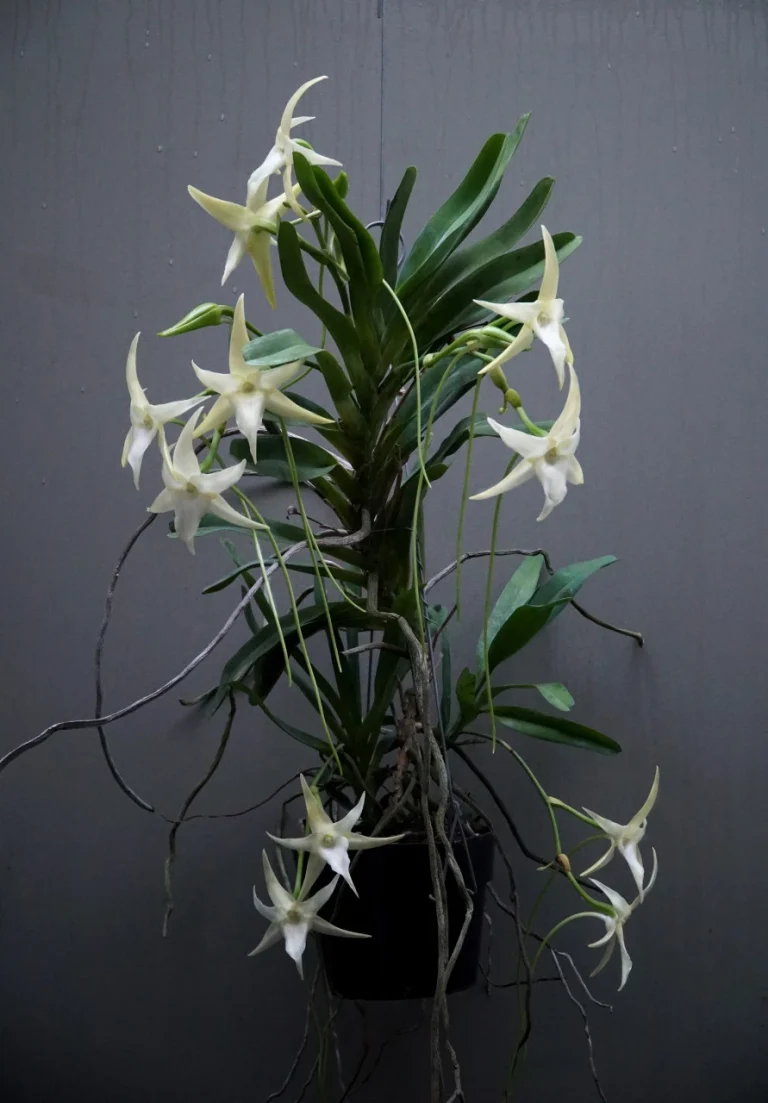
This orchid is an epiphytic subshrub with erect stems that become pendulous with age. Stems are somewhat flattened and bear two‑ranked, thick, fleshy, linear‑lanceolate leaves that are unequally bilobed at the apex. Leaves are spaced widely along the stem. The inflorescence is a short peduncle (2.5–4 cm) bearing one to two flowers. Flowers are approximately 2 cm across, white‑creamy, with a moderately long spur (length not specified). Blooming occurs in the late winter to early spring. These characters are taken from the IOSPE description [3] and summarized by Orchidroots [4].
Native Range and Habitat
The species is endemic to the northern and east‑northeastern parts of Madagascar, occurring at about 900 m elevation in wet tropical forest. It grows as an epiphyte on tree branches in the lower montane zone. This distribution is documented by Kew [1] and the IOSPE entry [3].
Species‑Specific Care
| Factor | Documented guidance | Source |
|---|---|---|
| Temperature | Warm‑growing; typical orchid greenhouse temperatures (around 20‑28 °C) are implied by the description “warm growing epiphyte”. | [3] |
| Light | Not documented; natural habitat suggests bright, filtered light. | Not documented |
| Watering | Not documented. | Not documented |
| Humidity | Not documented; native wet forest indicates high humidity. | Not documented |
| Mounting / Potting | Epiphytic habit suggests mounting on bark or growing in a well‑draining orchid mix; specific recommendations are not recorded. | Not documented |
| Fertilisation | Not documented. | Not documented |
| Seasonal change | Not documented; flowering occurs in late winter‑early spring in the wild. | [3] |
Because the plant is naturally an epiphyte from a humid, montane forest, growers generally treat it as a warm‑temperature epiphyte, providing good air flow and avoiding water‑logged media. Detailed watering schedules, fertilizer regimes, and rest periods have not been published for this species.
Flowering and Pollination
In its native habitat the plant produces flowers in late winter to early spring. Individual flowers are about 2 cm in diameter. No information on fragrance, nectar spur length, or pollinator identity is available in the cited sources.
Evidence and Limitations
Most morphological and ecological details are derived from brief horticultural descriptions (IOSPE, Orchidroots) and taxonomic databases (Kew, IPNI). Quantitative data on temperature ranges, watering, humidity, and pollination biology are absent, so cultivation advice is limited to the general “warm‑growing epiphyte” label. Further field studies would be needed to confirm pollinator relationships and precise micro‑climatic requirements.
Frequently asked questions
What temperature range does Angraecum moratii prefer in cultivation?
It is described as a warm‑growing epiphyte, indicating a preference for warm greenhouse temperatures (approximately 20‑28 °C). This is based on the IOSPE description [3].
When does Angraecum moratii flower in the wild?
Flowering occurs in late winter to early spring in its native northern Madagascar habitat, as noted by IOSPE [3].
FOLLOW THE EVIDENCE
Sources & references
- Angraecum moratii Bosser | Plants of the World Online | Kew Science – https://powo.science.kew.org/taxon/urn:lsid:ipni.org:names:616283-1
- Angraecum moratii | International Plant Names Index – https://www.ipni.org/n/616283-1
- IOSPE PHOTOS – Angraecum moratii – http://www.orchidspecies.com/angmoratii.htm
- Orchidroots – Angraecum moratii – https://orchidroots.com/display/summary/orchidaceae/9554/