At a glance
RECORDED PROFILE DATA- Scientific name
- Angraecum caulescens Thouars
- Name status
- Accepted
- Native region
- Comoros, Mauritius, Réunion
- Growth habit
- Epiphytic subshrub
- Cultivation temperature group
- Not documented
Names and Taxonomy
Angraecum caulescens Thouars is the accepted name for this species according to Kew’s Plants of the World Online [1]. It was first described in 1822 (Hist. Orchid.: Second Tabl. Esp.). The name has several homotypic synonyms, including Aerobion caulescens (Thouars) Spreng., Epidorkis caulescens (Thouars) Kuntze, Gomphocentrum caulescens (Thouars) Szlach., Mytnik & Grochocka, and Mystacidium caulescens (Thouars) Ridl. A heterotypic synonym recorded is Angorkis caulangis Thouars [1]. No common name is documented in the available sources.
How to Identify This Species
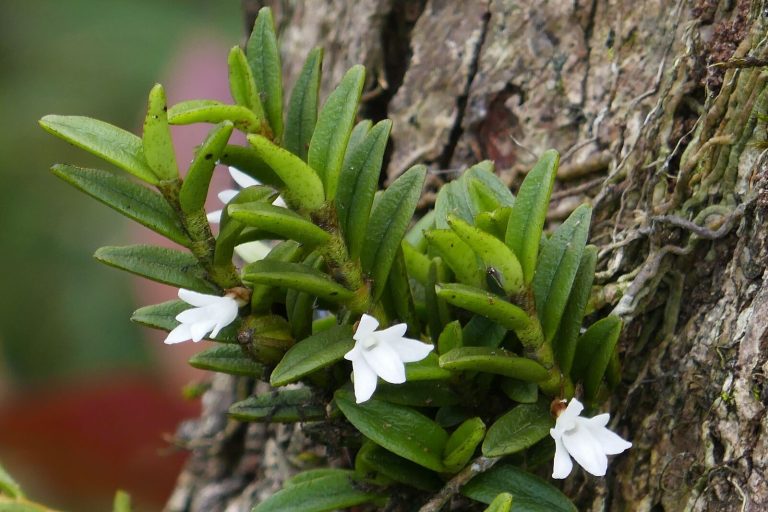
The plant is a small, erect, woody‑stemmed epiphyte (often described as a subshrub). Roots are greyish and elongated, typical of epiphytic orchids. Leaves are dark green, up to ten per plant, undulate, ligulate, narrowing toward the base and appearing petiolate; the apex is very unequally bilobed [2].
Flowering stems arise from the base of the leaves, unbranched, 8–12 cm long, bearing 3–5 flowers. Individual flowers are about 1/2 in (≈1.25 cm) across, white, with a modest nectar spur (size not specified). The inflorescence and flower size are given by IOSPE [2]. The species resembles other miniature Angraecums such as A. calceolus, but differs in having a single, unbranched inflorescence and smaller flowers.
Native Range and Habitat
According to Kew, Angraecum caulescens is native to the Comoros, Mauritius and Réunion, i.e., the western Indian Ocean islands [1]. It is described as an epiphytic subshrub that grows primarily in wet tropical forest biomes. A doubtful presence is noted for Rodrigues, but this is not confirmed [1]. Specific elevation limits are not provided in the sources.
Species‑Specific Care
| Factor | Documented guidance | Source |
|---|---|---|
| Growth habit | Epiphytic; can be mounted on bark or grown in a well‑draining orchid mix. | [2] |
| Light | Bright, indirect light; direct midday sun may be too intense. | [2] |
| Temperature | Warm to cool conditions; exact temperature range not documented. | [2] |
| Humidity | High humidity typical of wet tropical forests; maintain good air flow. | [2] |
| Watering | Water when the mounting medium or potting mix begins to dry; avoid prolonged dryness. | [2] |
| Fertilisation | Not documented; a balanced orchid fertilizer applied at reduced strength during growth is a common practice for related species. | Not documented |
| Repotting / remounting | Not documented; typical practice is to repot every 2–3 years or when roots outgrow the medium. | Not documented |
| Seasonal changes | Not documented; no specific rest period reported. | Not documented |
In cultivation the most reliable guidance comes from the IOSPE description, which emphasizes that the species is a “warm to cool growing epiphyte” and highlights its miniature size and preference for humid, well‑ventilated conditions [2]. Growers should therefore provide an environment that mimics wet tropical forest canopies: moderate to bright indirect light, high humidity, and steady but not excessive watering.

Flowering and Pollination
Flowering occurs in the late summer to early autumn in its native range, with inflorescences bearing 3–5 small white flowers each about 1.25 cm across [2]. The flowers are short‑lived (typical of many Angraecums) but the exact longevity is not documented. No pollinator observations are recorded for this species; pollination mechanisms remain unknown.
Evidence and Limitations
Most of the morphological and cultivation information derives from the IOSPE species page, which aggregates data from several historic floras and horticultural observations [2]. The native distribution is based on Kew’s Plants of the World Online [1]. Detailed data on elevation, precise temperature ranges, humidity values, and pollinators are not documented in the available sources, so recommendations are necessarily general and should be refined with field observations or specialist advice.
Frequently asked questions
What is the native habitat of Angraecum caulescens?
It is native to the Comoros, Mauritius and Réunion, where it grows as an epiphytic subshrub in wet tropical forest habitats. [1]
When does Angraecum caulescens flower?
Flowering is reported in late summer to early autumn, with small white flowers about 1.25 cm across. [2]
FOLLOW THE EVIDENCE
Sources & references
- Angraecum caulescens Thouars | Plants of the World Online | Kew Science, https://powo.science.kew.org/taxon/urn:lsid:ipni.org:names:616014-1
- IOSPE PHOTOS – Angraecum caulescens, https://www.orchidspecies.com/angcaulescens.htm