At a glance
RECORDED PROFILE DATA- Scientific name
- Angraecum peyrotii Bosser
- Name status
- Accepted
- Native region
- Madagascar
- Growth habit
- Epiphytic subshrub
- Cultivation temperature group
- Not documented
Names and Taxonomy
The accepted scientific name is Angraecum peyrotii Bosser, published in Adansonia n.s., 11: 32 (1989)【1†L1-L3】. Kew’s Plants of the World Online lists the name as accepted and records its native range as central Madagascar【1†L1-L4】. No synonyms or spelling variants are recorded in the consulted databases. A horticultural common name recorded in the IOSPE database is “Peyrot’s Angraecum”【3†L1-L3】.
How to Identify This Species
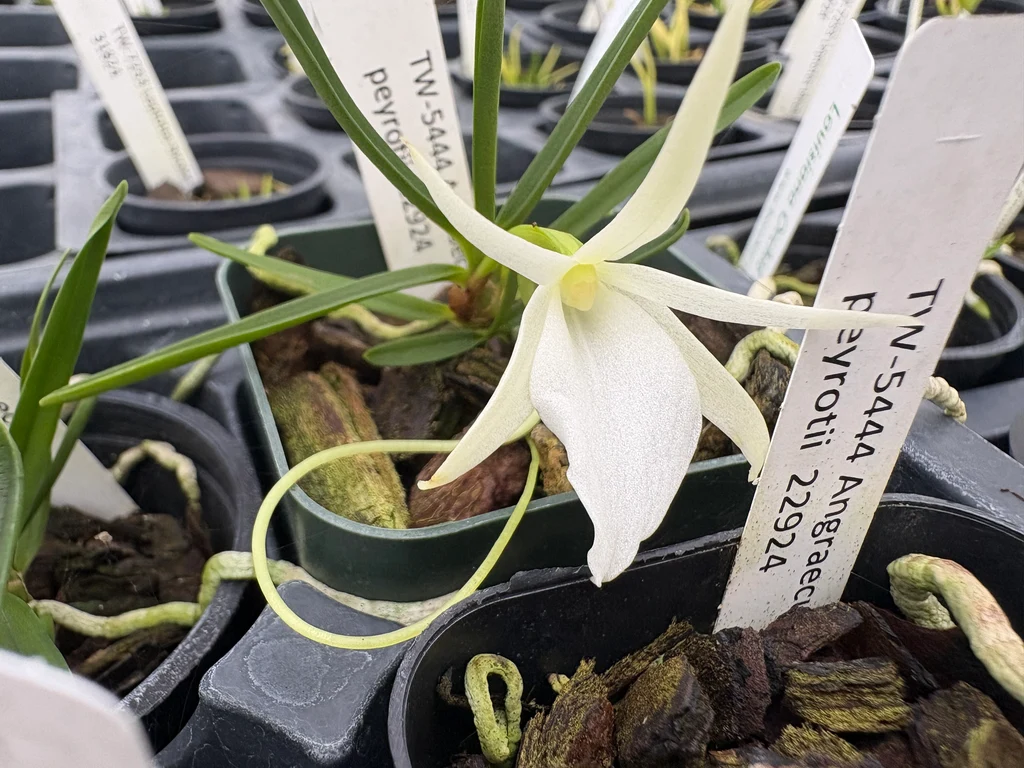
Growth habit. A short, robust epiphytic subshrub with a stem 5–6 cm long and 4–5 mm in diameter, bearing many smooth aerial roots【2†L1-L3】.
Leaves. Six to eight thick, semi‑cylindric leaves, concave on the upper surface, 10–12 cm long and 7–8 mm wide【2†L1-L3】. The leaves are a key field character, distinguishing it from the more slender‑leafed members of the genus.
Inflorescence. Single‑flowered, arising from an axillary peduncle 1–2 cm long that is completely sheathed in thin bracts. The bract is 15–18 mm long, shorter than the ovary【2†L1-L3】.

Flower. Large and fleshy. Sepals are narrowly triangular, 3.5–4.5 cm long and 5–8 mm wide; petals are similar but slightly smaller. The lip is broadly elliptic, 3.5–4 cm long and 2–2.5 cm wide, white in colour. The nectar spur is filiform, 10–15 cm long【2†L1-L3】. Sepals and petals are pale green, giving a subtle contrast to the white lip【3†L1-L3】.
Comparison. The species resembles Angraecum rutenbergianum but can be separated by its longer, very fleshy, semi‑cylindric leaves and a markedly longer spur. It also differs from A. didieri and A. elephantinum which have shorter, less robust leaves【3†L1-L3】.
Native Range and Habitat
Angraecum peyrotii is endemic to central Madagascar, occurring in the wet tropical biome of the island’s interior【1†L1-L4】. In the wild it grows as an epiphyte on tree trunks in shady, humid forest at elevations of roughly 1300–1500 m above sea level【2†L1-L3】. The species prefers the cool, moist microclimate provided by the forest canopy.
Species‑Specific Care
| Factor | Documented guidance | Evidence |
|---|---|---|
| Light | Prefers shaded or low‑to‑medium indirect light, reflecting its growth under forest canopy. | [2] |
| Humidity | High humidity is advisable, mimicking the wet tropical forest where it occurs. | [2] |
| Substrate | Mount on bark or use a very coarse, well‑draining orchid mix suitable for epiphytes. | [2] |
| Watering | Keep roots moist but allow rapid drying between waterings; avoid prolonged soggy conditions. | [2] |
| Fertilization | Not documented for this species. | Not documented |
| Temperature | Not documented; native elevation suggests a cool to intermediate range but no specific data are available. | Not documented |
| Seasonal rest | Not documented. | Not documented |
Because the species is an epiphyte from a humid, shaded forest, growers should prioritize good air circulation, consistent moisture, and protection from direct midday sun. Until more precise temperature or rest‑period data become available, treat it as a cool‑intermediate orchid and adjust based on plant response.
Flowering and Pollination
Flowering has been recorded in September in its native habitat【2†L1-L3】. Each plant produces a single flower of approximately 4 cm overall length, with a very long spur (10–15 cm) that is typical of moth‑pollinated Angraecum species. No specific pollinator has been documented for A. peyrotii, and fragrance has not been reported in the available sources.
Conservation and Responsible Cultivation
No formal conservation assessment (e.g., IUCN Red List category) was found for Angraecum peyrotii in the supplied references. The species’ restriction to a limited elevational band in central Madagascar suggests potential vulnerability to habitat loss, but further evaluation is required.
Evidence and Limitations
The profile is based on three primary online sources: Kew’s Plants of the World Online for nomenclature and distribution, a detailed species description on Africanorchids.dk, and the IOSPE photographic database. Key gaps include precise temperature requirements, fertilization regimes, pollinator identity, and formal conservation status. Future field studies and horticultural trials would be valuable to fill these gaps.
Frequently asked questions
What is the natural habitat of Angraecum peyrotii?
It is an epiphyte that grows on tree trunks in shady, humid forest at 1300–1500 m elevation in central Madagascar.
When does Angraecum peyrotii flower?
Flowering has been recorded in September in its native range.
How can I distinguish Angraecum peyrotii from similar Angraecum species?
A. peyrotii has thick, semi‑cylindric leaves 10–12 cm long and a very long (10–15 cm) filiform spur, whereas related species such as A. rutenbergianum have shorter leaves and a shorter spur.
FOLLOW THE EVIDENCE
Sources & references
- Angraecum peyrotii Bosser | Plants of the World Online | Kew Science, https://powo.science.kew.org/taxon/urn:lsid:ipni.org:names:937618-1
- Angraecum peyrotii – African Orchids, http://www.africanorchids.dk/?catid=299angraecum&id=1039angraecum-peyrotii&view=article
- IOSPE PHOTOS – Angraecum peyrotii, https://www.orchidspecies.com/angpeyrotii.htm

