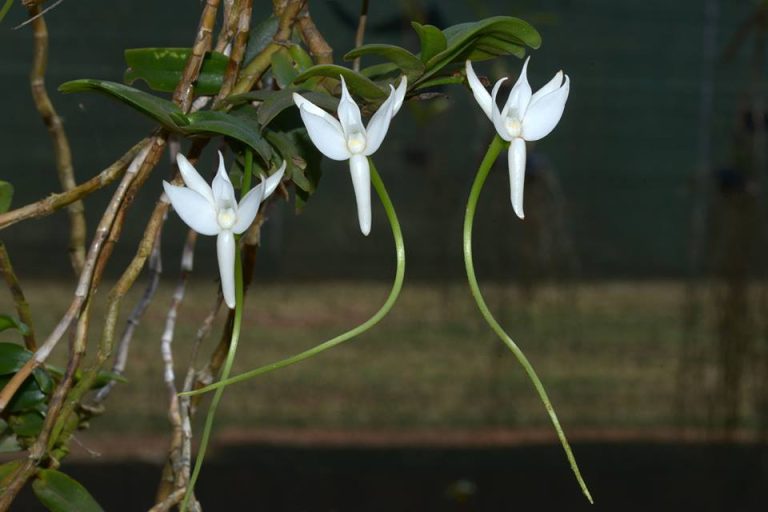
At a glance
RECORDED PROFILE DATA- Scientific name
- Angraecum corynoceras Schltr.
- Name status
- Accepted
- Native region
- Northern Madagascar
- Growth habit
- Epiphytic subshrub
- Cultivation temperature group
- Not documented
Names and Taxonomy
The accepted scientific name is Angraecum corynoceras Schltr. The name was first published in Repert. Spec. Nov. Regni Veg. Beih. 33: 345 (1925) and is listed as an accepted species by Kew’s Plants of the World Online.1 No synonyms or spelling variants are recorded in the consulted sources. Common names are not documented for this species.
How to Identify This Species
Plants are epiphytic subshrubs that typically reach about 30 cm in height.2 Leaves are arranged along a short stem, but detailed leaf morphology is not documented. The inflorescence bears one or a few flowers that are white to greenish‑white and emit a noticeable fragrance. Blooming has been reported throughout the year, suggesting a lack of strict seasonal trigger.2 Specific measurements of the labellum, spur length, or flower size are not provided in the available references, so identification should be confirmed with herbarium material or expert consultation.
Native Range and Habitat
The species is endemic to the northern part of Madagascar, occurring in the island’s wet tropical biome.1 In nature it grows as an epiphyte on trees within humid forest environments. Elevational limits and precise host tree preferences are not documented.
Species‑Specific Care
| Factor | Documented guidance | Source / notes |
|---|---|---|
| Growth habit | Epiphytic; can be mounted on bark or grown in a very coarse, well‑draining medium. | Derived from epiphytic habit noted in POWO and NativePlants.info.1,2 |
| Light | Not documented for this species. | — |
| Temperature | Not documented; northern Madagascar’s lowland forests are warm‑humid. | — |
| Watering | Not documented; epiphytic orchids generally require regular moisture without water‑logging. | — |
| Humidity | Not documented; native wet tropical habitat suggests high humidity. | — |
| Fertilisation | Not documented. | — |
| Repotting / mounting | Not documented; typical practice for small epiphytes is to refresh mount or medium every 2–3 years. | — |
| Seasonal changes | Not documented; flowering can occur year‑round. | NativePlants.info reports year‑round blooming.2 |
Because specific cultural requirements are not published for A. corynoceras, growers should start with general Angraecum epiphytic guidelines and adjust based on plant response. Maintaining good air circulation, avoiding prolonged dryness, and providing a mounting substrate that mimics tree bark are reasonable initial steps.
Flowering and Pollination
Flowers are reported to be fragrant and white to greenish‑white, with blooming observed in all months of the year.2 No study has documented the pollinator for this species, and pollination mechanisms remain unverified.
Evidence and Limitations
The profile relies on three online sources. Detailed morphological data (e.g., flower dimensions, spur length), precise ecological parameters (elevation range, host tree species), and species‑specific cultivation protocols are not documented in the consulted material. Further field studies or horticultural reports would be needed to fill these gaps.
Frequently asked questions
What is the native habitat of Angraecum corynoceras?
It is endemic to the northern part of Madagascar, where it grows as an epiphyte in wet tropical forest environments.
When does Angraecum corynoceras flower?
Flowering has been reported throughout the year, with no strict seasonal limitation.
FOLLOW THE EVIDENCE
Sources & references
- Angraecum corynoceras Schltr. | Plants of the World Online | Kew Science, https://powo.science.kew.org/taxon/urn:lsid:ipni.org:names:616046-1
- Angraecum corynoceras | NativePlants.info, https://www.nativeplants.info/plant/magnoliophyta-flowering-plants/orchidaceae/angraecum/angraecum_corynoceras.html
- List of Angraecum species, Wikipedia, https://en.wikipedia.org/wiki/List_of_Angraecum_species