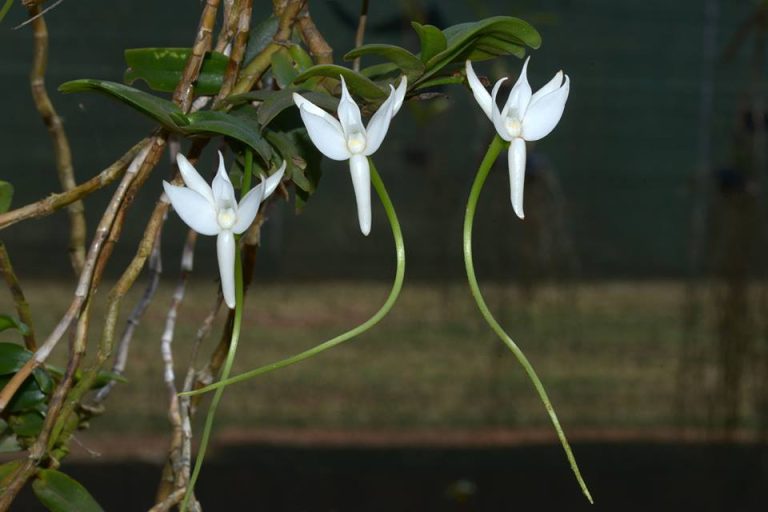
At a glance
RECORDED PROFILE DATA- Scientific name
- Angraecum trichoplectron (Rchb.f.) Schltr.
- Name status
- Accepted
- Native region
- Madagascar
- Growth habit
- Epiphytic subshrub
- Cultivation temperature group
- Not documented
Names and Taxonomy
The accepted scientific name for this orchid is Angraecum trichoplectron (Rchb.f.) Schltr.[1] The basionym was published as Aeranthes trichoplectron by Heinrich Gustav Reichenbach in 1888 and later transferred to Angraecum by Rudolf Schlechter in 1915.[2] Current taxonomic databases list the name as accepted and place it in the family Orchidaceae, subtribe Angraecinae.[1] Documented synonyms include:
- Aeranthes trichoplectron Rchb.f.
- Mystacidium trichoplectron (Rchb.f.) T.Durand & Schinz
- Pseudojumellea trichoplectron (Rchb.f.) Szlach., Mytnik & Grochocka
No common name has been recorded for this species in the consulted sources.[3]
How to Identify This Species
Published descriptions are limited to the taxonomic record. The species is recorded as an epiphytic subshrub, a growth form typical of many Angraecum orchids, growing on tree branches rather than in soil.[1] Detailed morphological characters such as leaf size, flower colour, lip shape, or spur length are not provided in the available excerpts, so reliable field identification must rely on herbarium specimens or specialist monographs that are not currently cited.
Because the genus contains many species with similar vegetative habit, identification without flower characters is uncertain. When flowers are available, comparison with the original description (Schlechter 1915) would be required.

Native Range and Habitat
Angraecum trichoplectron is endemic to Madagascar.[1] It occurs in the seasonally dry tropical biome, typically as an epiphyte on trees in forested areas that experience a marked dry season. Elevational limits are not specified in the sources consulted.
Species-Specific Care
| Factor | Documented guidance | Evidence |
|---|---|---|
| Growth medium | Not documented | — |
| Mounting vs. potting | Not documented | — |
| Temperature | Not documented | — |
| Light | Not documented | — |
| Watering | Not documented | — |
| Humidity | Not documented | — |
| Fertilisation | Not documented | — |
| Seasonal rest | Not documented | — |
Because no species‑specific cultivation reports were located, growers should treat this orchid with the general care guidelines used for other Madagascan Angraecum species, adjusting based on observed plant response. Until formal observations are published, any specific regimen remains speculative.
Flowering and Pollination
Information on flowering time, flower morphology, fragrance, nectar spur length, or pollinator interactions for Angraecum trichoplectron was not found in the supplied sources.[1][3] Consequently, these aspects are listed as not documented.
Evidence and Limitations
The profile relies on three online references: Kew’s Plants of the World Online, the PlantaeDB taxonomic entry, and a Swedish Wikipedia page generated by an automated bot. While these confirm the accepted name, native range, and synonymy, they provide little detail on morphology, ecology, or horticulture. Future work should consult the original protologue (Schlechter 1915) and field studies from Madagascar to fill the gaps identified above.
FOLLOW THE EVIDENCE
Sources & references
- Angraecum trichoplectron (Rchb.f.) Schltr. | Plants of the World Online | Kew Science, https://powo.science.kew.org/taxon/urn:lsid:ipni.org:names:616458-1
- Angraecum trichoplectron in Genus Angraecum | PlantaeDB, https://plantaedb.com/taxa/phylum/angiosperms/order/asparagales/family/orchidaceae/genus/angraecum/species/angraecum-trichoplectron
- Angraecum trichoplectron – Swedish Wikipedia, https://sv.wikipedia.org/wiki/Angraecum_trichoplectron