At a glance
RECORDED PROFILE DATA- Scientific name
- Angraecum clavigerum Ridl.
- Name status
- Accepted
- Native region
- Madagascar (central highlands)
- Growth habit
- Epiphytic subshrub, miniature (~30 cm tall)
- Cultivation temperature group
- Cool (highland) – Not documented precise range
Names and Taxonomy
Angraecum clavigerum Ridl. is the accepted name for this species according to Kew’s Plants of the World Online ([1]). It was first described in 1885 in the Journal of the Linnean Society, Botany (21: 485). Homotypic synonyms recorded include Angorkis clavigera (Kuntze), Angraecoides clavigera (Szlach., Mytnik & Grochocka) and Monixus claviger (Finet) ([1]). A common name noted in horticultural sources is the “Club‑Carrying Angraecum”, referring to the swollen tip of the floral spur ([4]).
How to Identify This Species
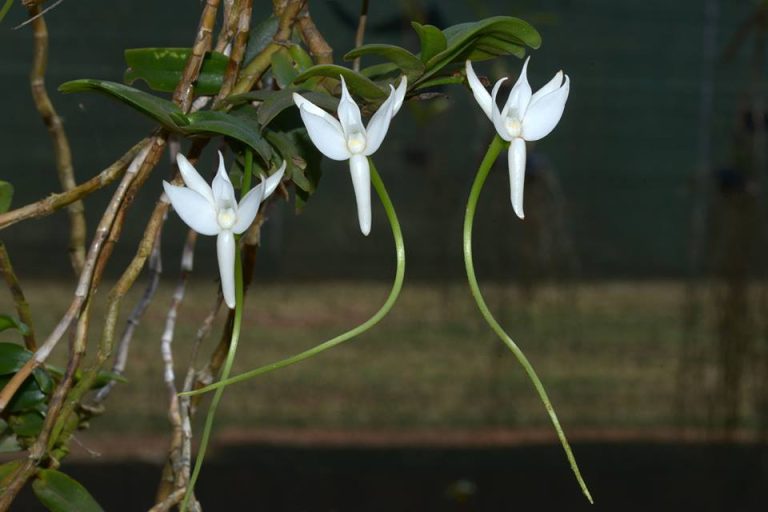
This is a miniature epiphytic subshrub reaching about 30 cm in height ([5]). Leaves are stiff, lingulate, 6‑12 in number, unequally bilobed at the apex and clasping the stem at the base ([4]). The plant produces a single flower on a short axillary inflorescence that is sheathed by two to three basal sheaths and an additional scarious bract ([4]).
The flower measures roughly 2.5 cm (1 inch) across, is white to green‑tinged, and emits a noticeable fragrance ([5]). A diagnostic feature is the markedly swollen, club‑shaped spur (“claviger” = “club‑bearing”) ([4]).
While other miniature Angraecum species may share leaf shape, the combination of a single flower, the clubbed spur, and the specific leaf bilobing helps separate A. clavigerum from look‑alikes such as A. madagascariense.

Native Range and Habitat
The species is endemic to Madagascar, occurring primarily in the central highlands of the island’s north‑ and east‑central region ([1]). It inhabits wet tropical, moss‑forest environments at elevations of 1,280–2,000 m ([4]). In the wild it grows as an epiphyte on tree trunks and branches, favouring humid, mist‑laden forest canopies.
Species‑Specific Care
| Factor | Documented Guidance | Source |
|---|---|---|
| Temperature | Cool‑growing; replicate highland conditions (cool nights, moderate days) | [4] |
| Light | Bright, filtered light similar to forest understory | Not documented |
| Water & Humidity | Maintain consistent moisture; high humidity typical of moss forests | Not documented |
| Substrate / Mounting | Epiphytic mounting on bark or a very well‑draining orchid mix | Not documented |
| Fertilisation | Balanced orchid fertilizer during active growth | Not documented |
| Rest Period | Not documented | Not documented |
Because the plant is described as a “cool growing epiphyte” in horticultural notes ([4]), growers should aim for night temperatures around 10‑15 °C and daytime temperatures not exceeding 22‑24 °C, while providing good air circulation and high humidity. Mounting on a piece of cork bark or using a coarse, well‑aerated medium will emulate its natural epiphytic habit.
Flowering and Pollination
Flowering has been reported throughout the year in cultivation ([5]), suggesting a lack of strict seasonal trigger. Flowers are short‑lived, fragrant, and possess a long spur that likely contains nectar, but specific pollinators have not been documented for this species.
Conservation and Responsible Cultivation
An IUCN Red List assessment for Angraecum clavigerum exists (published 2019) ([10]), but the conservation category (e.g., Least Concern, Endangered) is not provided in the available excerpt. Collectors should verify the current IUCN status and ensure that any material obtained complies with CITES regulations and local export permits.
Evidence and Limitations
Key aspects such as precise temperature ranges, watering frequency, and pollinator identity remain undocumented in the sources consulted. The care table therefore includes several “Not documented” entries, and growers are encouraged to treat the guidance as a starting point, adjusting based on plant response.
FOLLOW THE EVIDENCE
Sources & references
- Angraecum clavigerum Ridl. | Plants of the World Online | Kew Science (https://powo.science.kew.org/taxon/urn:lsid:ipni.org:names:616031-1)
- IOSPE PHOTOS – Angraecum clavigerum Ridl. 1885 (https://www.orchidspecies.com/angclavigerum.htm)
- Angraecum clavigerum (Angraecum clavigerum) | NativePlants.info (https://www.nativeplants.info/plant/magnoliophyta-flowering-plants/orchidaceae/angraecum/angraecum_clavigerum.html)
- Angraecum clavigerum: IUCN Red List of Threatened Species (https://doi.org/10.2305/iucn.uk.2021-1.rlts.t64593953a64613608.en)