At a glance
RECORDED PROFILE DATA- Scientific name
- Angraecum pumilio Schltr.
- Name status
- Accepted species
- Native region
- Madagascar
- Growth habit
- Epiphytic
- Cultivation temperature group
- Not documented
Names and Taxonomy
The accepted scientific name for this species is Angraecum pumilio Schltr. It was first described in Beih. Bot. Centralbl. 34(2): 337 (1916) [3]. A later synonym, Boryangraecum pumilio (Schltr.) Szlach., Mytnik & Grochocka, was published in 2013 [3]. Current online databases list Angraecum pumilio as an accepted name [1][2]. No common names were found in the consulted sources.
How to Identify This Species
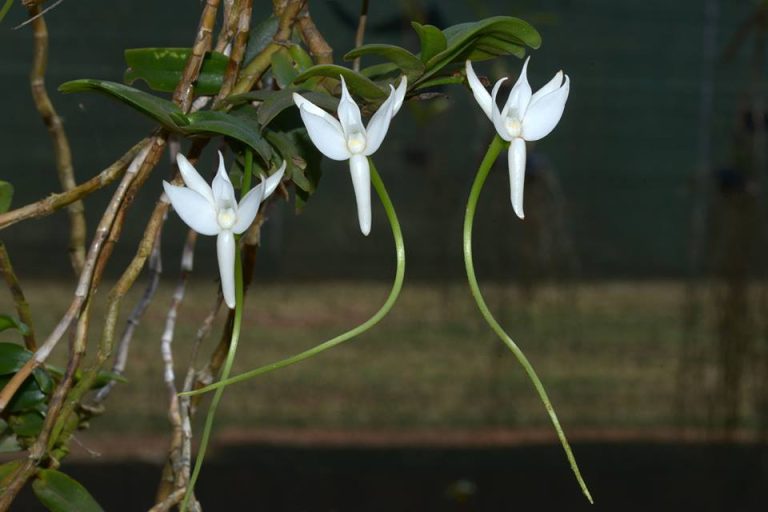
Field reports describe Angraecum pumilio as a diminutive epiphyte reaching about 30 cm in overall height [1]. The plant bears narrow, linear leaves typical of many Angraecum species, but detailed leaf measurements are not documented. Its flowers are white, fragrant, and reported to appear throughout the year [1]. No published dimensions of the flower, lip, or spur are available, and the shape of the nectar spur has not been described in the accessible literature. Consequently, identification in the wild relies on a combination of habit (small epiphyte), white fragrant flowers, and geographic location (Madagascar).
Potential look‑alikes include other small white‑flowered Angraecum species such as A. ambrense or A. amplexicaule, which share a similar size and coloration but differ in flower morphology that requires close examination of the lip and spur—details not provided for A. pumilio.
Native Range and Habitat
The species is endemic to Madagascar [1][2]. It grows as an epiphyte on tree trunks and branches, typical of many Angraecum orchids that inhabit humid forest canopies. Specific habitat types (e.g., lowland rainforest, montane forest) and elevation ranges have not been recorded for A. pumilio in the sources consulted. The island’s eastern slopes host the majority of Angraecum diversity, suggesting a preference for moist, shaded environments, but this remains an inference rather than a documented fact for this species.
Species‑Specific Care
| Factor | Documented guidance | Source |
|---|---|---|
| Growth habit | Epiphytic; can be mounted on bark or grown in a coarse, well‑aerated medium. | [1][2] |
| Light | Not documented; growers generally provide bright, filtered light for Angraecum spp. | [4] |
| Temperature | Not documented; many Madagascan Angraecum tolerate warm to intermediate conditions. | [4] |
| Humidity | Not documented; high humidity (≥70 %) is typical for Angraecum orchids. | [4] |
| Watering | Not documented; epiphytic orchids are watered when the medium dries slightly. | [4] |
| Fertilisation | Not documented; a balanced, diluted fertilizer applied during active growth is common practice for the genus. | [4] |
| Potting / Mounting | Epiphytic; can be mounted on cork bark, tree fern fibre, or placed in a shallow basket with bark chips. | [1] |
| Seasonal rest | Not documented. | – |
| Propagation | Seeds require symbiotic mycorrhizal fungi or sterile agar media; conventional cold stratification is not applicable. | [1] |
Because detailed horticultural data for A. pumilio are lacking, growers are advised to follow general Angraecum guidelines (bright filtered light, warm‑intermediate temperatures, high humidity, and good air circulation) while monitoring the plant’s response. Adjustments should be made based on growth and flowering performance.
Flowering and Pollination
The species produces white, fragrant flowers that can appear in any month of the year, indicating a non‑seasonal blooming pattern [1]. The fragrance suggests attraction of nocturnal pollinators, a common trait in Angraecum, but no specific pollinator (e.g., hawk‑moth) has been recorded for A. pumilio. Nectar spur length and pollination ecology remain undocumented.
Conservation and Responsible Cultivation
No formal conservation assessment (e.g., IUCN Red List) for Angraecum pumilio was found in the supplied sources. Madagascar’s forests face ongoing threats, so any collection from the wild should comply with national regulations and CITES provisions that cover the genus Angraecum. Ex situ cultivation using seed propagation under sterile conditions is recommended as a conservation‑friendly approach.
Evidence and Limitations
Most of the species‑specific information comes from a brief native‑plant database entry and a regional orchid list. Critical data such as precise flower measurements, elevation range, pollinator identity, and detailed horticultural requirements are not documented in the available sources. Consequently, the profile relies on general Angraecum knowledge where species‑level details are absent, and all such extrapolations are clearly identified as generic.
Frequently asked questions
Is Angraecum pumilio commonly cultivated?
Specific cultivation records are limited. Growers who attempt it usually apply general Angraecum care guidelines, but the species is not widely reported in horticultural literature.
What is the flowering period of Angraecum pumilio?
According to NativePlants.info, the plant can flower throughout the year, producing white fragrant blooms.
Can Angraecum pumilio be propagated from seed?
Yes, seed propagation requires symbiotic mycorrhizal fungi or sterile agar media; conventional cold stratification is not applicable.
FOLLOW THE EVIDENCE
Sources & references
- Angraecum pumilio | NativePlants.info, 2026, https://www.nativeplants.info/plant/magnoliophyta-flowering-plants/orchidaceae/angraecum/angraecum_pumilio.html
- Page A7 – Liste des orchidées de Madagascar, madaorchidee.free.fr, 2026, http://madaorchidee.free.fr/lesorchideesdemadagascar/pagesalphabetiques/pageA7.htm
- Angraecum pumilio – PlantaeDB, plantaedb.com, 2026, https://plantaedb.com/taxa/phylum/angiosperms/order/asparagales/family/orchidaceae/genus/angraecum/species/angraecum-pumilio
- Angraecum – American Orchid Society, aos.org, 2026, https://www.aos.org/explore/angraecum