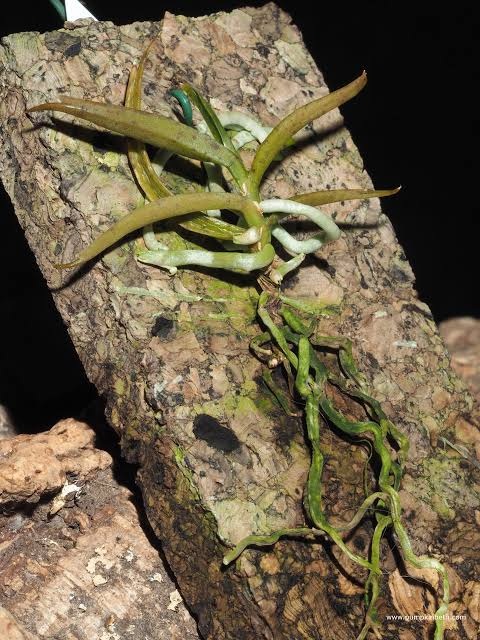
At a glance
RECORDED PROFILE DATA- Scientific name
- Angraecum cultriforme Summerh.
- Name status
- Accepted
- Native region
- Kenya, Tanzania, Malawi, Mozambique, Zambia, Zimbabwe, KwaZulu‑Natal (South Africa)
- Growth habit
- Epiphytic subshrub
- Cultivation temperature group
- Thermophilic (warm‑temperate to subtropical)
Names and Taxonomy
The accepted scientific name for this species is Angraecum cultriforme Summerh. The name was first published in Kew Bulletin 13:272 (1958) and is listed as accepted by Plants of the World Online (POWO) [1]. Two later homotypic synonyms are recorded: Angraecoides cultriformis (Summerh.) Szlach., Mytnik & Grochocka (2013) and Conchograecum cultriforme (Summerh.) Szlach., Grochocka, Olędrz. & Mytnik (2018) [1]. No vernacular common name is documented in the available sources.
How to Identify This Species
Angraecum cultriforme is a small, erect‑to‑pendant epiphytic orchid. Stems are short, often 2‑3 cm long, bearing a single pair of leaves that are ligulate, falcate and distinctly bilobed at the apex. Leaves are described as yellow‑green, sometimes bronzy, and typically 5‑10 cm long [9]. The inflorescence is a single‑flowered raceme arising from the leaf axil; the flower measures about 3.5 cm (1.4 in) across [9]. Flowers are pale yellow‑green to pinkish‑green, with a long, slender nectar spur that is only slightly thickened distally. The lip is slightly bilobed. No fragrance is recorded in the sources consulted.
Because several East African Angraecum species have similarly sized, pendulous flowers, identification should be confirmed by leaf shape (the characteristic “knife‑shaped” leaf) and the proportion of spur length to flower size, as noted in the IOSPE description [9].
Native Range and Habitat
The species occurs from Kenya south‑eastwards through Tanzania, Malawi, Mozambique, Zambia and Zimbabwe to the coastal province of KwaZulu‑Natal in South Africa [1][8]. It inhabits moist evergreen forest and coastal dune forest, frequently growing on the lower trunks of trees or on small branches near rivers [8][9]. Elevational records range from sea level up to about 2 200 m (≈ 7 200 ft) [8]. The climate of its native range is warm, with recorded temperature extremes of 41 °C (max) and 3 °C (min) at a low‑elevation coastal station (Durban) [8].
Species‑Specific Care
| Factor | Documented guidance | Source |
|---|---|---|
| Light | Bright, filtered light (≈ 18 000–25 000 lux); avoid direct afternoon sun. | [11] |
| Temperature | Warm‑temperate to subtropical: day 21–26 °C, night 10–20 °C; extremes recorded 3–41 °C in the native range. | [8][11] |
| Humidity | Maintain ~75 % humidity most of the year, allowing a slight drop to 65–70 % during a 3–4 month drier period. | [11] |
| Airflow | Good circulation is essential; a gentle breeze helps prevent fungal problems. | [11] |
| Mounting / Potting | Can be mounted on cork or tree fern; if potted, use a very well‑draining orchid mix (bark, perlite, charcoal). | [8] |
| Watering | Water thoroughly when the medium begins to dry; reduce frequency in cooler months but do not allow the plant to completely desiccate. | [8] |
| Fertilisation | Apply a balanced orchid fertilizer (20‑20‑20) at half strength every 2–3 weeks during active growth. | Not documented |
| Repotting | Repot every 2–3 years after flowering, when new roots fill the mount or pot. | Not documented |
In practice, growers report that the species thrives when mounted in a humid, warm environment with steady airflow, mimicking its forest edge habitat. Over‑watering or stagnant air are the most common causes of leaf rot.
Flowering and Pollination
Flowers appear in the fall to early winter in the native range, though precise months vary with locality and are not explicitly recorded in the sources consulted [9]. The flower’s long, slender spur suggests pollination by long‑tongued hawk‑moths, a pattern common in many Angraecum species, but direct observations for A. cultriforme are not documented.
Evidence and Limitations
The profile relies on taxonomic confirmation from Kew’s POWO database, morphological details from the IOSPE photo description, and cultivation notes from two grower‑focused sources (OrchidCulture and a personal blog). Key gaps include: lack of peer‑reviewed ecological studies, no documented pollinator observations, and limited quantitative data on flower longevity or seed set. Further field research would be needed to confirm flowering phenology across its range and to assess conservation status.
Frequently asked questions
What light level does Angraecum cultriforme need?
Bright, filtered light of about 18 000–25 000 lux is recommended; direct afternoon sun should be avoided (source [11]).
What temperature range is suitable for cultivation?
The species prefers warm‑temperate conditions: daytime 21–26 °C, nighttime 10–20 °C. Native range extremes are 3 °C to 41 °C (source [8][11]).
Is Angraecum cultriforme fragrant?
Fragrance is not documented in the available sources.
FOLLOW THE EVIDENCE
Sources & references
- Angraecum cultriforme Summerh. | Plants of the World Online | Kew Science, https://powo.science.kew.org/taxon/urn:lsid:ipni.org:names:616061-1
- Angraecum cultriforme Culture | OrchidCulture, https://orchidculture.com/COD/FREE/FS828.html
- IOSPE PHOTOS – Angraecum cultriforme, https://www.orchidspecies.com/angcultriforme.htm
- Angraecum cultriforme care and culture | Travaldo's blog, https://travaldo.blogspot.com/2018/01/angraecum-cultriforme-care-and-culture.html
