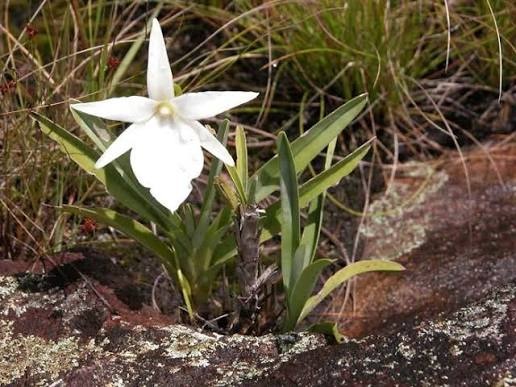
At a glance
RECORDED PROFILE DATA- Scientific name
- Angraecum protensum Schltr.
- Name status
- Accepted in POWO; homotypic synonym Perrierangraecum protensum
- Native region
- Central and South-Central Madagascar (POWO); Itremo region emphasized by Kew
- Growth habit
- Lithophytic subshrub; occasional semiterrestrial among rocks
- Cultivation temperature group
- Cool growing (IOSPE); numerical thresholds not documented
- Plant size
- Small sized (IOSPE); exact dimensions not documented
- Flower size
- 6–7 cm across
- Inflorescence
- 16–20 cm long, 1–2 flowers
- Flower color and fragrance
- White; sweetly fragrant; long-lasting
- Habitat elevation
- About 1550–2000 m
Angraecum protensum Schltr. is a small Madagascan orchid accepted by Plants of the World Online [1]. It is documented as a lithophytic subshrub from Central and South-Central Madagascar, with white, sweetly fragrant, long-lasting flowers [1][2][3]. Species-specific cultivation information is sparse: the available sources describe it as cool growing but do not give numerical temperature, light, watering, or potting protocols [3]. The parenthetical ‘SE Madagascar’ in the requested title is not supported by the Kew distribution summary used here and should be treated as needing review [1].
Names and Taxonomy
The accepted scientific name in the supplied Kew POWO treatment is Angraecum protensum Schltr. [1]. POWO gives the first publication as Repert. Spec. Nov. Regni Veg. Beih. 33: 358 (1925) [1]. The same treatment accepts the species and places its native range in Madagascar [1].
The principal homotypic synonym is Perrierangraecum protensum (Schltr.) Szlach., Mytnik & Grochocka, published in Biodivers. Res. Conservation 29: 20 (2013) [1]. A homotypic synonym is based on the same type and does not represent a separate species. No infraspecific taxa are documented in the supplied excerpts.
The common name ‘The Extended Angraecum’ appears in Smithsonian Gardens and IOSPE records [2][3]. IOSPE notes that the name may refer to the reed-like stem [3]; this is an explanatory note, not a formal nomenclatural statement. The requested title includes ‘SE Madagascar’, but the Kew POWO summary gives Central and South-Central Madagascar [1]. Because those statements do not agree, the parenthetical is not repeated here as a verified distribution claim.
How to Identify This Species
Documented habit: A. protensum is a small-sized orchid [3] recorded as a lithophytic subshrub [1] and as an occasional semiterrestrial among rocks [3]. The stem is described as stiff and reed-like, enveloped by dry leaf sheaths [3]. Leaves are light green, slightly unequally bilobed, with a prominent midrib, and are held in a fan-shaped arrangement [3]. Root details and exact vegetative dimensions are not documented in the supplied excerpts.
The inflorescence is axillary, 16–20 cm long, and carries one or two flowers [2][3]. Flowers are white, 6–7 cm across, long-lasting, and sweetly fragrant [2][3]. These are the most useful supported floral characters for checking a candidate plant. The supplied sources do not give lip or spur measurements, and they do not provide a full floral description; those characters should not be inferred from other Angraecum species.
Identification from a label or photograph alone is limited. A cultivated accession may lack wild provenance, as in the Smithsonian Gardens record [2], and a name on a label is not proof of identity. Confirmation should rely on flowers and vegetative characters together, with locality data treated separately from identification. No species-specific look-alike comparison is documented in the supplied evidence.
Native Range and Habitat
POWO gives the native range as Central and South-Central Madagascar [1]. Smithsonian Gardens also gives C and SC Madagascar [2], while IOSPE describes it from east central Madagascar at about 1550–2000 m elevation [3]. Smithsonian Gardens records the habitat as dry tropical forests at 5085–6560 ft (1550–2000 m) [2], and POWO places the species in the seasonally dry tropical biome [1].
A Kew conservation article states that Angraecum protensum and A. coutrixii are found only in the Itremo region [4]. That is a narrower statement than the POWO range summary [1]. The supplied excerpts do not explain whether the difference reflects sampling, taxonomic interpretation, or the scope of the Kew article. Both statements should be reported as source-specific rather than averaged into a single precise map.
In habitat, the species is documented on rock as a lithophyte and occasionally as a semiterrestrial among rocks [1][3]. The supplied sources do not document host trees, root-zone chemistry, or microhabitat measurements. Native occurrence in Madagascar is not evidence of naturalized occurrence elsewhere, and no introduced records are supplied.
Species-Specific Care
Care evidence for this species is limited. The table separates documented statements from missing information; it does not convert native elevation into greenhouse setpoints.
| Factor | Documented guidance | Evidence or context |
|---|---|---|
| Temperature | Described as cool growing; no numerical day/night or seasonal temperature ranges documented. | IOSPE [3]. The label is a cultivation descriptor, not a threshold. |
| Light | Not documented. | No species-specific light data in the supplied sources. |
| Watering | Not documented. | No watering schedule or dry rest documented for this species. |
| Humidity and airflow | Not documented. | No species-specific humidity or airflow values supplied. |
| Potting or mounting | Habitat is lithophytic, with occasional semiterrestrial growth among rocks; no pot, mount, or medium recommendation documented. | POWO [1]; IOSPE [3]. |
| Feeding | Not documented. | No species-specific fertilizer data supplied. |
| Repotting | Not documented. | No species-specific repotting interval or root disturbance guidance supplied. |
| Seasonal changes | Bloom recorded September–October in the Northern Hemisphere for a Smithsonian Gardens accession [2]; IOSPE gives late spring and summer [3]. No rest period is documented. | Bloom timing is source- and context-dependent; the sources do not define the same growing context. |
The only explicit cultivation temperature descriptor in the supplied evidence is ‘cool growing’ from IOSPE [3]. That source does not give day, night, summer, or winter thresholds, so the label should not be expanded into invented numbers. The Smithsonian Gardens record documents a cultivated plant of unknown wild origin [2]; it shows that the species is held in cultivation but does not provide a complete cultural protocol.
Because water, light, humidity, airflow, feeding, and repotting are not documented for A. protensum, a grower should not assume that care used for better-known Angraecum species applies unchanged. The habitat record—rock substrate and occasional semiterrestrial growth among rocks [1][3]—is ecological context, not a potting recipe. Any practical culture regime would need to be built from locally observed results and clearly labeled as grower experience, which the supplied sources do not provide.
Flowering and Pollination
The inflorescence is 16–20 cm long and bears one or two white flowers [2][3]. Flowers are 6–7 cm across, long-lasting, and sweetly fragrant [2][3]. The Smithsonian Gardens record gives a bloom time of September to October in the Northern Hemisphere for its cultivated accession [2]. IOSPE gives late spring and summer [3]. The supplied excerpts do not state whether the IOSPE months refer to Madagascar, a Northern Hemisphere greenhouse, or another context, so the two records should not be merged into a single year-round calendar.
Smithsonian Gardens lists the pollination syndrome as ‘Likely moth’ [2]. A pollination syndrome is a set of floral traits associated with a pollinator group; it is not a recorded pollinator observation. No specific moth species, visitation record, nectar-spur measurement, or fragrance timing is documented for A. protensum in the supplied evidence. The sweet fragrance is reported [2], but whether it is strongest at night is not documented.
Conservation and Responsible Cultivation
No formal conservation assessment for A. protensum is stated in the supplied excerpts. POWO includes an IUCN Categories source in its page structure, but the excerpt used here does not give a status [1]. A Kew article discusses Madagascan orchid conservation and states that A. protensum and A. coutrixii are found only in the Itremo region [4]. The same article describes restricted Madagascan orchids as vulnerable to habitat loss, notes slash-and-burn agriculture, and reports fire damage observed on rocky ridges during field studies [4]. Those are conservation concerns, not a formal species assessment.
Legal or CITES appendix status is not documented in the supplied excerpts. A nursery listing or cultivated accession should not be treated as proof of legal provenance without separate documentation. Because the species is reported from a restricted area in at least one source [4], provenance records are useful for responsible cultivation and for keeping ex situ material clearly identified.
Evidence and Limitations
This profile is based on supplied search snippets and short records, not on full-page or full-paper verification. Material gaps include a complete morphological description, lip and spur measurements, root characters, exact plant dimensions, a formal conservation assessment, a documented pollinator, and a species-specific cultivation protocol. The distribution statements conflict in scope: the requested ‘SE Madagascar’ wording is not supported by the POWO summary [1], and the Kew article’s Itremo-only statement [4] is narrower than POWO’s Central and South-Central Madagascar range [1]. Bloom months also differ by source and context [2][3]. The draft is not botanically reviewed and should not be treated as a verified publication.
Frequently asked questions
Is Angraecum protensum an accepted species?
Yes. Plants of the World Online accepts Angraecum protensum Schltr.; Perrierangraecum protensum is a homotypic synonym [1].
Where is Angraecum protensum native?
POWO gives Central and South-Central Madagascar. A Kew conservation article emphasizes the Itremo region, while the requested 'SE Madagascar' wording is not supported by the POWO summary used here [1][4].
What temperature should Angraecum protensum be grown at?
IOSPE describes it as cool growing, but no numerical day/night or seasonal temperature ranges are documented in the supplied sources. Native elevation should not be converted directly into greenhouse setpoints [3].
When does Angraecum protensum bloom?
Smithsonian Gardens records September–October in the Northern Hemisphere for a cultivated accession; IOSPE gives late spring and summer. The sources do not share the same growing context [2][3].
What pollinates Angraecum protensum?
No specific pollinator is documented in the supplied evidence. Smithsonian Gardens lists the pollination syndrome as 'Likely moth', which is a hypothesis based on floral traits rather than a recorded visitor [2].
Related terminology
- Lithophyte
- A plant that grows on rocks, using rock surfaces rather than soil as its substrate.
- Homotypic synonym
- A synonym based on the same type specimen and original name.
- Pollination syndrome
- A suite of floral traits associated with a particular pollinator group; it is not proof of the actual pollinator.
FOLLOW THE EVIDENCE
Sources & references
- [1] Plants of the World Online: Angraecum protensum Schltr. Royal Botanic Gardens, Kew. https://powo.science.kew.org/taxon/urn:lsid:ipni.org:names:616351-1
- [2] Smithsonian Gardens: Angraecum protensum. Smithsonian Gardens. https://gardens.si.edu/collections/explore/object/ofeo-sg_2021-0767A
- [3] IOSPE PHOTOS: Angraecum protensum Schltr. 1925. Internet Orchid Species Photo Encyclopedia. http://www.orchidspecies.com/angprotensum.htm
- [4] Mycorrhizal research supports orchid conservation in Madagascar. Royal Botanic Gardens, Kew. https://www.kew.org/read-and-watch/mycorrhizeal-research-madagascar

