At a glance
RECORDED PROFILE DATA- Scientific name
- Angraecum platycornu Hermans, P.J.Cribb & Bosser
- Name status
- Accepted
- Native region
- Madagascar (northeastern)
- Growth habit
- Epiphytic subshrub, pendent
- Cultivation temperature group
- Not documented
Names and Taxonomy
Angraecum platycornu Hermans, P.J.Cribb & Bosser is the accepted name for this species according to Kew’s Plants of the World Online[1]. It was first described in Orchid Review 110: 22 (2002)[1][2]. The International Plant Names Index records the protologue and the type specimen collected on the Masoala Peninsula at 635 m elevation[2]. No synonyms or spelling variants are documented. A common name reported in horticultural literature is “Broad Spur”[6].
How to Identify This Species
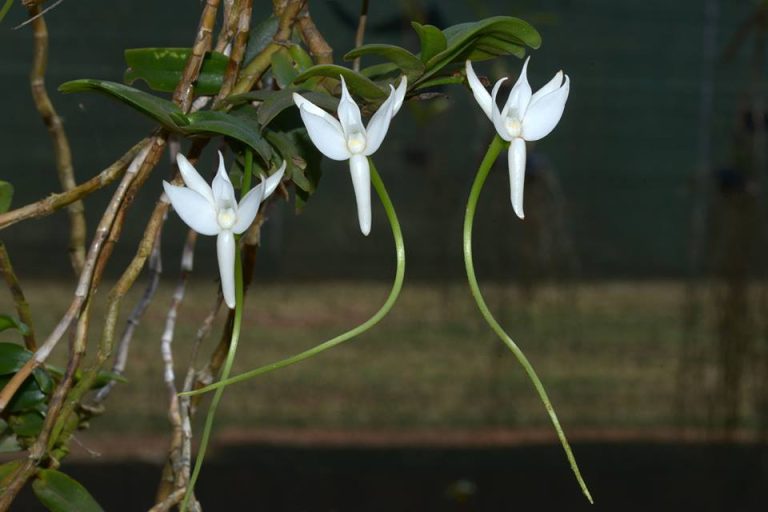
Angraecum platycornu is a small, pendent epiphytic subshrub typically reaching about 30 cm in height[8]. The stem is thin and elongate, bearing narrowly linear, acute leaves that are also thin and spaced along the stem[6]. The plant produces a single flower on an axillary, short inflorescence that emerges in early winter in the wild[6] (though other observations note year‑round blooming[8]).
The flower is white to greenish‑white, fragrant, and characterized by a relatively broad nectar spur – the feature that inspired the epithet “platycornu” (broad horn)[6]. Precise flower dimensions are not provided in the available sources. The combination of a slender pendent habit, linear leaves, and a single white flower with a broad spur distinguishes it from other Angraecum species, though overlap with other miniature Angraecums can occur.
Native Range and Habitat
The species is endemic to the northeastern part of Madagascar, occurring in humid lowland forest on the Masoala Peninsula[1][2]. It grows as an epiphyte on tree trunks or branches within the wet tropical biome[1]. The type locality is recorded at 635 m altitude on the west coast of Masoala overlooking Antongil Bay[2], indicating a preference for mid‑elevation forest edges. No introduced or cultivated wild populations are documented.

Species‑Specific Care
| Factor | Documented guidance | Evidence |
|---|---|---|
| Growth habit | Mount as a pendent epiphyte; bark or tree‑fern slab is suitable. | IOSPE description of pendent epiphyte[6] |
| Temperature | Hot to warm conditions preferred. | IOSPE notes “hot to warm growing”[6] |
| Light | Not documented. | — |
| Watering | Not documented. | — |
| Humidity | Not documented, but native humid forest suggests high humidity. | Inference from habitat, not a direct source. |
| Fertilisation | Not documented. | — |
| Seasonal change | Not documented; wild reports of early‑winter flowering[6] and year‑round blooming[8] indicate possible flexibility. | IOSPE and NativePlants.info[6][8] |
In practice, growers should treat this species as a warm‑temperature epiphyte, mounting it on a well‑aerated bark medium and providing ample airflow. Because specific watering and fertilisation regimes are not recorded, a moderate, regular watering schedule akin to other warm‑growing Angraecums can be tried, monitoring for signs of rot.
Flowering and Pollination
Flowering has been reported in early winter in its natural habitat[6] and, alternatively, as occurring throughout the year[8]. The flower is fragrant, a trait common in many Angraecum species, but the exact scent profile is not detailed. A 2015 article in Curtis’s Botanical Magazine discusses the pollination biology of this species, though the snippet does not provide specifics[4]; thus, the pollinator identity remains undocumented.
Conservation and Responsible Cultivation
An IUCN Red List entry for Angraecum platycornu exists (2021) but the retrieval snippet does not disclose its threat category[9]. Consequently, the formal conservation status cannot be stated here. Cultivation from seed or division should follow CITES regulations applicable to Orchidaceae and respect Madagascar’s biodiversity protection laws.
Evidence and Limitations
This profile relies on a limited set of online snippets. Detailed morphological measurements, precise flowering phenology, pollinator observations, and comprehensive cultural protocols are not documented in the available sources. Future field studies and horticultural trials are needed to fill these gaps.
Frequently asked questions
What is the common name of Angraecum platycornu?
The horticultural name “Broad Spur” is recorded for this species[6].
Is Angraecum platycornu fragrant?
Yes, the species is described as fragrant in both the IOSPE entry and NativePlants.info[6][8].
How tall does Angraecum platycornu grow?
Plants reach about 30 cm in height in cultivation[8].
FOLLOW THE EVIDENCE
Sources & references
- Angraecum platycornu Hermans, P.J.Cribb & Bosser | Plants of the World Online | Kew Science – https://powo.science.kew.org/taxon/urn:lsid:ipni.org:names:20003462-1
- Angraecum platycornu | International Plant Names Index – https://www.ipni.org/n/20003462-1
- IOSPE PHOTOS Angraecum platycornu – http://www.orchidspecies.com/angplatycornu.htm
- Angraecum platycornu – NativePlants.info – https://www.nativeplants.info/plant/magnoliophyta-flowering-plants/orchidaceae/angraecum/angraecum_platycornu.html
- 809. ANGRAECUM PLATYCORNU Curtis’s Botanical Magazine – https://doi.org/10.1111/curt.12101
- Angraecum platycornu: IUCN Red List of Threatened Species – https://doi.org/10.2305/iucn.uk.2025-1.rlts.t68501411a68702419.en