At a glance
RECORDED PROFILE DATA- Scientific name
- Angraecum falcifolium Bosser
- Name status
- Accepted
- Native region
- South‑central Madagascar
- Growth habit
- Epiphytic subshrub
- Cultivation temperature group
- Cool (described as cold‑growing)
Names and Taxonomy
The accepted scientific name is Angraecum falcifolium Bosser, first published in Adansonia 10:104 (1970) and recognised as accepted by Kew’s Plants of the World Online [1]. A later homotypic synonym is Lemurangis falcifolia (Bosser) Szlach., Mytnik & Grochocka (2013) [2]. The species is occasionally called “Sickle‑shaped leaf Angraecum” in horticultural sources [2].
How to Identify This Species
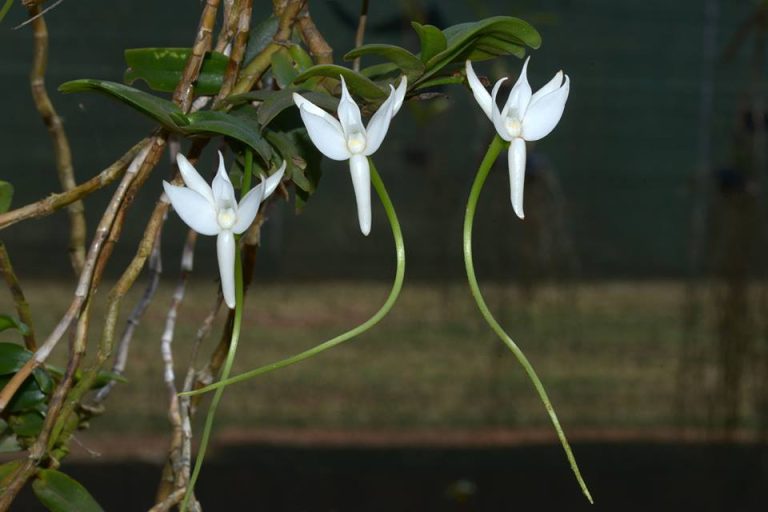
Growth habit. A small epiphytic subshrub that forms long, flattened, branching stems and grows on tree branches in forest canopies [1][2].
Leaves. Leaves are arranged in two ranks, imbricate, and are very distinctive – folded along the midline, falcate (sickle‑shaped) to recurved, amplexicaul, and apically bilobed. The leaves are described as “very distinctive, folded along the midline, compressed, oval‑oblong” [2].
Flowers. The inflorescence is axillary, up to about 1.5–1.8 cm long, bearing 3–5 small green flowers. Flowers are supported by a triangular floral bract that is shorter than the ovary. The lip is not described in detail, but the overall flower is modest in size and colour [2].
Size. The plant is described as a medium‑sized orchid; precise plant height is not documented, but the stems are long and flattened.
These characters together—especially the falcate, bilobed leaves—help separate A. falcifolium from other Angraecum species that have more linear or broader leaves.
Native Range and Habitat
The species is endemic to south‑central Madagascar. It occurs in shady, high‑elevation forests on the eastern side of the island, within a wet tropical biome [1][2]. In its natural setting the orchid grows as an epiphyte on tree trunks and large branches, favouring humid, cool montane conditions.
Species‑Specific Care
| Factor | Documented guidance | Source |
|---|---|---|
| Temperature | Cool‑growing; prefers lower night temperatures typical of montane forest (≈10‑15 °C). Described as “cold growing” in horticultural notes. | [2] |
| Light | Bright, indirect light or deep shade; native habitat is shady forest understory. | [2] |
| Water | Keep the medium consistently moist; the species originates from a wet tropical biome. | [1] |
| Humidity | High humidity (≥70 %). | [1] |
| Substrate / Mounting | Best grown mounted on bark or in a very well‑draining epiphytic mix (e.g., coarse bark, charcoal, perlite). | [2] |
| Fertiliser | Balanced, water‑soluble fertilizer at half strength applied during active growth (spring‑autumn). | [2] |
| Seasonal change | Not documented; growers should mimic the natural cool, moist summer and slightly drier winter. | Not documented |
Because the orchid is described as “cold‑growing” and originates from high‑elevation, humid forests, growers should aim for cooler night temperatures, avoid direct midday sun, and provide abundant airflow to prevent fungal problems. Mounting the plant allows the roots to dry quickly between waterings, which matches its epiphytic habit.
Flowering and Pollination
In the wild the plant flowers in the summer months of the southern hemisphere (approximately November–January) [2]. The inflorescence bears three to five small green flowers, each about 1.5–1.8 cm long. No fragrance is mentioned in the available sources, and specific pollinators have not been documented for this species.
Evidence and Limitations
Most of the morphological and ecological information comes from the IOSPE species page and Kew’s Plants of the World Online. Detailed measurements of plant height, leaf length, and pollinator observations are not available in the cited sources. Cultivation recommendations are based on the brief “cold‑growing” note and the description of its native wet, cool forest environment; growers should treat these as starting points and adjust based on observed plant response.
Frequently asked questions
What temperature range does Angraecum falcifolium prefer?
The species is described as a cold‑growing orchid, indicating a preference for cooler night temperatures typical of montane forests (about 10‑15 °C). This is based on the horticultural description that calls it “cold growing” [2].
When does Angraecum falcifolium flower?
In its native habitat the orchid flowers in the summer season of the southern hemisphere, roughly November to January, as reported in the IOSPE species account [2].
Is pollination information available for this species?
No specific pollinator has been documented for Angraecum falcifolium. The available sources only describe flower morphology and flowering time.
FOLLOW THE EVIDENCE
Sources & references
- Angraecum falcifolium Bosser | Plants of the World Online | Kew Science, https://powo.science.kew.org/taxon/urn:lsid:ipni.org:names:616116-1
- IOSPE PHOTOS – Angraecum falcifolium, https://www.orchidspecies.com/angfalcifolium.htm