At a glance
RECORDED PROFILE DATA- Scientific name
- Angraecum panicifolium H.Perrier
- Name status
- Accepted (Kew POWO)
- Native region
- Madagascar (eastern‑central)
- Growth habit
- Epiphytic subshrub
- Cultivation temperature group
- Not documented
Names and Taxonomy
The accepted scientific name is Angraecum panicifolium H.Perrier, first published in Notulae Systematicae (Paris) 7:105 (1938) [1]. Kew’s Plants of the World Online lists the name as accepted and places the species in the family Orchidaceae, subtribe Angraecinae. A later homotypic synonym is Angraecoides panicifolia (H.Perrier) Szlach., Mytnik & Grochocka (2013) [2]. No other common names are recorded beyond the provisional “? Leaved Angraecum” noted in an orchid species database [2].
How to Identify This Species
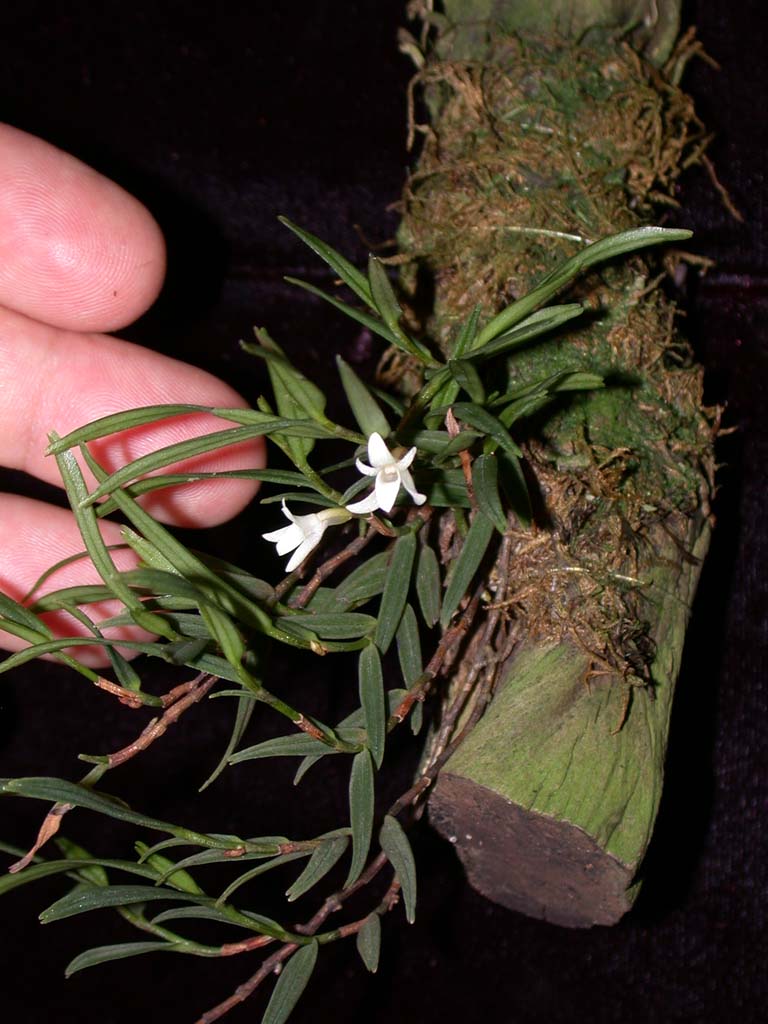
In the wild Angraecum panicifolium grows as a miniature to small epiphytic subshrub on tree trunks. The stem is thin, pendulous, and bears 5–6 linear, narrow, sub‑acute leaves that are spaced along the axis. Leaves are described as “thinly linear, narrow, subacute” [2]. The plant produces a very short, axillary inflorescence that bears a single flower. The flower is small (approximately 1/2 inch or 1.25 cm in diameter) and glabrous, with a white (or greenish‑white) coloration typical of many Angraecum species [2]. The lip and spur are not detailed in the available sources, and fragrance is reported as present [4]. Because the species is documented only from a few herbarium specimens and limited photographs, identification should be confirmed by comparing leaf shape, single‑flowered short axillary stalk, and the small white flower size with the description above.
Native Range and Habitat
According to Kew’s Plants of the World Online, A. panicifolium is native to eastern‑central Madagascar [1]. Field notes from an orchid specialist describe the orchid growing on tree trunks in moss‑rich, lichen‑covered wet tropical forests at elevations ranging from about 190 m to 1 200 m [2]. The species is therefore associated with humid, low‑ to mid‑elevation forest habitats that receive consistent rainfall.
Species‑Specific Care
| Factor | Documented guidance | Source |
|---|---|---|
| Growth habit | Epiphytic; mounts or well‑aerated bark medium recommended | [2] |
| Light | Bright, filtered light mimicking forest canopy | Not documented (inferred from habitat) |
| Temperature | Described as “hot to cool” growing; tolerates a moderate temperature range | [2] |
| Humidity | High humidity preferred, reflecting moss‑rich forest environment | [2] |
| Watering | Not documented; maintain moisture without waterlogging | — |
| Fertilisation | Not documented | — |
| Seasonal change | Not documented; species flowers in mid‑summer to early autumn in the wild | [2] |
Because detailed horticultural protocols are lacking, growers should aim to replicate the orchid’s natural environment: mount the plant on bark or a well‑draining medium, provide bright but indirect light, keep humidity high (70 % +), and maintain moderate temperatures without extreme heat or cold. Monitor the plant for signs of stress and adjust watering to keep the medium moist but not soggy.
Flowering and Pollination
In its native habitat the species produces a single flower on a short axillary stalk during the mid‑summer to early autumn period [2]. The flower lasts for a short period (typical of many Angraecum spp.) and is fragrant [4]. No specific pollinator has been recorded for A. panicifolium; pollination biology remains undocumented.
Conservation and Responsible Cultivation
Formal conservation assessments (e.g., IUCN Red List) are not cited in the available sources for this species. Habitat loss in Madagascar’s lowland forests is a general concern, but the precise status of A. panicifolium is not documented.
Evidence and Limitations
Most of the botanical description derives from the IOSPE species page and Kew’s POWO database. Detailed morphological measurements, pollinator observations, and precise cultivation parameters are absent from the cited literature. Growers should treat the presented care recommendations as provisional and seek additional information from field studies or specialist growers when possible.
Frequently asked questions
Is Angraecum panicifolium difficult to grow in cultivation?
Specific cultivation requirements for this species are limited in the literature. It is described as a miniature epiphyte that tolerates a range from warm to cool conditions, suggesting it is not extremely temperature‑sensitive, but growers should provide high humidity and good airflow. Detailed watering, feeding, and temperature thresholds are not documented.
When does Angraecum panicifolium flower in the wild?
Field observations record flowering in mid‑summer to early autumn in its native forest habitat [2].
FOLLOW THE EVIDENCE
Sources & references
- Angraecum panicifolium H.Perrier | Plants of the World Online | Kew Science, https://powo.science.kew.org/taxon/urn:lsid:ipni.org:names:616318-1
- IOSPE PHOTOS Angraecum panicifolium H. Perrier 1938, https://www.orchidspecies.com/angpanicifolium.htm
- Angraecum panicifolium - orchidroots, https://orchidroots.com/display/summary/orchidaceae/9588/
- Angraecum panicifolium (Angraecum panicifolium) | NativePlants.info, https://www.nativeplants.info/plant/magnoliophyta-flowering-plants/orchidaceae/angraecum/angraecum_panicifolium.html

