At a glance
RECORDED PROFILE DATA- Scientific name
- Angraecum firthii
- Name status
- Treated as Angraecum firthii in IOSPE; Conchograecum firthii listed as synonym; current POWO species status not documented in supplied excerpts.
- Common name
- Firth's Angraecum
- Native region
- Cameroon, Equatorial Guinea, Kenya, Uganda (IOSPE); orchid.guru lists Cameroon and Uganda.
- Growth habit
- Epiphyte; small to medium-sized.
- Cultivation temperature group
- Cool growing (IOSPE); cool to warm growing (orchid.guru); numeric thresholds not documented.
- Habitat elevation
- 1450–1600 m.
- Flower size
- About 2.5 cm (1 in).
- Inflorescence
- 3–12 cm long, 3–7-flowered.
- Flowering
- Spring reported; locality and hemisphere not specified.
Angraecum firthii is a small to medium-sized epiphytic orchid known in horticultural databases from evergreen forests in parts of tropical Africa. The supplied evidence is strongest for its gross morphology and broad native-range report, while current name status and cultivation requirements remain incompletely documented.
Names and Taxonomy
Angraecum firthii is the species name used in the IOSPE species entry, which also lists Conchograecum firthii (Szlach., Grochocka, Oledrz. & Mytnik) as a synonym [1]. The same entry cites a Summerhayes 1958 Kew Bulletin reference (Kew Bull. 13: 267) in its source list [1]. The supplied Kew POWO excerpt is for the genus Angraecum, not a species page for A. firthii, so current accepted-name status under POWO is not documented here [3]. A name in a horticultural database is not by itself proof of current taxonomic placement; the Conchograecum synonym indicates that placement has been revised in at least one treatment [1]. Common name: Firth’s Angraecum [1].
How to Identify This Species
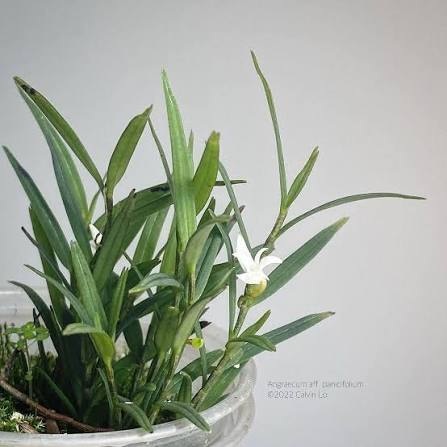
IOSPE describes A. firthii as a small to medium-sized epiphyte with erect, slightly flattened stems. Leaves are dark green, rather thin, oblanceolate to oblong, and unequally bilobed at the apex. The inflorescence is short, 3–12 cm long, slender, slightly fractiflex, and carries 3–7 flowers; floral bracts are broadly ovate and obtuse. Flowers are reported as about 2.5 cm (1 in) across [1].
These are the only species-specific morphological details in the supplied evidence. Flower color, lip shape, spur length, fragrance, and root description are not documented in the available sources. Identification from a photograph or label should therefore be treated cautiously; the combination of the bilobed leaves and short few-flowered inflorescence is useful only within the limits of the source description [1]. No documented look-alike comparison was found in the supplied material.

Native Range and Habitat
IOSPE lists A. firthii from Cameroon, Equatorial Guinea, Kenya, and Uganda, in evergreen forests at elevations of 1450–1600 m; it describes the plant as an epiphyte [1]. The orchid.guru entry gives a narrower native statement of Cameroon and Uganda [2]. The supplied evidence therefore conflicts on the country list, especially Equatorial Guinea and Kenya. No specimen citations, habitat host data, or local seasonality are provided in the excerpts.
Elevation and forest type are habitat data, not cultivation setpoints. The sources do not document rainfall, humidity, light levels, or microhabitat within the evergreen forest [1][2].
Species-Specific Care
Species-specific cultivation evidence is sparse. The table separates what is documented from what is not; it does not convert native elevation into greenhouse temperatures.
| Factor | Documented guidance | Evidence or context |
|---|---|---|
| Temperature | IOSPE calls it cool growing; orchid.guru calls it cool to warm growing. No numeric day/night or seasonal thresholds are given. | [1][2] |
| Light | Not documented. | [1][2] |
| Watering | Not documented. No wet/dry cycle or rest period is supported by the supplied sources. | [1][2] |
| Humidity and airflow | Not documented. | [1][2] |
| Potting or mounting | Not documented beyond the epiphytic habit; no pot, mount, or medium recommendation is given. | [1] |
| Feeding | Not documented. | [1][2] |
| Repotting | Not documented. | [1][2] |
| Seasonal changes | Not documented. Do not infer a dry rest from habitat elevation. | [1][2] |
| Flowering season | Spring reported by IOSPE, but locality, hemisphere, and cultivation context are not specified. | [1] |
The only care-relevant descriptors are the epiphytic habit and the temperature labels [1][2]. Because IOSPE says cool growing and orchid.guru says cool to warm growing, the sources do not agree on a single temperature group. Neither source provides measured temperatures, so a grower should not treat cool as a specific setpoint. Watering, light, humidity, airflow, feeding, and repotting recommendations are not documented for this species in the supplied evidence; they should not be copied from another Angraecum and presented as verified A. firthii care. The absence of a documented rest period is not evidence that a rest is needed.
Flowering and Pollination
IOSPE reports that A. firthii blooms in spring on a short, slender, 3–7-flowered inflorescence, with flowers about 2.5 cm across [1]. The source does not state whether spring refers to the northern or southern hemisphere, a particular country, or cultivated plants, so the season should be treated as a broad report rather than a local calendar. Flower longevity, fragrance timing, nectar spur dimensions, and pollination biology are not documented in the supplied evidence. No pollinator is recorded, and flower shape alone is not enough to assign one.
Conservation and Responsible Cultivation
No formal conservation assessment for A. firthii is present in the supplied sources. The excerpts do not provide population data, legal status, or trade information, so no conservation category should be inferred. Responsible cultivation statements would require a sourced assessment and legal context, which are not available here.
Evidence and Limitations
This profile is based on search-result snippets and short excerpts, not full-page or full-paper verification. The IOSPE entry supplies the main species-specific morphology, distribution, elevation, and flowering report [1]; orchid.guru supplies a conflicting narrower native-range statement and a different temperature label [2]. The supplied Kew POWO page is for the genus Angraecum, not the species, so accepted-name status and POWO distribution for A. firthii remain unverified here [3]. No original description, flora treatment, herbarium specimen, conservation assessment, or pollination study was available in the supplied evidence. Measurements and care labels should be checked against a current taxonomic treatment and species-specific cultivation records before publication.
Frequently asked questions
What is Angraecum firthii?
It is a small to medium-sized epiphytic orchid treated under the name Angraecum firthii in IOSPE, which reports it from evergreen forests at 1450–1600 m [1].
Is Conchograecum firthii a separate species?
IOSPE lists Conchograecum firthii as a synonym of Angraecum firthii [1]. The supplied Kew POWO excerpt is for the genus only, so current accepted placement is not verified here [3].
Where is Angraecum firthii native?
IOSPE lists Cameroon, Equatorial Guinea, Kenya, and Uganda [1]; orchid.guru lists Cameroon and Uganda [2]. The supplied sources conflict on the full country list.
What temperature does Angraecum firthii need?
IOSPE calls it cool growing, while orchid.guru calls it cool to warm growing; no numeric temperature thresholds are documented in the supplied evidence [1][2].
When does Angraecum firthii flower?
IOSPE reports spring flowering, but does not specify the locality, hemisphere, or cultivation context [1].
Related terminology
- Angraecum
- A genus in the orchid family Orchidaceae; Kew POWO treats Angraecum Bory as an accepted genus.
- Epiphyte
- A plant that grows on another plant for support without being parasitic; IOSPE describes Angraecum firthii as epiphytic.
- Conchograecum
- A segregate genus name listed by IOSPE as a synonym of Angraecum firthii.
FOLLOW THE EVIDENCE
Sources & references
- IOSPE PHOTOS. Angraecum firthii. Internet Orchid Species Photo Encyclopedia. https://www.orchidspecies.com/angfirthii.htm
- Angraecum « orchid.guru. https://orchid.guru/content/orchids/a/angraecum/
- Plants of the World Online. Angraecum Bory. Kew Science. https://powo.science.kew.org/taxon/urn:lsid:ipni.org:names:325979-2

