At a glance
RECORDED PROFILE DATA- Scientific name
- Angraecum eburneum subsp. eburneum
- Name status
- Accepted subspecies (POWO)
- Species authorship
- Angraecum eburneum Bory (1804)
- Native region
- Aldabra, Comoros, Madagascar, Mauritius, Réunion, Seychelles (POWO)
- Growth habit
- Lithophytic subshrub (POWO); species-level accounts also report epiphytic or lithophytic habit
- Cultivation temperature group
- Not documented
- Plant size
- Species-level FTEA: erect stem 60–100 cm; Cambridge page reports plants can exceed 1 m
- Flower
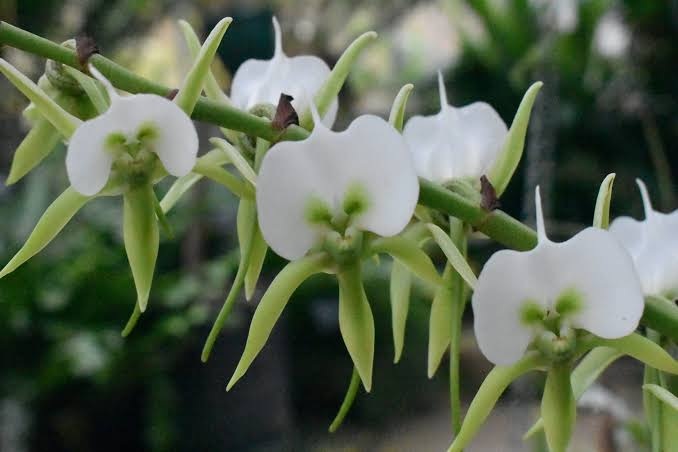
- Species-level FTEA: white lip, green sepals/petals/column, yellow-green at spur mouth, night scent
- Flowering context
- Historical Réunion note for A. eburneum sensu lato says July; modern subspecies-specific months not documented
- Conservation
- AERP predicted not threatened for species (confidence confident), not a formal subspecies assessment
Angraecum eburneum subsp. eburneum is the autonymic subspecies of Angraecum eburneum Bory, accepted by Plants of the World Online (POWO) as one of four accepted infraspecific taxa in the species [1][2]. POWO records the subspecies from the western Indian Ocean and describes it as a lithophytic subshrub of wet tropical biome [1]. Most detailed morphology and flowering data in the supplied evidence are species-level, so they are qualified below.
Names and Taxonomy
The accepted name used here is Angraecum eburneum subsp. eburneum. POWO accepts the subspecies under Angraecum eburneum Bory [1][2]. The species was published by Bory in Voy. îles Afrique 1: 359, t. 19 (1804), and IPNI records Orchidaceae as the family [4]. IPNI also records “Ins. Borbon” in the original data, and a 2021 Lankesteriana taxonomic account excerpt states that a lectotype was designated from Bory’s plate 19, with the type from Réunion [4][6]. The subspecies epithet repeats the species epithet, making it the autonymic subspecies; the supplied sources do not give a separate subspecies author, so none is assigned here.
POWO lists four accepted infraspecific taxa within A. eburneum: subsp. eburneum, subsp. giryamae, subsp. superbum, and subsp. xerophilum [2]. For subsp. eburneum, POWO lists five heterotypic synonyms: Angorkis brongniartiana, Angraecum brongniartianum, Angraecum eburneum var. brongniartianum, Angraecum eburneum var. virens, and Angraecum virens [1]. At species level, POWO lists the homotypic synonyms Angorkis eburnangis (marked nom. illeg. superfl.), Angorkis eburnea, and Limodorum eburneum [2]. These are nomenclatural records, not evidence that each synonym represents a separate horticultural species.
A regional flora index lists the French/local names “Petite comète,” “Gros faham,” and “Angrec d’ivoire” for A. eburneum [7]. Those names are recorded at species level and are not confirmed here as exclusive to subsp. eburneum. The parenthetical “W Indian Ocean” in the requested title is a geographic qualifier, not part of the botanical name.

How to Identify This Species
No subspecies-specific morphological description for subsp. eburneum was present in the supplied evidence. The most detailed description available is the Flora of Tropical East Africa account reproduced in POWO’s general information for A. eburneum [3]. It describes a large, robust epiphyte or lithophyte with an erect stem 60–100 cm long and 1.5–2 cm in diameter; roots thick, fleshy, and 3.5–5 mm in diameter; and 6–10 or more distichous, fleshy-coriaceous, obovate-ligulate leaves with unequally roundly bilobed apices, 16–50(–70) cm long and 2.9–7 cm wide [3]. Inflorescences are suberect or ascending, 8–20-flowered, and 30–75 cm long, with a stout peduncle 12–29 cm long bearing 1–3 well-spaced sheaths; bracts are amplexicaul, broadly ovate, obtuse, 0.9–1.5 cm long, and dark brown [3]. The flowers are described with a white lip, yellow-green at the mouth of the spur, green sepals, petals, and column, and a pleasant scent at night [3].
A Cambridge University Botanic Garden page for A. eburneum gives a partly different species-level summary: a robust plant growing on host trees and rocky surfaces, capable of exceeding 1 m in height, with racemes up to 60 cm long and up to 30 green and ivory flowers with an inverted lip [5]. The flower-count and inflorescence-length figures differ from the Flora of Tropical East Africa account (8–20 flowers and 30–75 cm), so they should not be averaged or treated as a single fixed range. The difference may reflect different counting contexts, but the supplied excerpts do not resolve it.
Because the diagnostic measurements above are species-level, a photograph or nursery label alone cannot confirm subsp. eburneum. Identification to subspecies should rest on documented provenance and taxonomic treatment, not on a single visual feature such as flower color or spur shape.
Native Range and Habitat
POWO records the native range of subsp. eburneum as Aldabra, the Comoros, Madagascar, Mauritius, Réunion, and Seychelles, within the western Indian Ocean [1]. The same entry describes the subspecies as a lithophytic subshrub growing primarily in wet tropical biome [1]. That is the clearest subspecies-level habitat statement in the supplied evidence. Elevation range and detailed microhabitat preferences for the subspecies are not documented in the available sources.
The species A. eburneum has a broader native range in POWO: southeastern Kenya to eastern Tanzania, including Pemba and Zanzibar, plus the western Indian Ocean [2]. The species is described there as an epiphyte of wet tropical biome [2]. The Flora of Tropical East Africa account describes the species as an epiphyte or lithophyte [3], and the Cambridge botanic garden page says the species grows on host trees and rocky surfaces [5]. These species-level statements should not be used to expand the subspecies’ documented native range. In particular, the Kenyan and Tanzanian records belong to the species account, not to the POWO subspecies account [1][2].
The Cambridge page is a cultivated botanic-garden record and is not evidence of a native occurrence in Cambridge [5]. No introduced or naturalized records for subsp. eburneum were present in the supplied evidence.
Species-Specific Care
The supplied sources do not contain a species-specific cultivation trial, greenhouse protocol, or indoor growing report for A. eburneum subsp. eburneum. The table below separates documented habitat context from missing cultivation data. “Not documented” means that no supported value was available in the supplied evidence; it is not a recommendation to guess.
| Factor | Documented guidance | Evidence or context |
|---|---|---|
| Temperature | Not documented for the subspecies. | POWO places the subspecies in wet tropical biome [1], but native climate is habitat context, not a greenhouse setpoint. |
| Light | Not documented. | No species-specific light measurements or cultivation observations were supplied. |
| Watering | Not documented. | No watering schedule or seasonal moisture regime for this subspecies was supplied. |
| Humidity and airflow | Not documented. | No humidity percentage or airflow recommendation was supplied; wet tropical biome is not a cultivation target. |
| Potting or mounting | No cultivation prescription documented. Natural habit is lithophytic for the subspecies. | POWO describes subsp. eburneum as a lithophytic subshrub [1]; the species-level FTEA account also reports epiphytic or lithophytic habit [3]. This is habitat evidence, not a tested potting recipe. |
| Feeding | Not documented. | No fertilizer type, strength, or frequency was supplied for this subspecies. |
| Repotting | Not documented. | No repotting interval or root-disturbance guidance was supplied. |
| Seasonal changes | Not documented. | No dry rest, cool season, or photoperiod treatment for this subspecies was supplied. |
The only defensible cultivation context in the supplied evidence is the natural growth habit: POWO describes subsp. eburneum as lithophytic [1], and species-level descriptions also report epiphytic or lithophytic growth [3][5]. That does not justify a specific medium, watering interval, humidity target, or fertilizer program. Growers should seek documented, location-specific experience for this subspecies rather than applying a generic Angraecum schedule. In particular, the supplied evidence does not support inventing a dry rest or promising that a particular temperature regime will induce flowering.
Flowering and Pollination
The Flora of Tropical East Africa account for A. eburneum describes inflorescences 30–75 cm long, 8–20-flowered, with a white lip, yellow-green at the mouth of the spur, green sepals, petals, and column, and a pleasant scent at night [3]. The Cambridge botanic garden page reports racemes up to 60 cm long and up to 30 green and ivory flowers with an inverted lip, also noting night fragrance and attraction of hawk moths [5]. These are species-level reports and do not establish a fixed flower count or inflorescence length for subsp. eburneum. The Cambridge wording supports hawkmoth attraction as a reported observation, but the supplied evidence does not name a confirmed pollinator species or describe a pollination experiment for this subspecies.
A historical flora note for Réunion, reproduced in a regional index, states that A. eburneum flowers in July and is terrestrial or saxicolous [7]. That note is old, applies to A. eburneum sensu lato, and is not a modern subspecies-specific phenology study. It should be read as a historical regional observation, not as a universal flowering month. Modern flowering months, flower longevity, and nectar-spur dimensions for subsp. eburneum are not documented in the supplied evidence.
A glasshouse reproductive-biology study was located for A. eburneum subsp. superbum, not for subsp. eburneum [8]. Its findings should not be transferred to this subspecies without direct evidence. For subsp. eburneum, the available evidence supports night fragrance and a report of hawkmoth attraction, but not a confirmed pollinator or breeding-system conclusion.
Conservation and Responsible Cultivation
POWO’s general information for A. eburneum reproduces an Angiosperm Extinction Risk Prediction (AERP) of “not threatened” with confidence “confident” [3]. That prediction is for the species A. eburneum, not specifically for subsp. eburneum, and it is not presented in the supplied evidence as a formal IUCN Red List assessment. No formal conservation status, legal protection, or trade status specific to subsp. eburneum was located in the supplied sources. A nursery purchase should not be assumed to be legally compliant without checking the applicable local and international rules.
Evidence and Limitations
This profile relies on search snippets and selected page excerpts, not complete articles or herbarium specimens. The accepted-name and native-range statements for the subspecies come from POWO [1]; the broader species range and infraspecific list come from the species-level POWO entry [2]. The detailed morphological and flowering measurements come from a Flora of Tropical East Africa account reproduced in POWO general information [3] and from a Cambridge University Botanic Garden page [5], both at species level. They are useful for understanding A. eburneum but are not a subspecies-specific diagnostic description.
Material gaps include subspecies-specific elevation, cultivation temperatures, light levels, watering, humidity, feeding, repotting, flowering months, flower longevity, spur dimensions, confirmed pollinators, and formal conservation status. The historical Réunion flowering note is old and species-level [7]. The reproductive-biology study available here concerns subsp. superbum, not subsp. eburneum [8]. The taxonomy is accepted by POWO at the time of the retrieved evidence, but no full taxonomic revision was read for this profile.
Frequently asked questions
Is Angraecum eburneum subsp. eburneum an accepted name?
Yes. POWO accepts it as one of four accepted infraspecific taxa within Angraecum eburneum Bory [1][2].
Where is Angraecum eburneum subsp. eburneum native?
POWO records it from Aldabra, the Comoros, Madagascar, Mauritius, Réunion, and Seychelles in the western Indian Ocean [1]. The species-level account has a broader range that also includes parts of Kenya and Tanzania, but that broader range is not assigned to the subspecies by the supplied evidence [2].
What cultivation temperature does this subspecies need?
Not documented in the supplied sources. POWO’s wet tropical biome statement is habitat context, not a greenhouse or indoor temperature setpoint [1].
When does Angraecum eburneum subsp. eburneum flower?
Modern subspecies-specific flowering months are not documented in the supplied evidence. A historical Réunion flora note for A. eburneum sensu lato says July, but it is old and not subspecies-specific [7].
What pollinates this subspecies?
The supplied evidence reports night fragrance and hawkmoth attraction for A. eburneum at species level, but it does not name a confirmed pollinator for subsp. eburneum [5].
Related terminology
- Autonym
- An infraspecific name that automatically repeats the species epithet when a species is divided into subspecies or varieties.
- Lithophyte
- A plant that grows on rock surfaces, often with roots anchored in crevices or thin organic debris.
- Subspecies
- A taxonomic rank below species used for geographically or morphologically distinct populations.
- Nectar spur
- A tubular extension associated with an orchid flower, often containing nectar; the supplied sources mention the mouth of the spur but do not give its dimensions for this subspecies.
FOLLOW THE EVIDENCE
Sources & references
- Angraecum eburneum subsp. eburneum | Plants of the World Online | Kew Science. Royal Botanic Gardens, Kew. https://powo.science.kew.org/taxon/urn:lsid:ipni.org:names:77167551-1
- Angraecum eburneum Bory | Plants of the World Online | Kew Science. Royal Botanic Gardens, Kew. https://powo.science.kew.org/taxon/616096-1
- Angraecum eburneum Bory | Plants of the World Online | Kew Science — General Information. Royal Botanic Gardens, Kew. https://powo.science.kew.org/taxon/urn:lsid:ipni.org:names:616096-1/general-information
- Angraecum eburneum | International Plant Names Index. https://www.ipni.org/n/616096-1
- Angraecum eburneum - Cambridge University Botanic Garden. Cambridge University Botanic Garden. https://www.botanic.cam.ac.uk/the-garden/plant-list/angraecum-eburneum/
- New combinations and other taxonomic changes for the forthcoming ‘flore des mascareignes’ Orchidaceae accounts. Hermans, J. & Cribb, P. Lankesteriana 21(2), 2021. https://www.redalyc.org/journal/443/44372514001/html/
- Index de la flore. Mascarine CBNM. No publication date shown. https://mascarine.cbnm.org/index.php/flore/index-de-la-flore/nom?code_taxref=705832
- Reproductive biology of Angraecum eburneum subsp. superbum (Orchidaceae) under glasshouse conditions. Buyun, L.I., Cherevchenko, T.M., Kovalska, L.A., & Ivannikov, R.V. No publication date shown in excerpt. https://eeb.lu.lv/EEB/201503/EEB_XII_1_Buyun.pdf

