At a glance
RECORDED PROFILE DATA- Scientific name
- Angraecum birrimense Rolfe
- Name status
- Accepted
- Native region
- West & West‑Central Tropical Africa
- Growth habit
- Epiphytic subshrub
- Cultivation temperature group
- Not documented
Names and Taxonomy
The accepted scientific name is Angraecum birrimense Rolfe, first published in Bulletin of Miscellaneous Information, Royal Gardens, Kew 1914:214[2]. Kew’s Plants of the World Online lists the name as accepted[1]. A later homotypic synonym is Eichlerangraecum birrimense (Rolfe) Szlach., Mytnik & Grochocka (2013) [1]. No common name is documented in the available sources.
How to Identify This Species
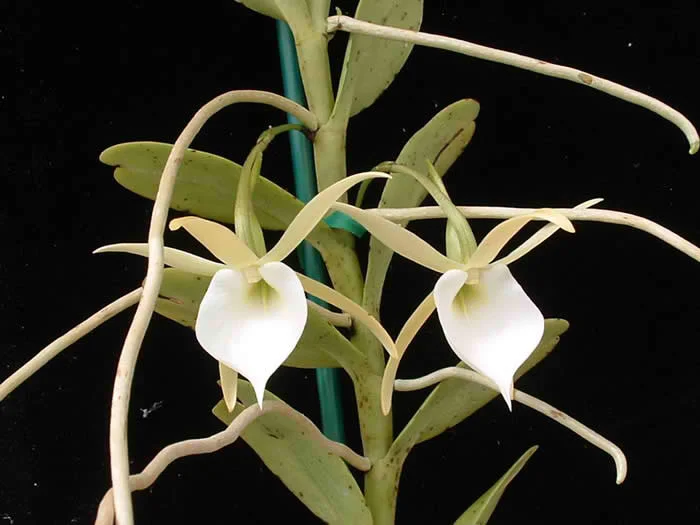
Angraecum birrimense is a large epiphytic subshrub with elongated stems that may reach several feet in the wild. Leaves are distichous, oblong‑lanceolate, and unequally bilobed at the apex. The species produces relatively large, fragrant flowers about 12.5 cm (5 in) long[3]. Flowers are orange‑tinged, with a white labellum bearing a green centre; the rounded lateral lobes of the lip do not extend beyond the base of the central apiculus, a feature that separates it from the similar A. eichlerianum[3]. The inflorescence bears one to three flowers and typically blooms in the summer to early autumn months.
Native Range and Habitat
The species is native to West and West‑Central Tropical Africa, recorded from Cameroon, Equatorial Guinea, Gabon, Ghana, Guinea, the Gulf of Guinea Islands, Ivory Coast, Liberia, Nigeria, and Sierra Leone[1]. It occurs in evergreen forest canopies, growing as an epiphyte on tree branches at low elevations (around 50 m above sea level) in the wet tropical biome[1][3].
Species‑Specific Care
| Factor | Documented guidance | Source |
|---|---|---|
| Growth medium | Well‑draining bark mix; mounting on a pole or slab is also used. | [3] |
| Support | Elongated stems can be tied to a sturdy pole until roots develop. | [3] |
| Light | Bright, filtered shade; avoid direct harsh sun. | [3] |
| Temperature | Hot to warm conditions (typical tropical greenhouse temperatures). Specific numbers not documented. | [3] |
| Humidity | High humidity preferred, consistent with evergreen forest conditions. | [3] |
| Watering | Regular watering to keep the medium moist but not water‑logged. | [3] |
| Fertilization | Balanced orchid fertilizer applied during active growth. | [3] |
| Seasonal changes | No specific rest period documented; maintain moderate conditions year‑round. | [3] |
In cultivation, growers report successful growth in pots with a bark mix, providing ample airflow and occasional misting to maintain humidity. Because the species originates from low‑elevation, warm forests, it does not tolerate prolonged cold temperatures.
Flowering and Pollination
Flowers appear in summer and early autumn, lasting several days and emitting a strong fragrance, especially in the evening. The floral morphology (long spur, nocturnal fragrance) suggests moth pollination, but no specific pollinator has been documented for this species[3]. Nectar spur length and scent timing are not detailed in the available sources.
Conservation and Responsible Cultivation
The Angiosperm Extinction Risk Predictions (2024) classify Angraecum birrimense as “not threatened” with a confident assessment[1]. Nevertheless, habitat loss in West African rainforests may impact wild populations, so sourcing plants from reputable, legally compliant nurseries is advised.
Evidence and Limitations
Key gaps include precise temperature ranges, detailed leaf measurements, and confirmed pollinator observations. Information on seasonal rest periods and exact fertilization regimes is lacking, and cultivation advice is based on a single grower’s report (IOSPE). Further field studies would improve understanding of the species’ ecology and horticultural needs.
FOLLOW THE EVIDENCE
Sources & references
- Angraecum birrimense Rolfe | Plants of the World Online | Kew Science, https://powo.science.kew.org/taxon/urn:lsid:ipni.org:names:615976-1
- Angraecum birrimense | International Plant Names Index, https://ipni.org/n/615976-1
- IOSPE PHOTOS Angraecum birrimense, https://www.orchidspecies.com/angbirrimense.htm
