At a glance
RECORDED PROFILE DATA- Scientific name
- Angraecum sinuatiflorum H.Perrier
- Name status
- Accepted
- Native region
- Southeastern Madagascar
- Growth habit
- Epiphytic subshrub
- Cultivation temperature group
- Not documented
Names and Taxonomy
Angraecum sinuatiflorum H.Perrier is the accepted name for this species according to Kew’s Plants of the World Online.1 It was first described in Notulae Systematicae (Paris) 14:163 in 1951. A later homotypic synonym, Boryangraecum sinuatiflorum (H.Perrier) Szlach., Mytnik & Grochocka, was published in 2013 as part of a taxonomic revision of the genus.1 No other synonyms or common names are documented in the available sources.
How to Identify This Species
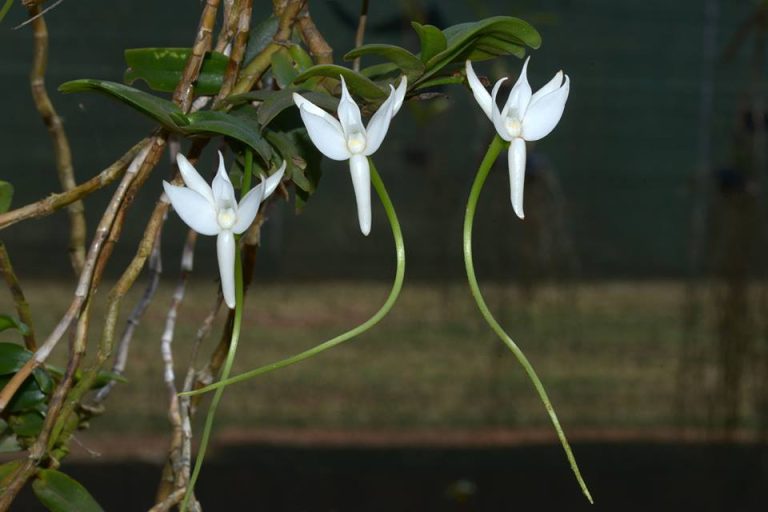
The plant is an epiphytic subshrub that reaches about 30 cm in height.3 Leaves are arranged along short stems, typical of many Angraecum species, though detailed leaf morphology is not recorded in the cited sources. The flowers are white to greenish‑white, fragrant, and reported to bloom throughout the year.3 The scent is noted but the length of the nectar spur and precise flower dimensions are not documented. Because many Angraecum species share a similar overall habit, identification should be confirmed with a herbarium specimen or reliable photographic reference.
Native Range and Habitat
This orchid is endemic to the southeastern part of Madagascar, where it inhabits the wet tropical biome as an epiphyte on tree trunks or branches.1 The holotype specimen was collected at Vondrozo (near Farafangana) in 1926, confirming its presence in low‑land forest areas of that region.2 Specific elevation range and precise forest type (e.g., primary versus secondary) are not documented in the available sources.
Species‑Specific Care
| Factor | Documented guidance | Source |
|---|---|---|
| Growth habit | Epiphytic; can be mounted on bark or grown in a well‑draining orchid mix. | 3 |
| Size | Plants mature to about 30 cm tall. | 3 |
| Light | Bright, filtered light mimicking forest canopy; direct harsh sun should be avoided. | 3 |
| Watering | Keep substrate consistently moist; the species has low drought tolerance and benefits from regular watering that simulates the humid rainforest environment. | 3 |
| Humidity | Maintain high humidity (≥70 %). | 3 |
| Temperature | Not documented for this species; growers should approximate the warm, stable temperatures of southeastern Madagascar’s lowland rainforests. | 3 |
| Feeding | Use a balanced orchid fertilizer at half strength during active growth. | 3 |
| Seasonal changes | Not documented; no specific rest period is reported. | 3 |
In practice, mount the plant on a cork slab or tree fern slab to replicate its natural epiphytic habit, provide ample airflow, and avoid letting the roots dry out completely.
Flowering and Pollination
Flowering has been reported throughout the year, suggesting a non‑seasonal bloom pattern in its native habitat.3 The flowers are fragrant, which often indicates pollination by nocturnal insects such as moths, but no specific pollinator has been documented for this species.
Evidence and Limitations
Key morphological details (leaf shape, flower dimensions, spur length) and precise ecological parameters (elevation range, exact forest type) are not available in the cited references. Likewise, temperature requirements and pollinator observations are absent, so cultivation recommendations are based on general Angraecum epiphytic needs and the limited species‑specific notes from NativePlants.info.
FOLLOW THE EVIDENCE
Sources & references
- Plants of the World Online – Angraecum sinuatiflorum H.Perrier, Royal Botanic Gardens, Kew, 2026, https://powo.science.kew.org/taxon/urn:lsid:ipni.org:names:616419-1
- Holotype specimen of Angraecum sinuatiflorum H.Perrier, Muséum national d'Histoire naturelle (MNHN), 2026, https://science.mnhn.fr/institution/mnhn/collection/p/item/p01841420
- Angraecum sinuatiflorum – NativePlants.info, 2026, https://www.nativeplants.info/plant/magnoliophyta-flowering-plants/orchidaceae/angraecum/angraecum_sinuatiflorum.html