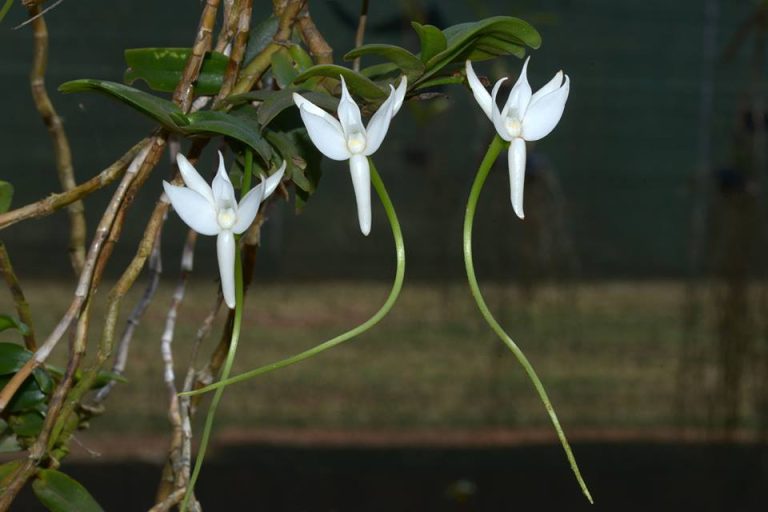
At a glance
RECORDED PROFILE DATA- Scientific name
- Angraecum inapertum Thouars
- Name status
- Accepted
- Native region
- Madagascar; Mascarene Islands (Mauritius, Réunion)
- Growth habit
- Epiphytic subshrub
- Cultivation temperature group
- Not documented
Names and Taxonomy
Angraecum inapertum Thouars is the accepted name for this species according to Kew’s Plants of the World Online.[1] It was first described in 1809 in the work “Nouv. Bull. Sci. Soc. Philom. Paris, sér. 2, 1: Tabl. Angorkis”. The name has been transferred to several genera, giving rise to a series of synonyms:
- Aerobion inapertum (Thouars) Spreng. (1826)
- Epidorkis inaperta (Thouars) Kuntze (1891)
- Gomphocentrum inapertum (Thouars) Szlach., Mytnik & Grochocka (2013)
- Mystacidium inapertum (Thouars) Ridl. (1885)
- Angorkis criptangis Thouars (original basionym)
No alternative common names are recorded in the consulted sources.
How to Identify This Species
The published material for Angraecum inapertum is limited. The type illustration shows a fruiting plant; a flower has been described only as “closed” without detailed measurements.[2] General characteristics of the genus suggest a monopodial growth habit with a short stem, narrow leaves, and a single flower borne on a short pedicel, but these cannot be confirmed for this species without further field study. Consequently, reliable identification must rely on herbarium specimens or a confirmed photograph of a flowering individual.
Because of the lack of detailed morphological data, we cannot provide a definitive comparison with a look‑alike species.
Native Range and Habitat
The species is native to eastern Madagascar and is reported as “doubtfully present” in Mauritius by Kew, while the IOSPE database records it from Madagascar, Mauritius, and Réunion.[1][2] It occurs in wet tropical forest, growing as an epiphytic subshrub on tree branches. Elevational records range from 700 m to 2 200 m, indicating an affinity for mid‑ to high‑elevation montane forest.
Species‑Specific Care
| Factor | Documented guidance | Source / notes |
|---|---|---|
| Growth habit | Epiphytic subshrub | Kew PO [1] |
| Temperature | Not documented | — |
| Light | Not documented | — |
| Watering / humidity | Not documented | — |
| Medium / mounting | Not documented | — |
| Fertilisation | Not documented | — |
| Seasonal rest | Not documented | — |
Because no cultivation record has been published for Angraecum inapertum, growers are advised to treat it as a typical high‑elevation epiphytic orchid: provide good air circulation, mount on bark or a coarse medium, and avoid extreme heat. These suggestions are general recommendations for related Angraecum species and are not documented for this taxon.
Flowering and Pollination
The only published note describes the flower as “closed” and does not give size, colour, fragrance, or pollinator information.[2] No peer‑reviewed study of its pollination biology is available.
Evidence and Limitations
Key gaps include detailed morphological description, flowering period, pollinator observations, and any horticultural experience. The species is poorly represented in the literature; most available information consists of distribution records and a brief, non‑illustrated flower note. Further field work and cultivation trials are required to fill these gaps.
FOLLOW THE EVIDENCE
Sources & references
- Angraecum inapertum Thouars | Plants of the World Online | Kew Science, https://powo.science.kew.org/taxon/urn:lsid:ipni.org:names:616193-1
- IOSPE PHOTOS Angraecum inapertum Thouars 1822, https://www.orchidspecies.com/anginapterum.htm