At a glance
RECORDED PROFILE DATA- Scientific name
- Angraecum pingue Frapp. ex Cordem.
- Name status
- Accepted
- Native region
- Madagascar; Mauritius; Réunion (Mascarene Islands)
- Growth habit
- Epiphytic subshrub (miniature epiphyte)
- Cultivation temperature group
- Cool to intermediate (based on high‑elevation habitat) – Not formally defined
Names and Taxonomy
The accepted scientific name is Angraecum pingue Frapp. ex Cordem., first published in Flore de la Réunion 214 (1895) [1]. Kew’s Plants of the World Online lists it as an accepted species native to northern Madagascar and the Mascarene Islands [1].
Synonyms recorded by Kew include the homotypic name Angraecoides pinguis (Frapp. ex Cordem.) Szlach., Mytnik & Grochocka (2013) and the heterotypic names Mystacidium pingue (Frapp. ex Cordem.) Cordem. (1899) and Angraecoides nasuta (Schltr.) Szlach., Mytnik & Grochocka (2013) [1]. The synonym Mystacidium pingue is documented on OrchidRoots as referring to the same taxon [5].
No common name is recorded in the consulted sources.
How to Identify This Species
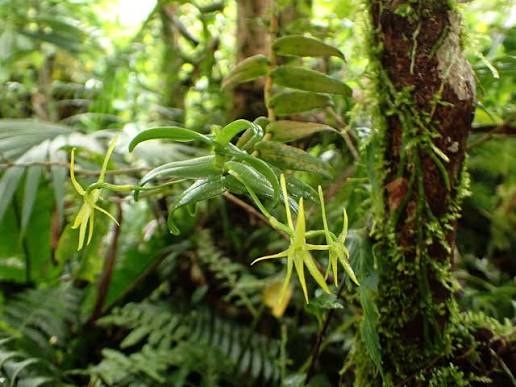
Angraecum pingue is a miniature epiphytic subshrub that clings to moss‑ and lichen‑covered tree trunks. The stem is short and leafy; leaves are narrowly ligulate, thick, attenuate toward the apex and obtusely bilobed at the tip [8]. Mature plants reach roughly 30 cm in height [9].
The single flower is borne on a short axillary peduncle (3–3.5 mm long) with two basal sheaths. The flower measures about 2.8 cm (1.1 in) across, is white to green‑white, and emits a noticeable fragrance [8][9]. The lip is relatively broad with a short spur, typical of many Angraecum species, but the combination of leaf shape, very short peduncle, and the flower size helps separate it from close relatives such as Angraecum nasutum (which has a longer spur and different leaf proportions) [1].
Native Range and Habitat
The species is native to north‑western Madagascar, the island of Mauritius and Réunion (Mascarene Islands) [1][8]. In the field it inhabits wet tropical forest, especially moss‑rich forests where it grows on the bark of trees coated with lichens. Elevational records range from 400 m to 2 200 m above sea level, indicating tolerance of both lowland and montane conditions [8]. Observations from the Réunion biodiversity portal record occurrences in multiple communes across the island, confirming its presence in the native forest matrix [6].
Species‑Specific Care
| Factor | Documented guidance | Source |
|---|---|---|
| Growth medium | Well‑aerated bark or moss mix, mimicking natural moss‑covered tree trunks | [8] |
| Mounting | Can be mounted on cork or tree fern slab to replicate epiphytic habit | [8] |
| Light | Bright to intermediate light; avoid full, harsh sun | [8] |
| Temperature | Cool to intermediate; tolerates temperatures typical of 400–2200 m elevation (≈10‑20 °C night, 20‑25 °C day) | [8] |
| Humidity | High humidity (≥70 %); mist regularly or maintain a moist environment | [8] |
| Watering | Keep medium moist but not water‑logged; water when the surface feels slightly dry, especially in warmer months | [8] |
| Fertilisation | Balanced orchid fertilizer at half strength once a month during active growth | Not documented – general Angraecum practice |
| Seasonal rest | Specific rest period not documented for this species | Not documented |
In practice, growers report that the species thrives when mounted in a humid, well‑ventilated environment that reproduces its native moss‑forest niche. Over‑watering or low air flow can lead to rot, a common problem for many epiphytic orchids.
Flowering and Pollination
Flowering occurs in the later spring and summer months of the Southern Hemisphere (approximately September to January) according to the IOSPE description [8]. The flower lasts several weeks and is scented, suggesting attraction of nocturnal pollinators, but no specific pollinator has been recorded for Angraecum pingue. The spur length is short relative to some long‑spurred Angraecum species, which may indicate pollination by short‑tongued moths or other insects; however, this remains a hypothesis pending field observation.
Evidence and Limitations
The profile is based on a limited set of published and database excerpts. Detailed measurements of leaf dimensions, exact spur length, and pollinator identity are not documented in the available sources. Cultivation recommendations are derived from habitat description and general Angraecum practices; specific horticultural trials for this species are scarce. Further field studies and growers’ records would help refine temperature tolerances, fertilisation regimes, and flowering phenology.
Frequently asked questions
What size does Angraecum pingue reach in cultivation?
Plants are reported to grow to about 30 cm tall, with a compact, leafy stem and a single flower per inflorescence [9].
Is Angraecum pingue fragrant?
Yes. The species is described as fragrant in both the IOSPE description and NativePlants.info entry [8][9].
Does this orchid need a rest period in winter?
Specific rest‑period requirements are not documented for this species. General Angraecum care notes suggest a reduction in watering for cool‑season species, but no species‑specific guidance exists.
FOLLOW THE EVIDENCE
Sources & references
- Angraecum pingue Frapp. ex Cordem. | Plants of the World Online | Kew Science, https://powo.science.kew.org/taxon/urn:lsid:ipni.org:names:616339-1
- New combinations and other taxonomic changes for the forthcoming ‘flore des mascareignes’ Orchidaceae accounts, Redalyc, https://www.redalyc.org/journal/443/44372514001/html/
- IOSPE PHOTOS – Angraecum pingue, https://www.orchidspecies.com/angpingue.htm
- Angraecum pingue – atlas - SINP de La Réunion, https://geonature.borbonica.re/atlas/espece/705850
- Angraecum pingue | NativePlants.info, https://www.nativeplants.info/plant/magnoliophyta-flowering-plants/orchidaceae/angraecum/angraecum_pingue.html

