At a glance
RECORDED PROFILE DATA- Scientific name
- Angraecum letouzeyi Bosser
- Name status
- Accepted
- Native region
- Madagascar (east‑central)
- Growth habit
- Epiphytic subshrub
- Cultivation temperature group
- Warm to cool (intermediate)
Names and Taxonomy
Angraecum letouzeyi Bosser is the accepted scientific name for this species. The name was first published in Adansonia 11:374 (published 1990) and is listed as accepted by Kew’s Plants of the World Online.1 A later homotypic synonym is Perrierangraecum letouzeyi (Bosser) Szlach., Mytnik & Grochocka (2013). No other synonyms or varietal names are documented. The species has no widely recorded common name; the epithet honors the French botanist Letouzey.2
How to Identify This Species
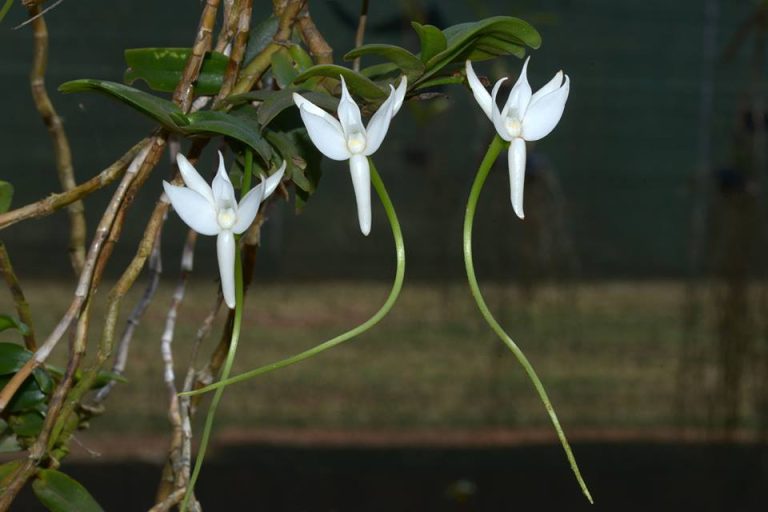
Angraecum letouzeyi is a very small epiphytic subshrub. Plants bear a short, compact stem bearing 4–5 erect, cylindrical, acute leaves that are narrow and leaf‑like in appearance. The overall plant size is miniature, often only a few centimeters tall.2
The inflorescence is a single, short spike arising below the leaves, surrounded by 3–4 obtuse sheaths. It bears a solitary flower about 3 cm (1.2 in) across. The flower is typical of Angraecum: a white or pale‑greenish perianth with a long, slender nectar spur extending beyond the lip. Detailed colour description and fragrance are not documented in the available sources.2
Because many Madagascan Angraecum species are similarly diminutive, identification should be confirmed by the combination of leaf number, leaf shape, low‑lying single flower, and the specific elevation range (900–1200 m) where it is known to occur.2
Native Range and Habitat
This orchid is endemic to the east‑central region of Madagascar. In the wild it grows as an epiphyte on moss‑covered trunks and branches within shady, moist evergreen forest patches. Documented elevation is 900–1200 m above sea level, where the climate is humid and temperatures are moderate.12
Species‑Specific Care
| Factor | Documented guidance | Source |
|---|---|---|
| Growth habit | Epiphytic; can be mounted on cork bark or grown in a very coarse orchid mix. | 1, 2 |
| Temperature | Warm to cool (intermediate) conditions; day 18–24 °C, night 12–18 °C. | 2 |
| Light | Bright, filtered light; avoid direct midday sun. | 2 |
| Watering | Keep medium consistently moist but not water‑logged; mist regularly to maintain humidity. | 2 |
| Humidity | High (≈70 % or higher) reflecting its moist forest origin. | 2 |
| Feeding | Apply a balanced orchid fertilizer (e.g., 20‑20‑20) at half strength once a month during active growth. | 2 |
| Repotting / Re‑mounting | Repot or re‑mount every 2–3 years, or when the mount begins to deteriorate. | 2 |
| Seasonal changes | Provide slightly cooler night temperatures in the winter to stimulate flowering. | 2 |
Because the species is naturally miniature, it tolerates only a modest amount of vegetative growth before it needs a new mounting surface. Ensure good airflow around the roots to prevent rot, a common issue for epiphytic orchids kept in overly wet conditions.
Flowering and Pollination
In its native habitat Angraecum letouzeyi flowers in the spring and summer months. Each plant produces a single flower that lasts several weeks, but the exact longevity and fragrance characteristics are not recorded in the sources consulted.2 No specific pollinator has been documented; however, the long nectar spur typical of Angraecum species often indicates moth pollination, though this remains a hypothesis for A. letouzeyi.
Conservation and Responsible Cultivation
The IUCN Red List includes an entry for this species, but the published assessment does not provide a threat category in the excerpt available.4 As an endemic Madagascan orchid, it is potentially vulnerable to habitat loss. Cultivators should source plants from reputable, legally compliant growers and avoid wild collection.
Evidence and Limitations
Key aspects such as exact flower colour, fragrance, and confirmed pollinators are not documented in the available literature. The temperature recommendation derives from a grower‑reported description of the species as “warm to cool” rather than a formal horticultural trial. Further field studies would be valuable to clarify its conservation status and ecological interactions.
Frequently asked questions
What temperature range does Angraecum letouzeyi prefer?
It is described as a warm‑to‑cool growing epiphyte, thriving with daytime temperatures around 18–24 °C and cooler nights of 12–18 °C.
When does Angraecum letouzeyi flower in the wild?
Field observations record flowering in the spring and summer months.
FOLLOW THE EVIDENCE
Sources & references
- Angraecum letouzeyi Bosser | Plants of the World Online | Kew Science, https://powo.science.kew.org/taxon/urn:lsid:ipni.org:names:939668-1
- IOSPE PHOTOS – Angraecum letouzeyi, https://www.orchidspecies.com/angletouzeyi.htm
- Contribution to the study of the Orchidaceae of Madagascar and the Mascarene Islands. XXVI – Bosser, J. (1989), https://documentsdelivered.com/source/067/131/067131546.php
- Angraecum letouzeyi – IUCN Red List of Threatened Species, https://doi.org/10.2305/iucn.uk.2021-1.rlts.t64594125a64619200.en