At a glance
RECORDED PROFILE DATA- Scientific name
- Angraecum coriaceum (Thunb. ex Sw.) Schltr.
- Name status
- Accepted
- Native region
- Madagascar
- Growth habit
- Epiphytic subshrub
- Cultivation temperature group
- Not documented
Names and Taxonomy
The accepted scientific name is Angraecum coriaceum (Thunb. ex Sw.) Schltr. This name was first published in Beih. Bot. Centralbl., Abt. 2 33:432 (1915) and is listed as accepted by Kew’s Plants of the World Online.[1] Several historical synonyms exist, all referring to the same taxon: Aerides coriacea Sw., Epidendrum coriaceum Poir., Limodorum coriaceum Thunb. ex Sw., and Saccolabium coriaceum Lindl. These synonyms are recorded in the Kew database.[1] No common name has been documented in the available sources.
How to Identify This Species
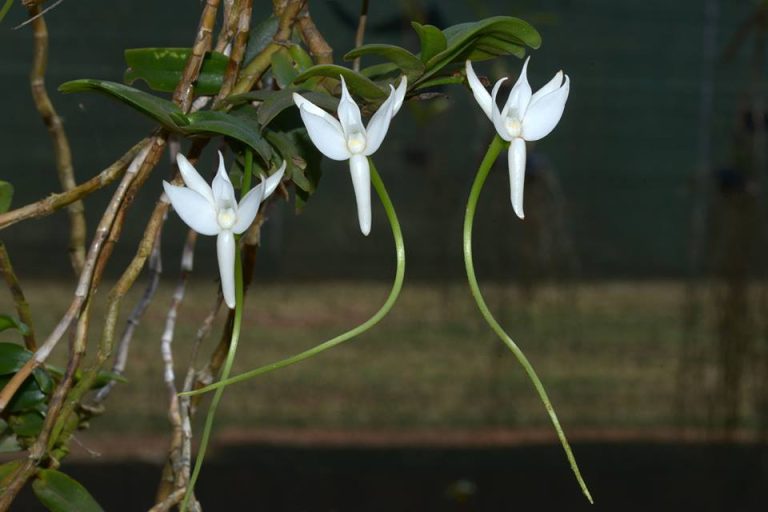
Angraecum coriaceum is an epiphytic subshrub that typically reaches about 30 cm in height.[2] The plant bears leathery, narrow leaves arranged along a monopodial stem, a habit typical of the genus. Flowers are white to greenish‑white, fragrant, and may be produced at any time of year. Specific measurements of the flower (spur length, lip dimensions) are not documented in the sources consulted.
Because many Angraecum species share a similar growth form, reliable identification should combine habit, leaf texture, and the distinctive white, fragrant flowers. Photographs with verified provenance are essential for confirmation, as the literature does not provide a single diagnostic character unique to this species.
Native Range and Habitat
The species is endemic to Madagascar, where it occurs in the seasonally dry tropical biome.[1] In the wild it grows as an epiphyte on tree branches, favouring forest patches that experience a pronounced dry season. Elevational range and precise forest type (e.g., deciduous versus spiny forest) have not been documented in the available references.
Species‑Specific Care
| Factor | Documented guidance | Evidence |
|---|---|---|
| Growth habit | Epiphytic; mount on bark or use a coarse, well‑draining medium that mimics tree branches. | [2] |
| Size | Plants reach ~30 cm tall in cultivation. | [2] |
| Light | Not documented for this species; typical Angraecum species prefer bright, filtered light. | Not documented |
| Temperature | Not documented; native habitat is seasonally dry tropical, suggesting warm to intermediate conditions. | Not documented |
| Watering | Not documented; epiphytic habit indicates need for regular moisture without waterlogging. | Not documented |
| Humidity | Not documented; a moderate to high humidity (≥70 %) is typical for many Madagascar epiphytes. | Not documented |
| Fertilisation | Not documented; a balanced, half‑strength fertilizer during active growth is commonly used for Angraecum. | Not documented |
| Repotting / Re‑mounting | Not documented; avoid disturbing roots excessively. | Not documented |
Because specific horticultural studies for Angraecum coriaceum are lacking, growers should treat it as a typical Madagascar epiphytic orchid: provide good air circulation, avoid prolonged drought, and monitor for the usual orchid pests (e.g., mealybugs, scale). Adjust light and temperature based on observed growth vigor and any signs of stress.
Flowering and Pollination
Flowers may appear throughout the year, as indicated by the month‑by‑month bloom record in the NativePlants.info entry.[2] The blossoms are white to greenish‑white and emit a noticeable fragrance, suggesting attraction of nocturnal pollinators, but no specific pollinator has been recorded for this species in the literature.
Evidence and Limitations
The profile relies on taxonomic and distribution data from Kew’s Plants of the World Online and basic horticultural notes from NativePlants.info. Detailed morphological measurements, precise elevation range, and species‑specific cultivation protocols are not documented in the sources consulted. Pollination ecology remains unknown. Future field studies and growers’ observations would be valuable to fill these gaps.
FOLLOW THE EVIDENCE
Sources & references
- Angraecum coriaceum (Thunb. ex Sw.) Schltr. | Plants of the World Online | Kew Science, https://powo.science.kew.org/taxon/urn:lsid:ipni.org:names:616042-1
- Angraecum coriaceum (Angraecum coriaceum) | NativePlants.info, https://www.nativeplants.info/plant/magnoliophyta-flowering-plants/orchidaceae/angraecum/angraecum_coriaceum.html