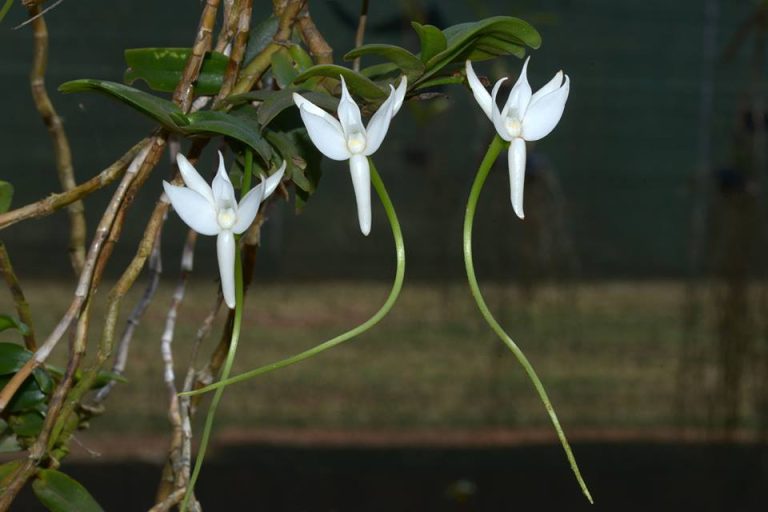
At a glance
RECORDED PROFILE DATA- Scientific name
- Angraecum viguieri Schltr.
- Name status
- Accepted
- Native region
- Madagascar
- Growth habit
- Epiphytic subshrub (monopodial orchid)
- Cultivation temperature group
- Warm‑intermediate (≈16‑29 °C)
- Flowering period (wild)
- October‑November
- IUCN status
- Least Concern
Names and Taxonomy
Angraecum viguieri Schltr. is the accepted name for this species. It was first described in Repertorium Specierum Novarum Regni Vegetabilis 18:326 (1922) [1]. A later homotypic synonym is Rudolfangraecum viguieri (Schltr.) Szlach., Mytnik & Grochocka (2013) [1]. The species is commonly known as Viguier’s Angraecum [2]. The IUCN Red List classifies it as Least Concern [1].
How to Identify This Species
In the wild A. viguieri grows as a modest epiphytic subshrub, typically 25–30 cm tall [5]. Stems are monopodial and bear two‑ranked, strap‑shaped leaves 6–14 cm long and 0.8–1.2 cm wide [5]. The leaves are leathery and arranged alternately along the stem.
The solitary flower is large for the genus. Sepals and petals are 5.5–6 cm long, yellow‑green to orange‑brown, while the lip is white with a subtle orange‑yellow gradient that intensifies toward the base [7]. The lip is broadly ovate, about 5.5 cm long and 3.5 cm wide, and is edged with a thin, recurved margin. A distinctive feature is the long, curved nectar spur, up to 10 cm in length, which arches away from the flower centre [5]. The fragrance is strongest at night, a trait shared with many moth‑pollinated Angraecum species [4]. Flower size and spur length readily distinguish it from the more uniformly white, shorter‑spurred Angraecum species of Madagascar.
Native Range and Habitat
The species is endemic to Madagascar, primarily the northeastern part of the island, recorded from the provinces of Antsiranana, Toamasina and Fianarantsoa [5][7]. It inhabits humid, evergreen montane forests, often on moss‑covered ridge tops, at elevations between 900 and 1 100 m (approximately 3 000–3 600 ft) [5][9]. In its natural setting the orchid grows epiphytically on tree branches in a wet tropical biome, where humidity remains high year‑round and light is filtered through the forest canopy.
Species‑Specific Care
| Factor | Documented guidance | Source |
|---|---|---|
| Mounting / potting | Can be mounted on bark or grown in a well‑draining fine bark mix; both methods have been reported successful. | [4][4] |
| Light | Moderately bright light; some direct sun tolerated, but avoid intense midday exposure. | [4][8] |
| Temperature | Warm to intermediate: day temperatures 21–29 °C, night 16–24 °C; cooler winter period (down to 13 °C night) can stimulate flowering. | [4][8] |
| Humidity | High humidity, ideally 80–86 %. | [4][9] |
| Watering | Keep the medium consistently moist; water regularly, especially during warm periods. Avoid letting the roots dry out. | [4][8] |
| Fertilisation | Apply a balanced, water‑soluble fertilizer at half strength weekly during active growth. | [8] |
| Airflow | Good air movement is beneficial; a gentle fan helps prevent fungal problems. | [8] |
| Repotting / re‑mounting | Refresh the bark medium every 2–3 years or when roots outgrow the support. | [8] |
| Seasonal cues | Providing a cooler, slightly drier winter (night 13–16 °C) has been reported to encourage flowering. | [4] |
In practice, growers have found that a moderate temperature drop in winter, combined with the species’ natural preference for high humidity and bright filtered light, yields the most reliable flowering.
Flowering and Pollination
In the wild, A. viguieri flowers in the early wet season, typically from October to November [5][9]. The flowers are nocturnally fragrant, a trait that suggests pollination by long‑tongued moths (hawkmoths), a common pollination syndrome in the genus. The long, curved spur (up to 10 cm) stores nectar at its tip, matching the proboscis length of many hawkmoths. However, direct observations of pollinators for this species have not been published, so the pollination mechanism remains inferred rather than documented.
Conservation and Responsible Cultivation
The IUCN Red List assesses Angraecum viguieri as Least Concern, although habitat pressures such as deforestation and forest fragmentation have been noted in recent studies of the Andasibe‑Mantadia protected area [5]. All orchids are listed under CITES Appendix II, which regulates international trade. Cultivators should source plants from reputable growers who provide propagation‑derived material rather than wild‑collected specimens.
Evidence and Limitations
Most morphological data (leaf size, flower dimensions, spur length) are drawn from regional floras and horticultural reports. Precise pollinator observations are lacking, and quantitative watering or fertiliser regimes are based on grower experience rather than controlled experiments. Further field research would help clarify the species’ ecological requirements and confirm its pollination biology.
Frequently asked questions
What temperature range should I maintain for Angraecum viguieri?
Growers report day temperatures of 21–29 °C and night temperatures of 16–24 °C, with a cooler winter down to about 13 °C at night to encourage flowering.
Can Angraecum viguieri be grown mounted?
Yes, the species thrives both mounted on bark and in a well‑draining fine bark potting mix, as documented by multiple growers.
When does Angraecum viguieri flower in cultivation?
In cultivation, flowering has been observed from late summer into early autumn, often after a cooler winter period; in the wild it flowers in October–November.
FOLLOW THE EVIDENCE
Sources & references
- Angraecum viguieri Schltr. | Plants of the World Online | Kew Science, https://powo.science.kew.org/taxon/urn:lsid:ipni.org:names:616478-1
- Angraecum viguieri | orchid.guru, https://www.orchid.guru/content/orchids/a/angraecum/viguieri/
- Angraecum viguieri – personal cultivation notes, Orchid Borealis blog, http://orchidborealis.blogspot.com/2022/04/angraecum-viguieri.html
- Angraecum viguieri outcross culture, Mostly Species, http://sonic.net/~mturkel/mostlyspecies/f.ang.vig.1385.html
- Angraecum viguieri – BOTANY.cz, https://botany.cz/cs/angraecum-viguieri/
- Angraecum viguieri – Orchidee.de, https://orchidee.de/angraecum-viguieri/
- Contribution à l'étude de quelques espèces endémiques d'orchidées… (2008 dissertation), https://doi.org/10.63917/mem.2008.1046