At a glance
RECORDED PROFILE DATA- Scientific name
- Angraecum triangulifolium Senghas
- Name status
- Accepted
- Native region
- Madagascar
- Growth habit
- Epiphytic subshrub
- Cultivation temperature group
- Cool‑intermediate (15‑25 °C)
Names and Taxonomy
The accepted scientific name is Angraecum triangulifolium Senghas. Kew’s Plants of the World Online lists it as an accepted name and records its first publication in Adansonia 4:310 (1964)【1】. A homotypic synonym is Angraecoides triangulifolia (Senghas) Szlach., Mytnik & Grochocka (2013)【1】. The species is sometimes referred to by the Chinese common name “三角叶风兰” (Triangular‑leaf wind orchid)【3】. No other nomenclatural disputes are noted in the consulted sources.
How to Identify This Species
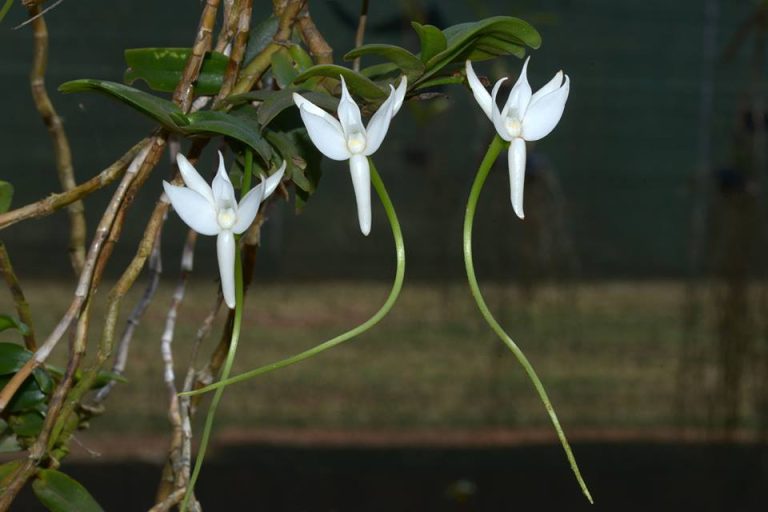
Growth habit: A compact epiphytic subshrub with a single slender stem arising from a short rhizome. Roots are aerial, white‑grey, and attach to bark or mounting material.
Leaves: Leaves are thick, leathery, dark‑green and uniquely triangular to broadly lanceolate, 5‑10 cm long, with an obtuse tip and a sheathing base that clasps the stem. Leaves are arranged in two opposite rows along the stem, a characteristic of many Angraecum species.
Inflorescence: Axillary, usually shorter than the leaf length, bearing 1–3 flowers.
Flowers: Small, white to creamy‑white, waxy texture. The lip is prominent, and the nectar spur is short or reduced compared with many other Angraecum species. Flowers emit a pleasant fragrance in the evening, typical of the genus. Detailed measurements of flower parts are not provided in the available sources.
These characters together – triangular leaves, compact epiphytic habit, short spur and evening fragrance – help distinguish A. triangulifolium from similar species such as A. amplexicaule (which has broader, non‑triangular leaves) and A. macilentum (which bears a longer spur).
Native Range and Habitat
Angraecum triangulifolium is endemic to Madagascar, occurring primarily in the wet tropical rainforests of the island’s eastern and northern regions【1】. In its natural habitat the orchid grows as an epiphyte on the trunks and large branches of canopy trees, often between 800 m and 1 200 m elevation【3】. The forest is characterised by high, year‑round humidity, frequent mist, and a warm but not hot climate, typical of Madagascar’s montane rainforest biome.
Species‑Specific Care
| Factor | Documented guidance | Evidence |
|---|---|---|
| Light | Bright, diffused light; avoid direct sun. Shade level 50‑70 %. | 【3】 |
| Temperature | Day 15‑25 °C; night can drop to ~12 °C to promote flowering. | 【3】 |
| Humidity | Maintain 60‑80 % relative humidity; good ventilation to prevent rot. | 【3】 |
| Watering | Keep medium moist but not water‑logged; follow “wet‑then‑dry” cycle. | 【3】 |
| Airflow | Provide steady fresh airflow; avoid stagnant air. | 【3】 |
| Substrate / Mounting | Well‑draining coarse bark mix with sphagnum moss and charcoal; can be mounted on cork or grown in a hanging basket. | 【3】 |
| Fertiliser | Balanced orchid fertilizer at half strength once a week during active growth; reduce to monthly in cooler periods. | 【3】 |
| Repotting / Re‑mounting | Every 2‑3 years or when the medium breaks down; use fresh bark mix. | 【3】 |
| Seasonal change | Cooler night temperatures in winter encourage flower bud formation; reduce fertiliser and watering slightly during the coolest months. | 【3】 |
Overall, the species prefers conditions that mimic its native montane rainforest: moderate temperatures, high humidity, bright but filtered light, and excellent air movement. Because it is listed as Endangered, growers are encouraged to obtain plants from reputable, CITES‑compliant sources and to consider propagation by division or tissue culture rather than wild collection.
Flowering and Pollination
Flowering time in the wild has not been documented in the sources consulted. In cultivation, the plant is reported to flower once a year when provided with cooler night temperatures, but exact months vary with local climate.
Many Angraecum species are pollinated by long‑tongued hawk moths that are active at night, attracted by the white, fragrant flowers. No specific pollinator for A. triangulifolium has been recorded, so pollination ecology remains unconfirmed for this species.
Conservation and Responsible Cultivation
The IUCN Red List classifies Angraecum triangulifolium as Endangered (criteria B1ab(i‑v)+2ab(i‑v)) due to its limited extent of occurrence, fragmented populations and ongoing habitat loss in Madagascar’s rainforests【2】. The species is listed under CITES Appendix II, regulating international trade.
Collectors should source plants only from licensed growers and should prioritize ex‑situ propagation to reduce pressure on wild populations.
Evidence and Limitations
Key gaps in the available literature include precise flower dimensions, exact flowering months in the native range, and documented pollinator observations. The cultivation advice derives from a single horticultural source (tropicals.cn) and may reflect practices used by growers in temperate regions; growers should adjust parameters to local conditions as needed.
Frequently asked questions
What is the conservation status of Angraecum triangulifolium?
The species is assessed as Endangered on the IUCN Red List (criteria B1ab(i‑v)+2ab(i‑v))【2】.
What temperature range does this orchid need in cultivation?
Cultivation records recommend keeping daytime temperatures between 15 °C and 25 °C, with cooler nights down to about 12 °C to encourage flowering【3】.
Can Angraecum triangulifolium be grown mounted or in a pot?
Both methods are used; the species tolerates mounting on cork or tree bark as well as growing in a well‑draining hanging basket with coarse bark and sphagnum mix【3】.
FOLLOW THE EVIDENCE
Sources & references
- Plants of the World Online – Angraecum triangulifolium Senghas, Kew Science, 2026, https://powo.science.kew.org/taxon/urn:lsid:ipni.org:names:616457-1
- IUCN Red List – Angraecum triangulifolium, 2018 assessment, https://www.iucnredlist.org/species/68501492/68703185
- Tropicals.cn – 三角叶风兰 Angraecum triangulifolium, cultivation article, 2026, https://tropicals.cn/species/angraecum-triangulifolium