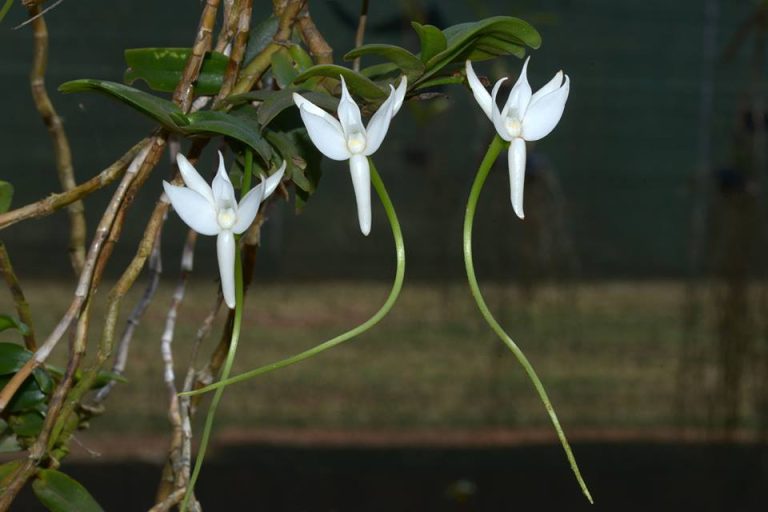
At a glance
RECORDED PROFILE DATA- Scientific name
- Angraecum tenuispica Schltr.
- Name status
- Accepted
- Native region
- Madagascar
- Growth habit
- Epiphytic subshrub
- Cultivation temperature group
- Not documented
Names and Taxonomy
The accepted scientific name for this species is Angraecum tenuispica Schltr. The name was first published in Repertorium Specierum Novarum Regni Vegetabilis 15: 339 (1918) [1]. Kew’s Plants of the World Online lists the name as accepted and records a single homotypic synonym: Lepervenchea tenuispica (Schltr.) Szlach., Mytnik & Grochocka (2013) [1]. No common names are documented for this species.
How to Identify This Species
Published information on the morphology of Angraecum tenuispica is limited to a brief habit description. It is recorded as an epiphytic subshrub growing in wet tropical forest [1]. Detailed measurements of stems, leaves, or flowers, as well as diagnostic characters such as lip shape, spur length, or fragrance, are not documented in the available sources. Consequently, reliable identification in the field should rely on herbarium specimens or expert confirmation rather than visual traits alone.
Native Range and Habitat
This orchid is endemic to Madagascar. Kew indicates its native range is “likely to be Madagascar” and it occurs in the wet tropical biome as an epiphyte on tree branches [1]. Elevation range, specific forest type, or host tree preferences are not detailed in the cited material.
Species‑Specific Care
| Factor | Documented guidance | Source |
|---|---|---|
| Growth habit | Epiphytic subshrub; likely requires mounting or a very well‑draining medium. | Not documented (inferred from habit) – [1] |
| Temperature | Not documented. | – |
| Light | Not documented. | – |
| Watering | Not documented. | – |
| Humidity | Not documented. | – |
| Fertilisation | Not documented. | – |
Because specific horticultural information for Angraecum tenuispica is lacking, growers should treat it as a typical wet‑forest epiphytic orchid: mount on bark or use a coarse, airy medium, maintain high humidity, and provide bright but filtered light. However, these suggestions are not sourced from species‑specific observations and should be applied with caution.
Flowering and Pollination
No published data on the flowering period, flower morphology, scent, or pollinators of Angraecum tenuispica were found in the supplied sources. Therefore, flowering time and pollination ecology remain undocumented.
Evidence and Limitations
The profile relies primarily on Kew’s Plants of the World Online entry, which confirms the accepted name, synonymy, and general habitat type. Detailed morphological descriptions, phenology, and cultivation protocols are not available in the consulted material. Further field studies and horticultural reports are needed to fill these gaps.
Frequently asked questions
Is Angraecum tenuispica considered endangered?
The conservation status of Angraecum tenuispica is not documented in the sources consulted.
Can Angraecum tenuispica be grown in cultivation?
Specific cultivation guidelines are not available; growers may treat it as a typical wet‑forest epiphytic orchid, but success is unverified.
Related terminology
- Epiphyte
- A plant that grows upon another plant (such as a tree) for physical support, deriving its nutrients and moisture from the air, rain, and debris accumulating around it.
- Subshrub
- A perennial plant with woody stems near the base and herbaceous growth above, often low‑growing.
FOLLOW THE EVIDENCE
Sources & references
- Angraecum tenuispica Schltr. | Plants of the World Online | Kew Science, 2026, https://powo.science.kew.org/taxon/urn:lsid:ipni.org:names:616451-1
- Angraecum tenuispica in Genus Angraecum, PlantaeDB, 2026, https://plantaedb.com/taxa/phylum/angiosperms/order/asparagales/family/orchidaceae/genus/angraecum/species/angraecum-tenuispica