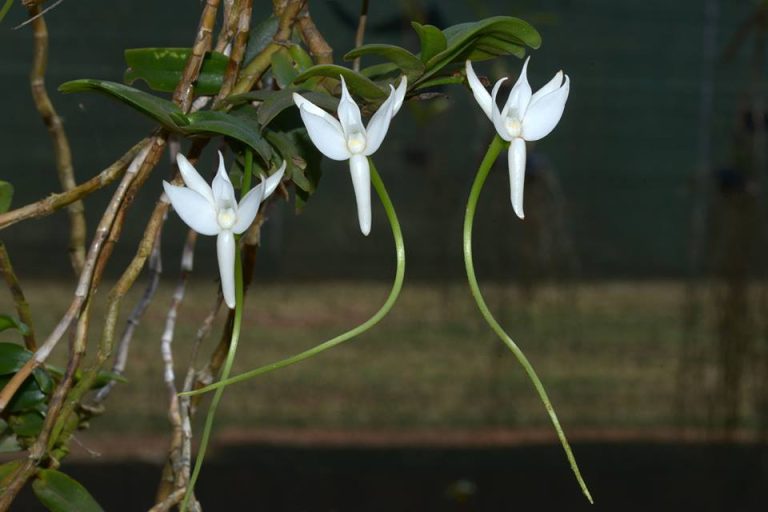
At a glance
RECORDED PROFILE DATA- Scientific name
- Angraecum tenuipes Summerh.
- Name status
- Accepted name (POWO)
- Native region
- Northern and central Madagascar
- Growth habit
- Epiphytic subshrub
- Cultivation temperature group
- Not documented
Names and Taxonomy
Angraecum tenuipes Summerh. is the accepted name for this species according to Kew’s Plants of the World Online (POWO) database[1]. The name was first published in Kew Bulletin 6: 473 (1951, published 1952). POWO lists two homotypic synonyms: Angraecum ischnopus Schltr. (illegitimate) and Gomphocentrum tenuipes (Summerh.) Szlach., Mytnik & Grochocka[1]. No common name has been recorded in the available sources.
How to Identify This Species
The published material provides only a very brief description of growth habit (epiphytic subshrub) and habitat (wet tropical biome). Detailed morphological data—such as leaf size, stem length, flower colour, lip shape, spur length, or fragrance—are not documented in the sources consulted. Consequently, reliable field identification must rely on examination of a living specimen’s flower morphology in comparison with the generic key for Angraecum, but the specific diagnostic characters for A. tenuipes remain unavailable in the current literature.
For growers who encounter a plant labelled as Angraecum tenuipes, verification should be performed by a qualified orchid taxonomist using herbarium material or high‑resolution photographs of the flower, especially the lip and spur, which are the principal characters distinguishing Angraecum species.
Native Range and Habitat
POWO records the native distribution of Angraecum tenuipes as northern and central Madagascar[1]. The species is described as an epiphyte growing on tree branches in wet tropical forests. No elevation range, specific host trees, or precise locality data are given in the cited sources. The wet‑tropical biome of Madagascar typically experiences high humidity, abundant rainfall, and relatively stable warm temperatures throughout the year.
Species‑Specific Care
| Factor | Documented guidance | Source / Context |
|---|---|---|
| Growth habit | Epiphytic (mount or basket) | POWO – native habit[1] |
| Light | Not documented | — |
| Temperature | Not documented | — |
| Watering | Not documented | — |
| Humidity | Not documented | — |
| Medium / Substrate | Not documented (epiphytic suggests bark or coarse orchid mix) | Inference from habit only |
| Fertilisation | Not documented | — |
| Repotting / Re‑mounting | Not documented | — |
| Seasonal changes | Not documented | — |
Because species‑specific horticultural data are absent, growers are advised to apply general practices for Malagasy epiphytic Angraecum orchids: mount on well‑draining bark, provide bright filtered light, maintain high humidity, and keep temperatures similar to lowland rainforest conditions (approximately 20‑28 °C). However, these recommendations are extrapolated from the genus and not verified for A. tenuipes itself.
Flowering and Pollination
No published information on the flowering period, flower dimensions, scent, or pollinator relationships for Angraecum tenuipes was found in the available references. Many Angraecum species possess long nectar spurs and are pollinated by hawk moths, but applying that pattern to A. tenuipes would be speculative without direct evidence.
Evidence and Limitations
The profile is based primarily on the Kew Plants of the World Online entry for Angraecum tenuipes and a brief Swedish Wikipedia entry confirming authorship and synonymy. Detailed morphological descriptions, phenology, pollination biology, and horticultural guidelines are not documented in the sources consulted. Consequently, many sections contain “Not documented” statements, and any cultivation advice is derived from general knowledge of the genus rather than species‑specific research.
Frequently asked questions
Is Angraecum tenuipes considered endangered?
The conservation status of Angraecum tenuipes is not listed in the sources consulted; a formal assessment (e.g., IUCN) has not been documented.
What light conditions does Angraecum tenuipes need?
Specific light requirements are not documented for this species. Growers typically provide bright, filtered light for epiphytic Angraecum orchids.
FOLLOW THE EVIDENCE
Sources & references
- Angraecum tenuipes Summerh. | Plants of the World Online | Kew Science, https://powo.science.kew.org/taxon/urn:lsid:ipni.org:names:616450-1
- Angraecum tenuipes – Swedish Wikipedia, https://sv.wikipedia.org/wiki/Angraecum_tenuipes