At a glance
RECORDED PROFILE DATA- Scientific name
- Angraecum sterrophyllum Schltr.
- Name status
- Accepted
- Native region
- Madagascar (central, Antananarivo province)
- Growth habit
- Epiphytic subshrub
- Cultivation temperature group
- Not documented
Names and Taxonomy
The accepted scientific name is Angraecum sterrophyllum Schltr. The name was first published in Beih. Bot. Centralbl. 34:338 (1916) and is accepted by Kew’s Plants of the World Online.[1] A later synonym is Arachnangraecum sterrophyllum (Schltr.) Szlach., Mytnik & Grochocka (2013). No common names are recorded in the consulted sources.[1]
How to Identify This Species
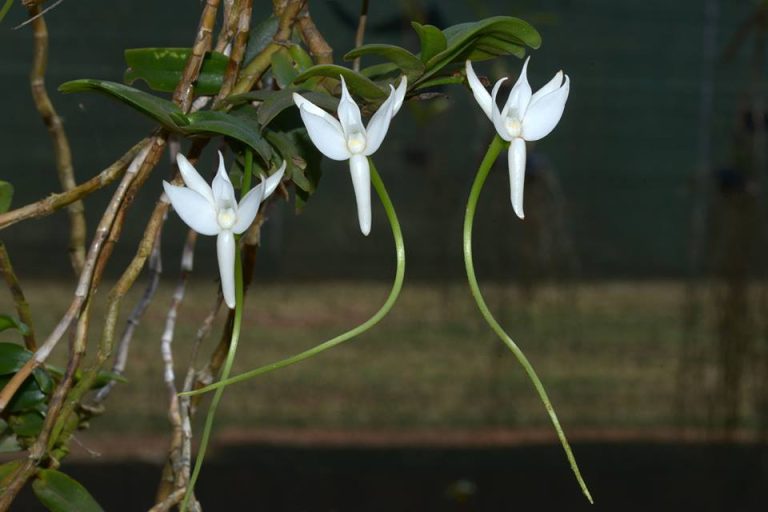
Plants are epiphytic subshrubs that reach about 30 cm in height.[4] Leaves are arranged along a short stem, but detailed leaf morphology is not documented in the available sources. Flowers are reported as white to greenish‑white and fragrant; blooming has been observed throughout the year in cultivation.[4] No measurements of flower size, lip shape, or spur length are currently available.
Because many Angraecum species share a similar growth habit, reliable identification requires comparison of the flower morphology against herbarium specimens or photographs confirmed by experts.
Native Range and Habitat
Angraecum sterrophyllum is endemic to Madagascar, specifically the central part of the island, with records concentrated in the Antananarivo province in the north‑central region.[2] It occurs at elevations of 1,000–1,500 m in sub‑humid forests, growing as an epiphyte on the tree Uapaca bojeri.[2] The habitat is described as seasonally dry tropical woodland, typical of the central highlands.[1]
Species‑Specific Care
| Factor | Documented guidance | Evidence |
|---|---|---|
| Growth habit | Epiphytic; can be mounted on bark or grown in a very well‑draining medium. | Inferred from epiphytic habit; not a specific cultivation protocol.[4] |
| Light | Not documented for this species. | |
| Temperature | Not documented for this species. | |
| Watering | Not documented for this species. | |
| Humidity | Not documented for this species. | |
| Feeding | Not documented for this species. | |
| Seasonal rest | Not documented for this species. |
Because the species is extremely rare in the wild and there are few cultivated specimens, growers should treat any cultural advice as tentative and base practices on general Angraecum requirements: bright indirect light, moderate temperatures (15–25 °C), and high humidity, while ensuring excellent air flow to mimic its forest canopy environment. Any propagation attempts should use sterile media and consider the need for mycorrhizal fungi, as noted for many Angraecum orchids.[4]
Flowering and Pollination
In cultivation the plant has been reported to flower in all months of the year, producing fragrant white to greenish‑white flowers.[4] No specific data on flower longevity, nectar spur dimensions, or natural pollinators have been documented for this species.
The fragrance suggests moth pollination, a common syndrome in the genus, but this remains a hypothesis pending field observation.
Conservation and Responsible Cultivation
The IUCN Red List classifies Angraecum sterrophyllum as Critically Endangered (Possibly Extinct).[2][5] The last confirmed collection dates to the early 20th century, and habitat loss in Madagascar’s central highlands continues to threaten remaining populations. Conservation actions focus on habitat protection and ex‑situ propagation, but the scarcity of living material limits propagation programs.
Evidence and Limitations
Key aspects such as detailed flower morphology, precise temperature and humidity preferences, and natural pollinator observations are not documented in the available sources. Most horticultural information comes from a single online plant‑information site and may reflect limited observations. Further field studies and cultivation trials are needed to fill these gaps.
Frequently asked questions
What is the conservation status of Angraecum sterrophyllum?
It is listed as Critically Endangered (Possibly Extinct) on the IUCN Red List and in the French Wikipedia entry.[2][5]
When does Angraecum sterrophyllum flower?
Cultivated specimens have been reported to produce fragrant white to greenish‑white flowers throughout the year.[4] Wild flowering timing has not been documented.
FOLLOW THE EVIDENCE
Sources & references
- Angraecum sterrophyllum Schltr. | Plants of the World Online | Kew Science, https://powo.science.kew.org/taxon/urn:lsid:ipni.org:names:616429-1
- Angraecum sterrophyllum – French Wikipedia, https://fr.wikipedia.org/wiki/Angraecum_sterrophyllum
- Angraecum sterrophyllum – Recently Extinct Species website, https://recentlyextinctspecies.com/asparagales-aloes-asparagus-garlic-irises-onions-etc/angraecum-sterrophyllum
- Angraecum sterrophyllum – NativePlants.info, https://www.nativeplants.info/plant/magnoliophyta-flowering-plants/orchidaceae/angraecum/angraecum_sterrophyllum.html
- Angraecum sterrophyllum – IUCN Red List entry, https://doi.org/10.2305/iucn.uk.2015-2.rlts.t68501557a68715503.en