At a glance
RECORDED PROFILE DATA- Scientific name
- Angraecum rubellum Bosser
- Name status
- Accepted (Kew POWO)
- Native region
- Madagascar
- Growth habit
- Epiphytic subshrub (miniature epiphyte)
- Cultivation temperature group
- Intermediate to warm (20–28 °C day)
Names and Taxonomy
Angraecum rubellum Bosser is the accepted name for this species. It was first described in Adansonia n.s., 10: 22 (1988) and is listed as an accepted orchid by Kew’s Plants of the World Online.[1]
How to Identify This Species
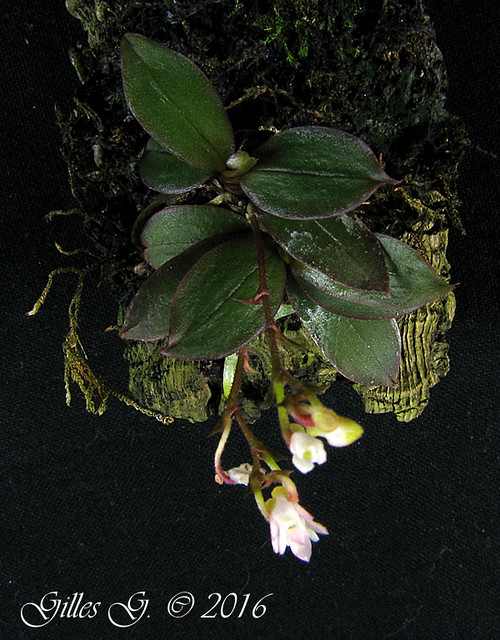
Plants are miniature epiphytic subshrubs that typically reach about 30 cm in height.[3] The leaves are obovate to elliptic, strongly keeled on the lower surface and often display a reddish‑purple tinge. Flowering spikes are short and bear 1–3 flowers. Individual blossoms are 1.5–2.5 cm long, whitish to slightly pink, and covered with tiny papillose hairs that give a textured appearance. The fragrance is reported as pleasant and noticeable.[5][7] These characters together distinguish A. rubellum from other small Angraecum species, although overlap in leaf shape and flower size can occur.
Native Range and Habitat
The species is endemic to eastern Madagascar, specifically the ENE part of the island, where it inhabits humid tropical forests and grows as an epiphyte on tree trunks and branches.[1] It prefers the wet tropical biome but precise elevation limits have not been published.
Species-Specific Care
| Factor | Documented guidance | Evidence |
|---|---|---|
| Temperature | Daytime 20–28 °C (68–82 °F); night temperatures around 18 °C (64 °F) | [7] |
| Light | Bright, indirect light; avoid direct midday sun | [7] |
| Humidity | High humidity, ideally 75–80 % | [7] |
| Watering | Water thoroughly when the growing medium is nearly dry; use rain‑water or distilled water | [7] |
| Substrate / Mount | Epiphytic mount or well‑draining bark‑based mix; good airflow | [7] |
| Fertiliser | Balanced orchid fertilizer at half strength once a month during active growth | Not documented; general orchid practice |
| Repotting / Re‑mounting | Refresh bark medium every 2–3 years; avoid disturbing roots excessively | Not documented; inferred from epiphytic habit |
Overall, A. rubellum thrives under conditions that mimic its native humid forest: warm day temperatures, high humidity, and plenty of indirect light. Because the plant is small and lacks a prominent stem, mounting on a slab of cork bark or tree‑fern fiber is often preferred to a traditional pot.
Flowering and Pollination
In cultivation the species has been reported to flower throughout the year, producing up to three small blossoms per spike.[5] Flowers last several weeks and emit a pleasant fragrance, especially in the evening, but no specific pollinator has been recorded for this species.[5][7] The short nectar spur suggests moth pollination, a common trait in many Angraecum, yet direct evidence is lacking.
Conservation and Responsible Cultivation
The IUCN Red List classifies Angraecum rubellum as Critically Endangered (Possibly Extinct) based on the last known collection in 1963 and ongoing habitat loss in eastern Madagascar.[2] Cultivation from seed or tissue culture can reduce pressure on wild populations, but any trade should comply with CITES Appendix II regulations that cover all Orchidaceae.
Evidence and Limitations
Key information such as precise elevation range, natural pollinators, and detailed propagation protocols is not documented in the available sources. The care recommendations are derived from a single commercial grower’s notes and may not reflect the full variability of the species in cultivation.
FOLLOW THE EVIDENCE
Sources & references
- Angraecum rubellum Bosser – Plants of the World Online, Royal Botanic Gardens, Kew, 2026, https://powo.science.kew.org/taxon/urn:lsid:ipni.org:names:935204-1
- Angraecum rubellum – IUCN Red List of Threatened Species, 2015, https://dx.doi.org/10.2305/IUCN.UK.2015-2.RLTS.T68501519A68719905.en
- Angraecum rubellum – NativePlants.info, 2026, https://www.nativeplants.info/plant/magnoliophyta-flowering-plants/orchidaceae/angraecum/angraecum_rubellum.html
- Angraecum rubellum – Begin With Plants product page, 2026, https://beginwithplants.com/products/angraecum-rubellum

