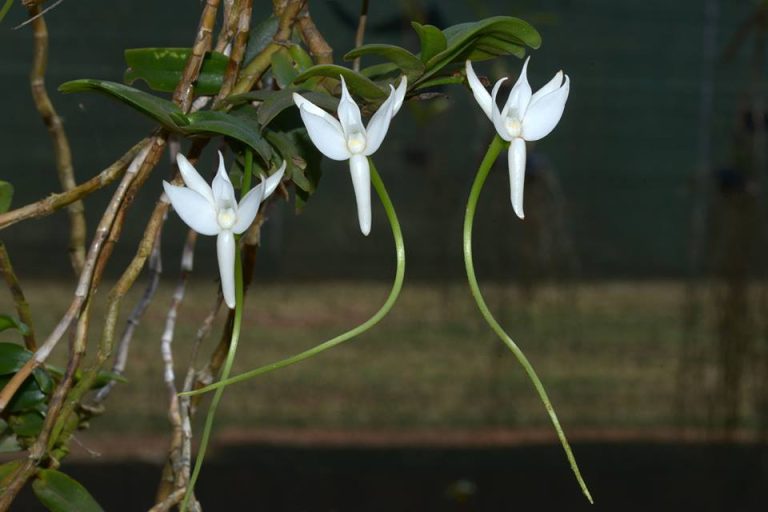
At a glance
RECORDED PROFILE DATA- Scientific name
- Angraecum rhizomaniacum Schltr.
- Name status
- Accepted
- Native region
- Northern Madagascar
- Growth habit
- Epiphytic subshrub
- Cultivation temperature group
- Not documented
Names and Taxonomy
The accepted scientific name is Angraecum rhizomaniacum Schltr. The name was first published in Repertorium Specierum Novarum Regni Vegetabilis. Beihefte 33: 315 (1925)【2】. Kew’s Plants of the World Online lists this name as accepted and records its native range as northern Madagascar【1】. A later homotypic synonym is Angraecoides rhizomaniaca (Schltr.) Szlach., Mytnik & Grochocka, published in 2013, but this is treated as a synonym of the accepted name【3】. No common name is documented in the available sources.
How to Identify This Species
Growth habit: Small epiphytic subshrub, typically about 30 cm tall in the wild【4】. Roots arise from the base of the stem and cling to tree bark.
Leaves: Not specifically described in the available sources; typical of the genus they are leathery, arranged along the stem.
Flowers: Reported as white with green tones and fragrant【4】. Blooming may occur in any month, suggesting a prolonged or continuous flowering period【4】. Detailed measurements of flower size, lip shape, or spur length are not documented.

Diagnostic features: The combination of a low, epiphytic habit, white‑green fragrant flowers and a northern Madagascar distribution helps separate it from other Angraecum species, but without a detailed floral description a definitive field identification may require comparison with herbarium specimens.
Native Range and Habitat
The species is endemic to the northern part of Madagascar【1】. It grows as an epiphyte on trees within wet tropical forest biomes, indicating a preference for high humidity and consistent moisture. Elevational limits are not recorded in the sources consulted.
Species‑Specific Care
| Factor | Documented guidance | Evidence |
|---|---|---|
| Growth habit | Epiphytic; mount on bark or grow in a very well‑draining medium that mimics tree branches. | Native habit described as epiphytic subshrub【4】 |
| Size | Plants remain small, about 30 cm tall in cultivation. | Reported height from cultivation notes【4】 |
| Light | Not documented for this species. | — |
| Temperature | Not documented; native forest is warm‑humid. | — |
| Watering | Not documented; epiphytes from wet forests generally require regular moisture without waterlogging. | — |
| Humidity | Not documented; native habitat is a wet tropical biome. | — |
| Fertilizer | Not documented. | — |
| Rest period | Not documented. | — |
Because specific cultural guidelines are lacking, growers should aim to replicate the species’ natural epiphytic environment: bright, filtered light; high humidity; warm temperatures (around 20‑28 °C) typical of lowland tropical forests; and frequent, gentle watering that keeps the mounting medium moist but not soggy. Monitoring for typical epiphytic orchid pests (e.g., mealybugs) is advisable.
Flowering and Pollination
Flowers are reported to be fragrant and may appear throughout the year【4】. No formal pollination study is available for this species, and the pollinator identity remains undocumented.
Evidence and Limitations
Taxonomic and distribution data are well supported by Kew’s Plants of the World Online and IPNI. Morphological details beyond habit, height, flower colour and fragrance are limited to a single cultivation‑focused source, and no peer‑reviewed floral description or pollination study was found. Conservation status is only indicated by a predictive model that classifies the species as “threatened”【5】; a formal IUCN assessment is not available. Consequently, many horticultural recommendations are inferred from the species’ native epiphytic habit rather than species‑specific trials.
Frequently asked questions
Is Angraecum rhizomaniacum considered endangered?
A predictive extinction‑risk model classifies the species as “threatened”, but it has not yet been formally assessed by the IUCN.
How large does Angraecum rhizomaniacum grow?
In the wild it is reported to reach about 30 cm in height.
FOLLOW THE EVIDENCE
Sources & references
- Angraecum rhizomaniacum | Plants of the World Online | Kew Science, https://powo.science.kew.org/taxon/urn:lsid:ipni.org:names:616375-1
- Angraecum rhizomaniacum | International Plant Names Index, https://www.ipni.org/n/616375-1
- Angraecoides rhizomaniaca (Schltr.) Szlach., Mytnik & Grochocka | Plants of the World Online | Kew Science, https://powo.science.kew.org/taxon/urn:lsid:ipni.org:names:77138529-1
- Angraecum rhizomaniacum (Angraecum rhizomaniacum) | NativePlants.info, https://www.nativeplants.info/plant/magnoliophyta-flowering-plants/orchidaceae/angraecum/angraecum_rhizomaniacum.html
- Angiosperm Extinction Risk Predictions v1 – Predicted threat status for Angraecum rhizomaniacum, 2024, https://nph.onlinelibrary.wiley.com/doi/full/10.1111/nph.19592