At a glance
RECORDED PROFILE DATA- Scientific name
- Angraecum podochiloides Schltr.
- Name status
- Accepted
- Native region
- West Tropical Africa; West‑Central Tropical Africa
- Growth habit
- Epiphytic subshrub
- Cultivation temperature group
- Not documented
Names and Taxonomy
Angraecum podochiloides Schltr. is the accepted name for this species according to Kew’s Plants of the World Online[1]. The name was first published in Botanische Jahrbücher für Systematik 38:162 in 1906[2]. Synonyms recorded include Dolabrifolia podochiloides (Schltr.) Szlach. & Romowicz (2007) and Monixus aporum Finet (1907)[1]. No common name is documented in the consulted sources. The taxonomic status is “accepted”.
How to Identify This Species
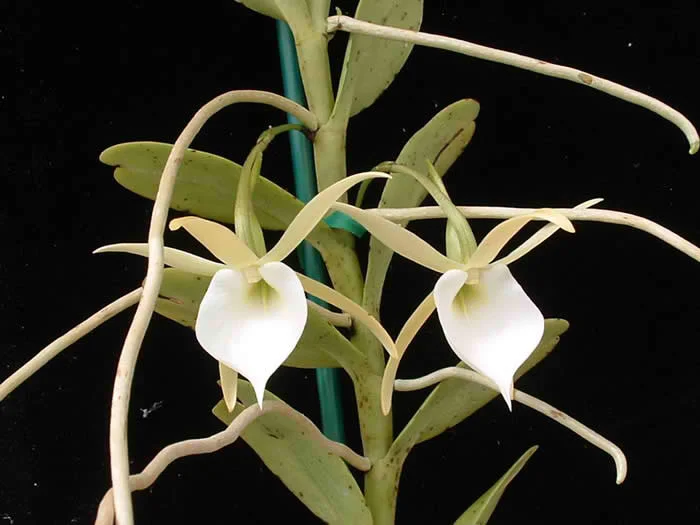
In the field the plant appears as an epiphytic subshrub up to about 60 cm long, with stems that may droop or curve upward and are often slightly flattened[3]. Leaves are distichous, fleshy, lanceolate‑oblong, 1–2 cm long and 0.2–0.3 cm wide, overlapping at the base and pressed together (imbricate). The plant produces a single flower on a very short pedicel arising opposite a leaf[3][4]. Flowers are white to yellow‑white, with linear tepals 4.5–5 mm long by 1.5–2 mm wide. The labellum is sac‑like, obovate, about 5 mm long by 4 mm wide, three‑lobed. The nectar spur is straight, funnel‑shaped, 4.5–6 mm long[3][4]. These characters, especially the single‑flowered axillary inflorescence and the short straight spur, help separate it from other Angraecum species that often have multiple flowers or longer curved spurs.
Native Range and Habitat
The species is native to West and West‑Central Tropical Africa, recorded from Cameroon, the Democratic Republic of the Congo, Equatorial Guinea, Gabon, Ghana, Guinea, Ivory Coast, Liberia and Nigeria[1]. It inhabits primary, humid rainforests, typically in shady understory positions on large trees such as Gilbertiodendron dewevrei and Dialium corbisieri[3]. It occurs from near sea level up to about 1 500 m altitude. The orchid prefers the moist, stable microclimate of dense forest canopies.
Species‑Specific Care
| Factor | Documented guidance | Source |
|---|---|---|
| Light | Bright, indirect light; avoid direct midday sun. | [5] |
| Humidity | Maintain 60–80 % relative humidity. | [5] |
| Watering | Water when the top inch of the growing medium is dry; ensure good drainage to prevent root rot. | [5] |
| Growing medium | Use a well‑draining orchid mix (e.g., bark, charcoal, perlite) or mount on cork bark. | [5] |
| Airflow | Provide moderate air movement to reduce fungal risk. | [5] |
| Fertilisation | Apply a balanced orchid fertilizer at half strength during active growth. | Not documented for this species; general orchid practice. |
| Temperature | Not documented for this species. | Not documented |
| Seasonal rest | Not documented; avoid assuming a dry rest period. | Not documented |
The care recommendations above stem from a horticultural overview that mentions Angraecum podochiloides specifically[5]. As the species is an epiphyte from humid lowland forests, providing ample air circulation, high humidity and a well‑draining medium is consistent with its natural ecology. Temperature ranges and rest periods have not been recorded for cultivated plants and should be approached cautiously.
Flowering and Pollination
Specific information on flowering time, flower longevity, fragrance or pollinator identity for Angraecum podochiloides is not documented in the available sources.
Conservation and Responsible Cultivation
The IUCN Red List assesses the species as Least Concern (LC)[6]. It is listed in CITES Appendix II, meaning international trade is regulated to ensure sustainability[7]. Collectors should obtain plants from reputable, legally compliant sources and avoid wild collection.
Evidence and Limitations
Most morphological and ecological details are derived from the African Plant Database and the Monaco Nature Encyclopedia, which provide concise but limited descriptions. Care guidance is based on a general horticultural article; detailed temperature preferences, flowering phenology and pollination biology remain undocumented. Further field studies and cultivated observations would improve the completeness of this profile.
Frequently asked questions
What type of habitat does Angraecum podochiloides naturally grow in?
It is an epiphytic orchid of primary, humid rainforests in West and Central Tropical Africa, often found on large trees such as Gilbertiodendron dewevrei and Dialium corbisieri at elevations from sea level up to about 1 500 m.[3][1]
Is Angraecum podochiloides threatened in the wild?
The species is assessed as Least Concern on the IUCN Red List and is listed in CITES Appendix II, indicating that while it is not currently endangered, trade is regulated to ensure sustainability.[6][7]
What are the key cultural requirements for growing this orchid at home?
Provide bright indirect light, maintain 60–80 % humidity, use a well‑draining orchid mix or mount on bark, water when the top inch of the medium dries, and ensure good airflow. Specific temperature ranges and rest periods have not been documented for this species.[5]
FOLLOW THE EVIDENCE
Sources & references
- Plants of the World Online – Angraecum podochiloides Schltr., Kew Science, https://powo.science.kew.org/taxon/urn:lsid:ipni.org:names:616343-1
- International Plant Names Index – Angraecum podochiloides Schltr., IPNI, https://ipni.org/n/616343-1
- African Plant Database – Angraecum podochiloides Schltr., https://africanplantdatabase.ch/en/nomen/specie/43513/angraecum-podochiloides-schltr
- Monaco Nature Encyclopedia – Angraecum podochiloides, https://www.monaconatureencyclopedia.com/angraecum-podochiloides-2/?lang=en
- Greg Editorial Team – Angraecum podochiloides Explained: Key Information, https://greg.app/angraecum-podochiloides-overview/
- IUCN Red List – Angraecum podochiloides, 2014 assessment, https://www.iucnredlist.org/species/16222589/16222892
- CITES Orchid Checklist – Angraecum podochiloides listed in Appendix II, https://www.monaconatureencyclopedia.com/angraecum-podochiloides/