At a glance
RECORDED PROFILE DATA- Scientific name
- Angraecum pinifolium Bosser
- Name status
- Accepted
- Native region
- Madagascar (northeastern)
- Growth habit
- Epiphytic subshrub (wet tropical)
- Cultivation temperature group
- Warm (tropical)
Names and Taxonomy
Angraecum pinifolium Bosser is the accepted scientific name for this species. The name was first published in Adansonia 10:99 (1970) and is listed as an accepted name by Kew’s Plants of the World Online [1]. A later homotypic synonym, Boryangraecum pinifolium (Bosser) Szlach., Mytnik & Grochocka, was created in 2013 but the Kew checklist retains Angraecum pinifolium as the correct name [1]. No common name has been documented in the sources.
How to Identify This Species
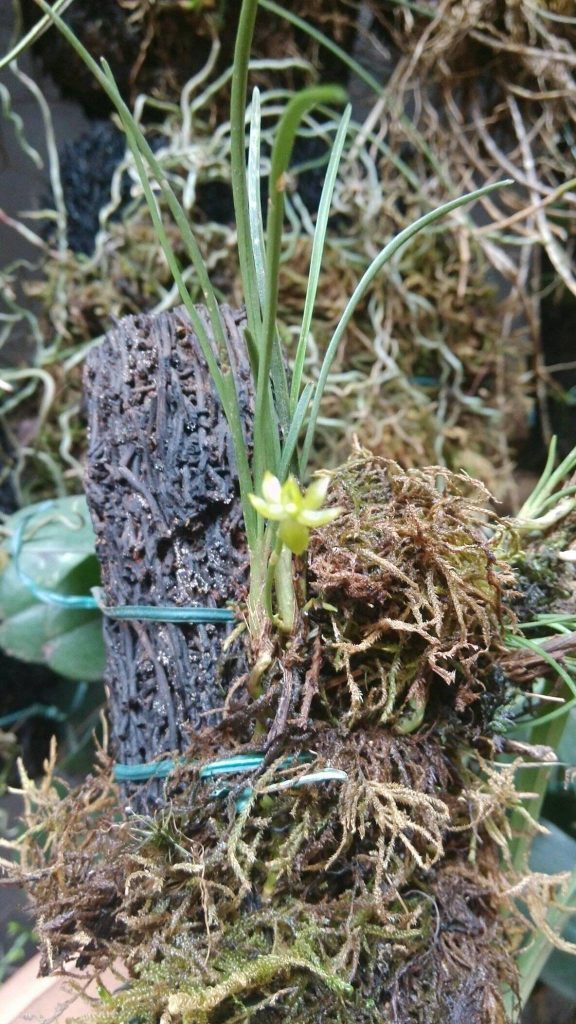
Angraecum pinifolium is a very small epiphytic orchid, often described as a miniature to small‑sized plant with an almost absent stem [2]. The vegetative parts are distinctive:
- Leaves: The plant bears four to five narrowly linear leaves that are canaliculate (grooved) on the upper surface, rounded below, and unequally bilobed at the tip. Leaves are acute and resemble pine needles, a feature reflected in the specific epithet “pinifolium” [2]. Length of the leaf cluster is typically 6–10 cm (2.4–4 in).
- Size: In cultivation the plant reaches about 30 cm in height, with a very short stem that is often hidden among the leaf bases [3]. Wild size is described as miniature, but precise measurements are not recorded.
- Roots: As an epiphyte it develops a network of aerial roots that attach to bark or branches.
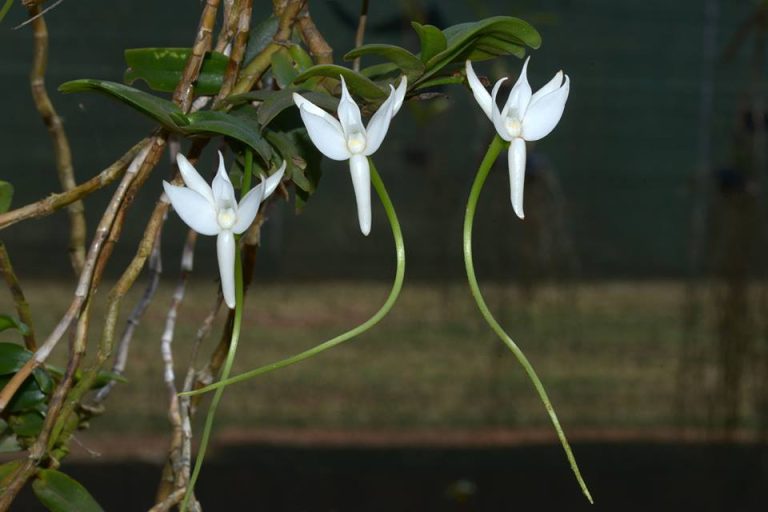
The inflorescence is a short, lax raceme that emerges from beneath the leaf cluster. It bears 2–4 flowers on a 6–10 cm (2.4–4 in) long axis [2]. Individual flowers are about 1.5 cm (0.6 in) across, white, and sit on green bracts. The lip is modestly sized, and the flower possesses a short nectar spur typical of many Angraecum species. Fragrance is reported as present, described simply as “fragrant” in cultivation notes [3]. The flowering period in the wild is reported as early summer, while cultivated plants have been observed to bloom throughout the year [3].
Native Range and Habitat
The species is endemic to the northeastern part of Madagascar, a region classified by Kew as “ENE Madagascar” [1]. It occurs in humid, evergreen forests that are part of the island’s wet tropical biome. Specimens have been collected at elevations around 900 m (≈3000 ft) in shady forest understories [2]. As an epiphytic subshrub, it grows on the trunks and branches of trees, relying on the high ambient humidity of these forests for water and nutrient uptake.
Species‑Specific Care
| Factor | Documented Guidance | Source |
|---|---|---|
| Temperature | Warm (tropical) conditions; typical daytime 22‑28 °C (72‑82 °F) | [2] |
| Light | Bright indirect light to moderate shade, mimicking forest understory | [2] |
| Humidity | High humidity (≥70 %) preferred, reflecting wet tropical habitat | [1] |
| Watering | Keep the medium evenly moist but not water‑logged; water when the surface begins to dry. | Not documented – inferred from wet forest habitat |
| Substrate / Mounting | Mount on bark slabs or grow in a coarse, well‑draining orchid mix rich in bark and charcoal. | [2] |
| Fertilization | Balanced orchid fertilizer applied at half strength every 2‑4 weeks during active growth. | Not documented – general orchid practice |
| Airflow | Good air circulation to prevent rot, consistent with forest breezes. | Not documented – inferred |
| Repotting / Re‑mounting | Every 2‑3 years, or when roots outgrow the medium. | Not documented |
| Seasonal Changes | No distinct rest period recorded; maintain moderate watering year‑round. | [3] |
Because the species is naturally a warm‑growing epiphyte from a humid forest, the most reliable approach is to provide a stable, warm environment with high humidity and filtered light. Mounting on bark or using a very open bark‑based mix helps reproduce its natural anchorage. Unlike some temperate Angraecum, there is no documented need for a cool winter rest.
Flowering and Pollination
In its native habitat Angraecum pinifolium flowers in the early summer months, though the exact calendar window is not specified beyond “early summer” [2]. Cultivated plants have been reported to produce flowers throughout the year, suggesting that under stable warm conditions the plant can rebloom repeatedly [3]. Flowers are modestly sized (≈1.5 cm) and emit a fragrance, a trait that often signals moth pollination in Angraecum, but no specific pollinator has been documented for this species.
Evidence and Limitations
The profile relies on three main sources: Kew’s Plants of the World Online for taxonomy and distribution, the IOSPE species page for detailed morphology and habitat elevation, and a general horticultural entry from NativePlants.info for growth habit and flowering notes. Precise temperature ranges, watering frequencies, and fertilization regimes are not published for this species; the care table therefore includes inferred practices based on its natural environment. Further field studies would be valuable to confirm pollinator relationships, exact elevation limits, and any in‑situ phenology.
Frequently asked questions
What size does Angraecum pinifolium reach?
In cultivation plants grow to about 30 cm tall, with a very short stem and a compact leaf cluster. In the wild it is described as a miniature orchid, but exact dimensions are not recorded.
When does Angraecum pinifolium flower?
In its natural forest habitat it flowers in early summer. Cultivated specimens have been observed to bloom throughout the year.
Is Angraecum pinifolium fragrant?
Yes, cultivation notes describe the flowers as fragrant.
Related terminology
- Epiphyte
- A plant that grows upon another plant (such as a tree) for physical support but is not parasitic, obtaining water and nutrients from the air, rain, and debris accumulating around it.
- Angraecum
- A genus of about 220 orchid species, primarily distributed in Africa and Madagascar, known for their often fragrant, star‑shaped flowers and long nectar spurs.
FOLLOW THE EVIDENCE
Sources & references
- Angraecum pinifolium Bosser | Plants of the World Online | Kew Science, https://powo.science.kew.org/taxon/urn:lsid:ipni.org:names:616340-1
- IOSPE PHOTOS – Angraecum pinifolium, https://www.orchidspecies.com/angpinifolium.htm
- Angraecum pinifolium (Angraecum pinifolium) | NativePlants.info, https://www.nativeplants.info/plant/magnoliophyta-flowering-plants/orchidaceae/angraecum/angraecum_pinifolium.html