At a glance
RECORDED PROFILE DATA- Scientific name
- Angraecum penzigianum Schltr.
- Name status
- Accepted
- Native region
- Madagascar (eastern & central highlands)
- Growth habit
- Epiphytic subshrub
- Cultivation temperature group
- Medium / cool‑to‑intermediate
Names and Taxonomy
Angraecum penzigianum Schltr. was first described in Repert. Spec. Nov. Regni Veg. Beih. 33: 357 (1925) and is accepted as a distinct species by Kew’s Plants of the World Online.[1] No synonymy or spelling variants are recorded in the consulted databases. A horticultural common name “Penzing’s Angraecum” appears in the IOSPE species page.[3]
How to Identify This Species
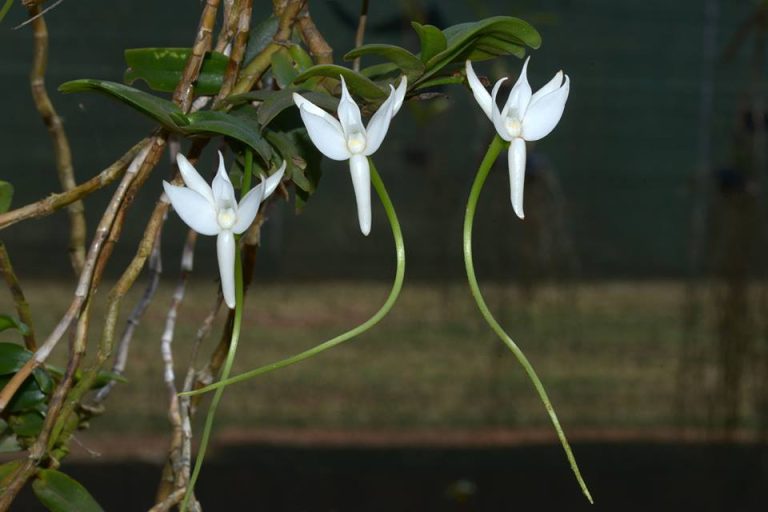
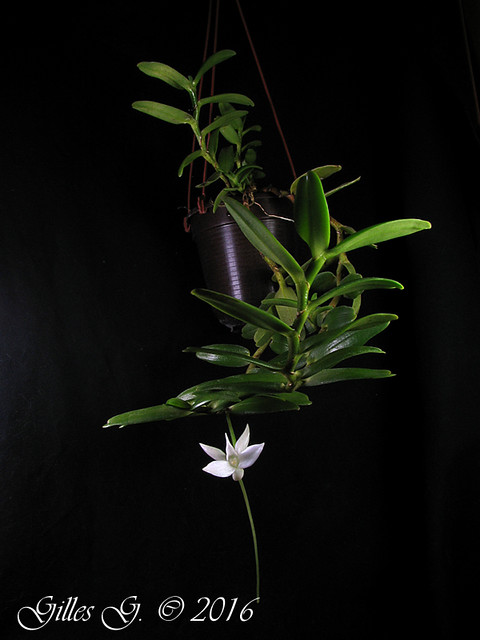
This epiphytic subshrub reaches 30–40 cm in height in the wild.[6] The stem is slender, initially erect and later pendulous, often branching. Leaves are arranged in a fan, distichous, oblong‑ligulate, 13–16 cm long and 3.5–5 cm wide, with an unequal bilobed apex.[6] The axillary inflorescence emerges beneath a leaf, 12.5–15 cm long, bearing 3–5 flowers.[3] Individual flowers are about 5 cm (2 in) long, white to greenish‑white, and emit a noticeable fragrance at anthesis.[3][5] Detailed measurements of the lip, spur, or pollinarium are not documented in the available sources.
Native Range and Habitat
A. penzigianum is endemic to Madagascar, recorded from the eastern‑central and southern‑central parts of the island (e.g., Antsiranana, Fianarantsoa, Toamasina provinces).[4] It inhabits moist, moss‑covered forest canopies at elevations of roughly 1,000–2,000 m, most often 1,500–1,800 m.[5][6] The species is epiphytic, growing on tree trunks and large branches in the wet tropical biome.[1][2]
Species‑Specific Care
| Factor | Documented guidance | Source |
|---|---|---|
| Light | Bright to medium, indirect light; avoid full midday sun. | [6] |
| Temperature | Cool‑to‑intermediate; typical greenhouse temperatures 12–22 °C (55–72 °F). Described as a “cool growing” species.[3][6] | [3][6] |
| Water | Keep medium evenly moist; water when the surface dries, providing a good soak each watering cycle. | [6] |
| Humidity | High humidity, ≥70 %. | [5] |
| Substrate / Mounting | Use a well‑aerated epiphytic mix (bark chips, sphagnum moss) or mount on a slab; a compost labelled “epiphyte” is recommended. | [6] |
| Fertiliser | Balanced (N‑P‑K) fertilizer at half strength once a month during active growth. | Not documented; general orchid practice applied. |
| Repotting / Re‑mounting | Every 2–3 years or when roots outgrow the medium. | Not documented; common practice for epiphytic orchids. |
| Seasonal changes | Reduce watering slightly in cooler months; maintain humidity. | Not documented; inferred from cool‑growing habit. |
Because the plant originates from high‑elevation, moss‑rich forests, it prefers good air flow and a stable, cool environment. Over‑watering or prolonged dryness can lead to root rot or leaf desiccation.

Flowering and Pollination
In its native range flowering has been recorded in January.[6] When cultivated in temperate regions the bloom often appears in late spring (May–June). Flowers are white, fragrant, and last several weeks under suitable conditions.[3][5] Specific pollinators have not been documented for this species; the long, narrow spur typical of many Angraecum species suggests moth pollination, but this remains a hypothesis pending field observation.
Conservation and Responsible Cultivation
The IUCN Red List classifies A. penzigianum as Near‑Threatened (NT).[4] Primary threats include slash‑and‑burn agriculture, cattle grazing, charcoal production and occasional bush fires.[4] Collecting from the wild should be avoided; growers are encouraged to obtain plants propagated from seed or tissue culture and to support in‑situ conservation programmes.
Evidence and Limitations
Key data such as precise flower morphology (lip shape, spur length), pollinator identity, and detailed temperature tolerances are not documented in the currently available sources. Cultivation recommendations are based on limited grower observations and general practices for cool‑growing Angraecum species. Further field studies would clarify reproductive biology and refine horticultural guidelines.
Frequently asked questions
What light conditions does Angraecum penzigianum need?
It prefers bright to medium, indirect light, similar to the filtered light it receives under the forest canopy.
Is Angraecum penzigianum cool‑growing?
Yes. Field observations place it at 1,500–1,800 m elevation, and grower notes describe it as a cool‑growing epiphyte.
Can I grow this orchid from seed?
Seed germination requires symbiotic mycorrhizal fungi or sterile asymbiotic agar; conventional cold stratification is not applicable.[5]
FOLLOW THE EVIDENCE
Sources & references
- Angraecum penzigianum Schltr. | Plants of the World Online | Kew Science, https://powo.science.kew.org/taxon/urn:lsid:ipni.org:names:616329-1
- Angraecum penzigianum – IUCN Red List entry (Near Threatened), https://www.iucnredlist.org/species/44393550/102855035
- IOSPE PHOTOS – Angraecum penzigianum, https://www.orchidspecies.com/angpenzingianum.htm
- Page A6 – Angraecum penzigianum (French orchid site), http://madaorchidee.free.fr/lesorchideesdemadagascar/pagesalphabetiques/pageA6.htm
- NativePlants.info – Angraecum penzigianum, https://www.nativeplants.info/plant/magnoliophyta-flowering-plants/orchidaceae/angraecum/angraecum_penzigianum.html